
1197 Results for "

Platelets

" in MedChemExpress (MCE) Product Catalog:
Products (1197)

1197 Results for "Platelets" in MCE Product Catalog:

Cat. No.: HY-174935C
DBCO-PEG5000-NHS is a dibenzocyclooctyne-conjugated polyethylene glycol derivative bearing an NHS group. DBCO-PEG-NHS forms a stable covalent linkage with the amino group of target molecules via the NHS ester at one end, while introducing a DBCO group at the other end, thus preparing for subsequent click chemical conjugation with any azide-bearing molecule or material .
loading...
    loading...
Cat. No.: HY-174935D
DBCO-PEG10000-NHS is a dibenzocyclooctyne-conjugated polyethylene glycol derivative bearing an NHS group. DBCO-PEG-NHS forms a stable covalent linkage with the amino group of target molecules via the NHS ester at one end, while introducing a DBCO group at the other end, thus preparing for subsequent click chemical conjugation with any azide-bearing molecule or material .
loading...
    loading...
Cat. No.: HY-N1400
CAS No.: 80952-71-2
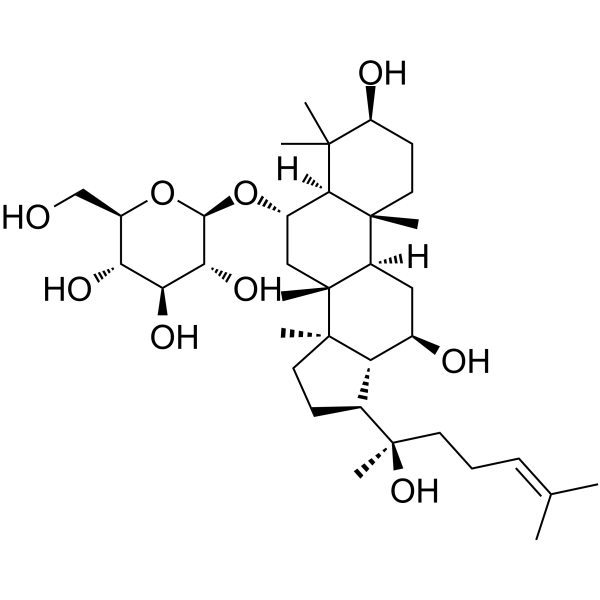
(20R)-Ginsenoside Rh1 is the R-isomer of Ginsenoside Rh1 (HY-N0604), and it is found in red ginseng, ginseng, and other sources. (20R)-Ginsenoside Rh1 inhibits thrombin-induced conversion of fibrinogen to fibrin, exerting anticoagulant and antithrombotic effects .
loading...
    loading...
Cat. No.: HY-N18260
CAS No.: 60010-74-4
Desmodilactone is a P2Y1R allosteric antagonist. Desmodilactone can be used for the research of thrombosis .
loading...
    loading...
Cat. No.: HY-170911
Target:  

PDGFR

Research Areas:  

Cancer

KIT/PDGFRA-IN-1 (compound 19) is a stem cell growth factor receptor (KIT) and platelet-derived growth factor receptor alpha (PDGFRA) inhibitor. KIT/PDGFRA-IN-1 inhibits KIT-wt, KIT-D816H, KIT-T670I, PDGFRA-wt, PDGFRA-D842V, PDGFRA-T674I and PDGFRA-G680R with IC50s of 2.3, 12, 492, 0.8, 99.9, 42.3, and 4.3 μM, respectively. KIT/PDGFRA-IN-1 inhibits GIST-T1, T1-a-D842V and GIST-48B cells (PDGFR- and KIT-Mutant GIST cell Lines) with GR50s of 12, 8900, ≥10 000 nM, respectively .
loading...
    loading...
Cat. No.: HY-N0570R
CAS No.: 10597-60-1
Synonyms: DOPET (Standard); 3,4-Dihydroxyphenethyl alcohol (Standard); 3-Hydroxytyrosol (Standard)
Hydroxytyrosol (Standard) (DOPET (Standard)) is the analytical standard of Hydroxytyrosol (HY-N0570). This product is intended for research and analytical applications. Hydroxytyrosol is an orally active, blood-brain barrier-permeable multi-active compound with multiple effects including antibacterial, antioxidant, anti-platelet aggregation, and neuroprotective activities. Hydroxytyrosol not only inhibits the growth of Vibrio by increasing bacterial membrane permeability, but also interacts with DNA and mediates supercoiled DNA relaxation. Meanwhile, Hydroxytyrosol effectively reduces thrombosis and inhibits lipid oxidation by inhibiting COX activity and promoting vascular nitric oxide production. In terms of neuroprotection, Hydroxytyrosol significantly alleviates neuronal apoptosis and inflammatory responses by up-regulating the expression level of ERβ, thereby improving cognitive function in Alzheimer's disease models. Hydroxytyrosol has been widely used in scientific research related to Vibrio infection, arterial thrombosis, Alzheimer's disease and other related fields .
loading...
    loading...
Cat. No.: HY-L088
3,660 compounds

Angiogenesis is the physiological process through which new blood vessels are formed from pre-existing vessels. It occurs in various physiological processes e.g. embryonic development, menstrual cycle, exercise and wound healing etc. Angiogenesis is regulated by both endogenous activators and inhibitors. Some key activators of angiogenesis include vascular endothelial growth factor (VEGF), basic fibroblast growth factor (bFGF), angiogenin, TGF-β, etc. whereas angiogenesis inhibitors are angiostatin, endostatin, interferon, platelet factor 4, etc. The loss of balance between these opposing signals leads to life threatening diseases like cancer, cardiovascular and ischemic diseases etc. which are thus controlled by exogenous angiogenesis activators (for cardiovascular/ischemic disorders) and inhibitors (for cancer).

MCE offers a unique collection of 3,660 compounds with validated angiogenesis targets modulating properties. MCE angiogenesis-related compound library is an effective tool for angiogenesis research and discovery of angiogenesis-related drugs.

Cat. No.: HY-131232
CAS No.: 2365172-82-1
Purity:  98.64%
Synonyms: Desmorpholinyl ABT-263-NH-Me
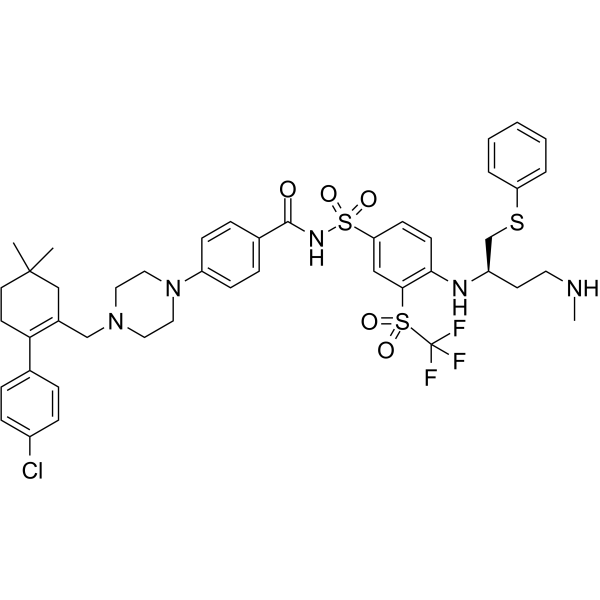
Desmorpholinyl navitoclax-NH-Me (Desmorpholinyl ABT-263-NH-Me) is an N-methylamino-substituted derivative of Navitoclax (HY-10087) and a BCL-XL-targeting PROTAC precursor. Desmorpholinyl navitoclax-NH-Me is used for the synthesis of BCL-XL-targeting PROTACs and related research .
loading...
    loading...
Cat. No.: HY-152179
CAS No.: 2143464-25-7
Target:  

PROTACs Bcl-2 Family

Research Areas:  

Inflammation/Immunology Cancer

PZ15227 is a potent and selective Bcl-XL PROTAC degrader with a DC50 of 46 nM, and its Ki values for Bcl-XL, Bcl-2 and Bcl-w are 1.90 nM, 3.52 nM and >1 mM, respectively. PZ15227 recruits Bcl-XL to CRBN, induces polyubiquitination of Bcl-XL and promotes its proteasome-dependent degradation, thereby selectively killing senescent cells that rely on Bcl-XL for survival without causing severe thrombocytopenia. PZ15227 can be used for research related to age-related diseases, aging and renal cancer .
loading...
    loading...
Cat. No.: HY-P1189
CAS No.: 154303-05-6
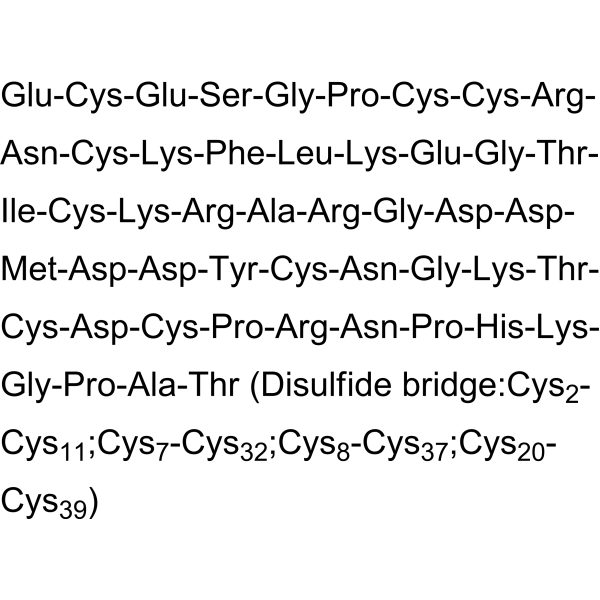
Echistatin is a naturally derived RGD-containing snake venom peptide. Echistatin exhibits an IC50 of 0.6 nM against mouse αvβ3 integrin, and acts as an antagonist against αvβ3, αII3, α5β1 integrins, pp125 FAK and paxillin. Echistatin reduces the phosphorylation of pp125 FAK and paxillin, inhibits the autophosphorylation and kinase activity of pp125 FAK, and weakens its binding to pp60src and paxillin. Echistatin disrupts the actin cytoskeleton and focal adhesions, induces melanoma cell detachment from fibronectin, and regulates cell adhesion and motility. Echistatin inhibits osteoclast maturation and migration, bone resorption, platelet aggregation, bone loss, as well as adhesion and metastasis of Lewis lung cancer cells; it also increases the number of osteoclasts and bone coverage area in mice with secondary hyperparathyroidism. Echistatin can be used in research related to melanoma, lung cancer and secondary hyperparathyroidism .
loading...
    loading...
Cat. No.: HY-P1189A
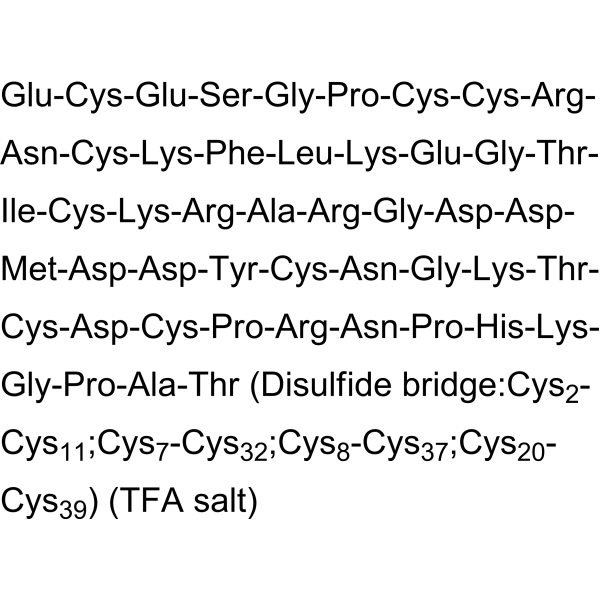
Echistatin TFA is a naturally derived RGD-containing snake venom peptide. Echistatin TFA exhibits an IC50 of 0.6 nM against mouse αvβ3 integrin, and acts as an antagonist against αvβ3, αII3, α5β1 integrins, pp125 FAK and paxillin. Echistatin TFA reduces the phosphorylation of pp125 FAK and paxillin, inhibits the autophosphorylation and kinase activity of pp125 FAK, and weakens its binding to pp60src and paxillin. Echistatin TFA disrupts the actin cytoskeleton and focal adhesions, induces melanoma cell detachment from fibronectin, and regulates cell adhesion and motility. Echistatin TFA inhibits osteoclast maturation and migration, bone resorption, platelet aggregation, bone loss, as well as adhesion and metastasis of Lewis lung cancer cells; it also increases the number of osteoclasts and bone coverage area in mice with secondary hyperparathyroidism. Echistatin TFA can be used in research related to melanoma, lung cancer and secondary hyperparathyroidism .
loading...
    loading...
Cat. No.: HY-P3335
CAS No.: 250612-06-7
Synonyms: DOTA-RGDfK dimer
SU015 (DOTA-RGDfK dimer) is a Integrin αvβ5 and αvβ3 antagonist. SU015 exhibits comparable affinity for αvβ5 and αvβ3, with relatively higher potency and specificity compared to other integrins. SU015 inhibits αvβ3-mediated cell adhesion to fibrinogen, αvβ3-mediated adhesion of activated platelets to osteopontin, and αvβ5-mediated cell adhesion to vitronectin. SU015 shows potent inhibitory effects on FGF2-induced angiogenesis in the CAM model. SU015 carries a linker arm available for radioisotope conjugation, and acts as a target-specific radioreagent when labeled with 90Y (i.e., RP697) or 177Lu (i.e., RP688). SU015 can be used in studies related to tumor metastasis and tumors .
loading...
    loading...
Cat. No.: HY-W011297
CAS No.: 2566-89-4
Synonyms: Arachidonic acid methyl ester
Target:  

PKC

Research Areas:  

Metabolic Disease

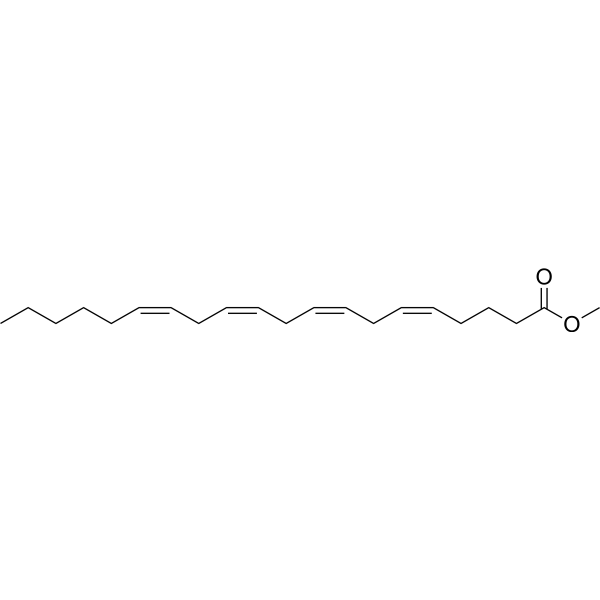
Methyl arachidonate is a protein kinase C activator and also an orally active substrate that undergoes esterase-mediated hydrolysis. Methyl arachidonate indirectly activates protein kinase C via eicosanoid metabolites generated through the arachidonic acid metabolic pathway, exerting effects via cyclooxygenase products at low concentrations and via lipoxygenase products at high concentrations. Methyl arachidonate can be used in studies related to lipodystrophy .
loading...
    loading...
Cat. No.: HY-W040176
CAS No.: 799268-45-4
Synonyms: N-Palmitoyl-tyrosine phosphoric acid ammonium
N-PTyrosine PA (N-Palmitoyl-tyrosine phosphoric acid) ammonium is a lysophosphatidic acid (LPA) receptor modulator, which exhibits weak inhibitory activity against LPA1 and partial agonist properties towards LPA5. N-PTyrosine PA ammonium inhibits the activation of LPA receptors and downstream responses by competing with agonists for binding sites. N-PTyrosine PA ammonium can induce morphological changes and aggregation, and also inhibit LPA-induced morphological changes through receptor desensitization caused by pre-incubation. N-PTyrosine PA ammonium can be used in the research of related diseases such as atherosclerosis and acute ischemic syndromes (e.g., unstable angina, myocardial infarction, stroke) .
loading...
    loading...
Cat. No.: HY-130064
CAS No.: 861006-80-6
Synonyms: P-OM3
Omega-3 acid ethyl esters (P-OM3) is a omega-3 polyunsaturated fatty acid. Omega-3 acid ethyl esters can be used for the researches of severe hypertriglyceridemia and cardiovascular diseases .
loading...
    loading...
Cat. No.: HY-181635
CAS No.: 146-36-1
Azapetine is an antagonist of α1-adrenoceptor, with an IC50 of 0.205 μM at rat α1-adrenoceptor and an IC50 of 1.3 μM at rat α2-adrenoceptor, and exhibits higher selectivity for α1-adrenoceptor than for α2-adrenoceptor. Azapetine functionally blocks postsynaptic α1-adrenoceptors, and at higher concentrations, it blocks presynaptic α2-adrenoceptors, central α-adrenoceptors, and H2 histamine receptors. Azapetine is used in related research on hypotension .
loading...
    loading...
Cat. No.: HY-181635A
CAS No.: 130-83-6
Azapetine phosphate is an antagonist of α1-adrenoceptor, with an IC50 of 0.205 μM at rat α1-adrenoceptor and an IC50 of 1.3 μM at rat α2-adrenoceptor, and exhibits higher selectivity for α1-adrenoceptor than for α2-adrenoceptor. Azapetine phosphate functionally blocks postsynaptic α1-adrenoceptors, and at higher concentrations, it blocks presynaptic α2-adrenoceptors, central α-adrenoceptors, and H2 histamine receptors. Azapetine phosphate is used in related research on hypotension .
loading...
    loading...
Cat. No.: HY-N21654
CAS No.: 53965-06-3
Chinensinaphthol is a lignan. Chinensinaphthol is isolated from Monsonia angustifolia and Monsonia glauca plants. Chinensinaphthol is used in the research of pancreatic cancer and cervical cancer [3[4] .
loading...
    loading...
Cat. No.: HY-W745352
CAS No.: 65-15-6
Azapetine hydrochloride is an antagonist of α1-adrenoceptor, with an IC50 of 0.205 μM at rat α1-adrenoceptor and an IC50 of 1.3 μM at rat α2-adrenoceptor, and exhibits higher selectivity for α1-adrenoceptor than for α2-adrenoceptor. Azapetine hydrochloride functionally blocks postsynaptic α1-adrenoceptors, and at higher concentrations, it blocks presynaptic α2-adrenoceptors, central α-adrenoceptors, and H2 histamine receptors. Azapetine hydrochloride is used in related research on hypotension .
loading...
    loading...
Cat. No.: HY-112624B
CAS No.: 9004-54-0
Synonyms: Dextran 70; Dextran D70; Dextran T70(MW 64000-76000)
Dextran 70,000 is a high molecular weight polysaccharide formed by glucose linked by α-(1→6) glycosidic bonds. Dextran 70,000 can expand blood volume through colloidal osmotic pressure effect and inhibit cell adhesion and platelet aggregation through steric hindrance. At the same time, Dextran 70,000 can be used as a drug carrier to achieve targeted delivery through endocytosis. Dextran 70,000 is biologically inert and has low immunogenicity. It can be used for clinical blood volume expansion, anti-thrombotic research, and evaluation of vascular permeability in in vitro experiments. It can also be combined with fluorescent dyes for cell tracking and drug delivery research. The Dextran series of compounds are also natural polysaccharide drug carriers that can be connected to drugs through covalent bonding methods such as ester bonds, amide bonds or click chemistry, or self-assembled to form carriers such as nanoparticles and hydrogels. Dextran is biodegradable and biocompatible, and can achieve targeted delivery and controlled release of drugs. Dextran derivatives can prolong the half-life of drugs, increase local concentrations, and reduce the activity of immune clearance.
loading...
    loading...

