168 Results for "

Platelet activating factor

" in MedChemExpress (MCE) Product Catalog:
Products (168)

168 Results for "Platelet activating factor" in MCE Product Catalog:

Cat. No.: HY-182583
CAS No.: 81635-83-8
PAF antagonist-1 is a platelet activating factor (PAF) receptor antagonist with a target Ki of 69 nM. PAF antagonist-1 inhibits PAF binding and displays enhanced affinity at A1, A2 a, and A3 adenosine receptor subtypes compared to related dihydropyridine analogs with smaller ester groups. PAF antagonist-1 can be used for cardiovascular disorders, especially hypertension and coronary heart disease .
loading...
    loading...
Cat. No.: HY-N9300
CAS No.: 57430-03-2
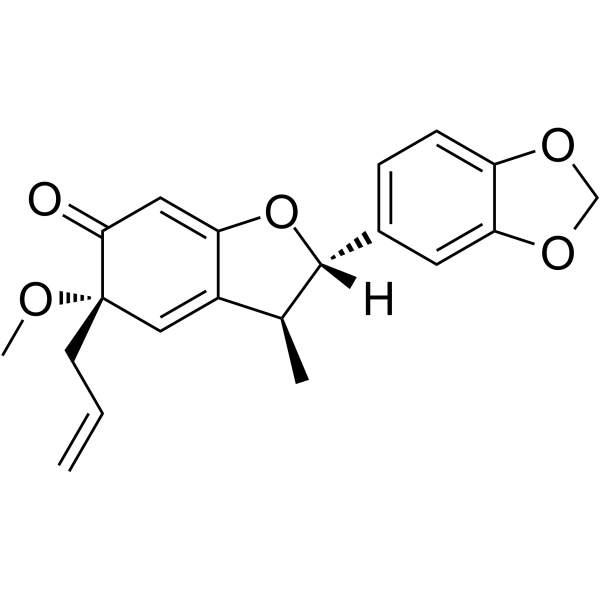
1,6-Dihydro-4,7-epoxy-1-methoxy-3,4-methylenedioxy-6-oxo-3,8-lignan, a lignan derivative from the ethyl acetate soluble fraction of twigs of Magnolia denudate (Magnoliaceae), exhibits anti-platelet-activating factor (PAF) activity. PAF is a potent lipid mediator in inflammation and asthma .
loading...
    loading...
Cat. No.: HY-P2817B
Research Areas:  

Metabolic Disease

Phospholipase C, Bacillus cereus (EC 3.1.4.3) is induced by thrombin and platelet-activating factor, forming 1,2-diacylglycerol and phosphatidic acid. Phospholipase C, Bacillus cereus (EC 3.1.4.3) hydrolyzes the phosphate bond on phosphatidylcholine and other glycerophospholipids yielding diacylglycerol. Phospholipase C, Bacillus cereus (EC 3.1.4.3) hydrolyzes the phosphate bonds of sphingomyelin, cardiolipin, choline plasmalogen and ceramide phospholipids.
loading...
    loading...
Cat. No.: HY-W027544S
Synonyms: 7-Methoxycoumarin-4-acetic acid-d3
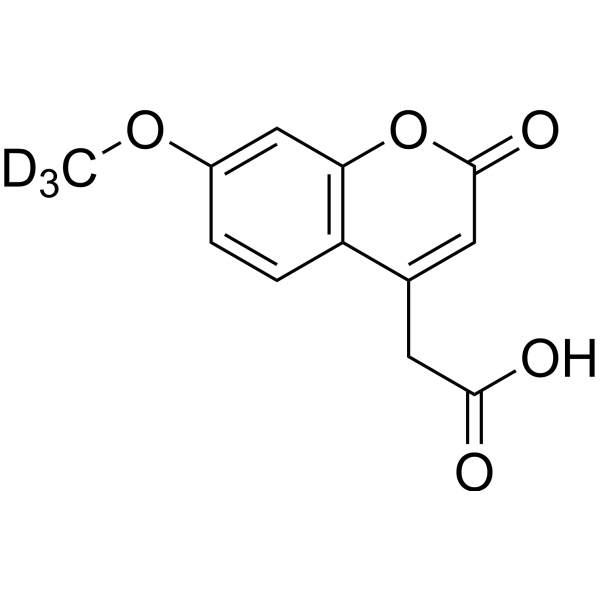
MCA-d3 (7-Methoxycoumarin-4-acetic acid3) is the deuterium labeled MCA (HY-W027544) . MCA is a Coumarin (HY-N0709) derivative. MCA quantitates platelet-activating factor (PAF) by high-performance liquid chromatography with fluorescent detection. MCA can modify FRET peptide substrates for analyzing protease activities .
loading...
    loading...
Cat. No.: HY-L088
3,660 compounds

Angiogenesis is the physiological process through which new blood vessels are formed from pre-existing vessels. It occurs in various physiological processes e.g. embryonic development, menstrual cycle, exercise and wound healing etc. Angiogenesis is regulated by both endogenous activators and inhibitors. Some key activators of angiogenesis include vascular endothelial growth factor (VEGF), basic fibroblast growth factor (bFGF), angiogenin, TGF-β, etc. whereas angiogenesis inhibitors are angiostatin, endostatin, interferon, platelet factor 4, etc. The loss of balance between these opposing signals leads to life threatening diseases like cancer, cardiovascular and ischemic diseases etc. which are thus controlled by exogenous angiogenesis activators (for cardiovascular/ischemic disorders) and inhibitors (for cancer).

MCE offers a unique collection of 3,660 compounds with validated angiogenesis targets modulating properties. MCE angiogenesis-related compound library is an effective tool for angiogenesis research and discovery of angiogenesis-related drugs.

Cat. No.: HY-P70993
Purity:  ≥ 90%, as determined by reducing SDS-PAGE.
Synonyms: PLA2G7; LDL-Associated Phospholipase A2; Phospholipase A2 Group VII; Group-VIIA Phospholipase A2; PAFAH; PAF 2-Acylhydrolase; LDL-PLA2; PAF Acetylhydrolase; Lp-PLA2; LDL-PLA(2); Phospholipase A2, Group VII (Platelet-activating factor Acetylhydrolase, Plasma); GVIIA-PLA2; 1-Alkyl-2-Acetylglycerophosphocholine Esterase; Lipoprotein-Associated Phospholipase A2; 2-Acetyl-1-Alkylglycerophosphocholine Esterase; PAFAD; Platelet-activating factor Acetylhydrolase
Species:  
Human
Source:  
HEK293
loading...
    loading...
Cat. No.: HY-148400
CAS No.: 913541-96-5
Synonyms: TXC hydrochloride
Research Areas:  

Metabolic Disease

Cetyl tranexamate (TXC) hydrochloride is an ester derivative of Tranexamic acid (HY-B0149). Cetyl tranexamate hydrochloride is an inhibitor of fibrinogen activation and can reduce the production of fibrinogen in keratinocytes induced by ultraviolet rays or damage, indirectly inhibiting the melanin production pathway. Cetyl tranexamate hydrochloride also targets melanin (dark spots) and hemoglobin (red spots), reducing vascular dilation and pigmentation by inhibiting inflammatory mediators (such as prostaglandins, platelet activating factors). Cetyl tranexamate hydrochloride can be used as a cosmetic ingredient and is suitable for epidermal pigment disorders such as photoaging, post-inflammatory hyperpigmentation (PIH), and melasma .
loading...
    loading...
Cat. No.: HY-108634S
CAS No.: 1185101-22-7
Synonyms: WEB 2086-d8
Apafant-d8 is the deuterium labeled Apafant. Apafant (WEB 2086) is a potent platelet-activating factor (PAF) antagonist, inhibits PAF binding to human PAF receptors with a Kiof 9.9 nM. Apafant increases the gene expression of PAF-r, α-globin, β-globin, decreases the c-myb gene expression. Apafant shows a protective effect on alkyl-PAF-mediated lethalit .
loading...
    loading...
Cat. No.: HY-11090A
CAS No.: 292135-59-2
DPC423 is a selective and orally active factor Xa inhibitor with a Kis of 0.15 (human) and 0.3 (rabbit) nM. DPC423 exhibits Kis of 60, 61 and 6000 nM against human trypsin, plasma kallikrein and thrombin. DPC423 blocks the formation of prothrombinase complex, reduces thrombin production, inhibits fibrin formation and platelet activation. DPC423 can be used for the study of anticoagulation of arterial thrombosis .
loading...
    loading...
Cat. No.: HY-119035
CAS No.: 115406-25-2
R-75317 is a specific platelet-activating factor (PAF) antagonist. R-75317 can prevent the decline in creatinine clearance (Ccr) in a rat model of glomerulonephritis induced by the injection of antibodies extracted from rabbits against rat glomerular basement membrane (GBM) antigens, delay the onset of proteinuria, and improve glomerular hypertrophy, mesangial matrix proliferation, and interstitial fibrosis. R-75317 may be useful in the study of glomerulonephritis .
loading...
    loading...
Cat. No.: HY-176466
CAS No.: 143484-41-7
ST-899 is a novel platelet-activating factor (PAF) receptor antagonist. ST-899 can significantly reduce the mortality of mice with endotoxin (LPS)-induced shock. ST-899 can significantly inhibit the increase in serum tumor necrosis factor (TNF) levels induced by LPS, but has no effect on interleukin-6 (IL-6). The regulatory mechanism of ST-899 is to block the positive feedback loop between PAF and TNF, thereby reducing the inflammatory response. ST-899 can be used to study inflammatory diseases such as septic shock .
loading...
    loading...
Cat. No.: HY-163101
CAS No.: 139401-43-7
CP-96021 is an orally active dual leukotriene D4 (LTD4) and platelet activating factor (PAF) receptor antagonist, featuring a guinea pig LTD4 receptor Ki of 34 nM and a rabbit PAF receptor Ki of 37 nM. CP-96021 blocks ligand binding to its target receptors, inhibits ligand-induced bronchoconstriction, and inhibits antigen-triggered airway obstructive effects. CP-96021 can be used for the research of asthma .
loading...
    loading...
Cat. No.: HY-N9970
CAS No.: 62268-42-2
Apigenin 7-O-β-D-glucuronide ethyl ester is a flavonoid glucuronate ester that can be isolated from Scutellaria regeliana. Apigenin 7-O-β-D-glucuronide ethyl ester possesses anti-inflammatory activity on the release of β-glucuronidase from rat polymorphonuclear leukocytes (PNMs) induced by platelet activating-factor. Apigenin 7-O-β-D-glucuronide ethyl ester can be used for anti-inflammatory research .
loading...
    loading...
Cat. No.: HY-108635R
CAS No.: 74389-68-7
Synonyms: PAF (C16) (Standard)
C16-PAF (Standard) is the analytical standard of C16-PAF. This product is intended for research and analytical applications. C16-PAF (PAF (C16)), a phospholipid mediator, is a platelet-activating factor and ligand for PAF G-protein-coupled receptor (PAFR). C16-PAF exhibits anti-apoptotic effect and inhibits caspase-dependent death by activating the PAFR. C16-PAF is a potent MAPK and MEK/ERK activator. C16-PAF induces increased vascular permeability .
loading...
    loading...
Cat. No.: HY-N0784R
CAS No.: 15291-77-7
Synonyms: BN-52021 (Standard)
Ginkgolide B (Standard) is the analytical standard of Ginkgolide B. This product is intended for research and analytical applications. Ginkgolide B (BN-52021), a terpene lactone, is a potent platelet activating factor antagonist. Ginkgolide B protects endothelial cells via the activation of PXR from injuries induced by xeno- and endobiotics. Ginkgolide B can pass through the brain-blood barrier. Ginkgolide B has anti-oxidant, anti-inflammatory, anti-tumor, and anti-apoptotic activity. Ginkgolide B has marked neuroprotective effects against ischemia-induced impairments .
loading...
    loading...
Cat. No.: HY-P5875
CAS No.: 1021346-05-3
P4pal10 is an antagonist for protease-activated receptor 4 (PAR4). P4pal10 inhibits the platelet aggregation, inhibits tissue factor (TF)-induced thrombin generation, and exhibits anticoagulant and antithrombotic activities. P4pal10 reduces the oedema and the granulocyte infiltration induced by Carrageenan (HY-125474). P4pal10 ameliorates the injury in mice myocardial ischemia/reperfusion (I/R) models .
loading...
    loading...
Cat. No.: HY-108634R
CAS No.: 105219-56-5
Synonyms: WEB 2086 (Standard)
Apafant (Standard) is the analytical standard of Apafant (HY-108634). This product is intended for research and analytical applications. Apafant (WEB 2086), a chemical probe, is a potent platelet-activating factor (PAF) antagonist, inhibits PAF binding to human PAF receptors with a Ki of 9.9 nM. Apafant increases the gene expression of PAF-r, α-globin, β-globin, decreases the c-myb gene expression. Apafant shows a protective effect on alkyl-PAF-mediated lethalit .
loading...
    loading...
Cat. No.: HY-11090
CAS No.: 209957-47-1
DPC423 free base is a selective and orally active factor Xa inhibitor with a Kis of 0.15 (human) and 0.3 (rabbit) nM. DPC423 free base exhibits Kis of 60, 61 and 6000 nM against human trypsin, plasma kallikrein and thrombin. DPC423 free base blocks the formation of prothrombinase complex, reduces thrombin production, inhibits fibrin formation and platelet activation. DPC423 free base can be used for the study of anticoagulation of arterial thrombosis .
loading...
    loading...
Cat. No.: HY-P702447
Purity:  ≥ 90%, as determined by reducing SDS-PAGE.
Synonyms: SMPD2; Lyso-PAF-PLC; Sphingomyelin Phosphodiesterase 2; N-SMase; NSMase; Sphingomyelin Phosphodiesterase 2, Neutral Membrane (Neutral Sphingomyelinase); Neutral Sphingomyelinase; NSMASE1; ISC1; NSMase1; Lyso-Platelet-activating factor-Phospholipase C
Species:  
Human
Source:  
E. coli Cell-free
loading...
    loading...
Cat. No.: HY-P7268
Purity:  ≥ 95%, as determined by reducing SDS-PAGE.
Synonyms: PPBP; Macrophage-Derived Growth factor; Prev. THBGB1; C-X-C Motif Chemokine 7; SCYB7; Beta-Thromboglobulin; CTAP3; NAP-2-L1; CXCL7; Small Inducible Cytokine Subfamily B, Member 7; MDGF; Neutrophil-activating Peptide-2; LDGF; Low-Affinity Platelet factor IV; TGB1; Neutrophil-activating Peptide 2; PBP; Small Inducible Cytokine B7; Platelet Basic Protein; Small-Inducible Cytokine B7; Beta-TG; Thromboglobulin, Beta-1; CTAPIII; CXC Chemokine Ligand 7; LA-PF4; Thrombocidin 1; B-TG1; Thrombocidin 2; NAP-2; CTAP-III; TGB; THBGB; Connective Tissue-activating Peptide III; TC1; Chemokine (C-X-C Motif) Ligand 7; TC2; Pro-Platelet Basic Protein; Leukocyte-Derived Growth factor
Species:  
Human
Source:  
E. coli
loading...
    loading...

