
1. Search Result
Search Result
Results for "

Axonal degeneration

" in MedChemExpress (MCE) Product Catalog:

12

Inhibitors & Agonists

1

Peptides

1

Inhibitory Antibodies

2

Natural
Products

Cat. No. Product Name Target Research Areas Chemical Structure
  • HY-128700
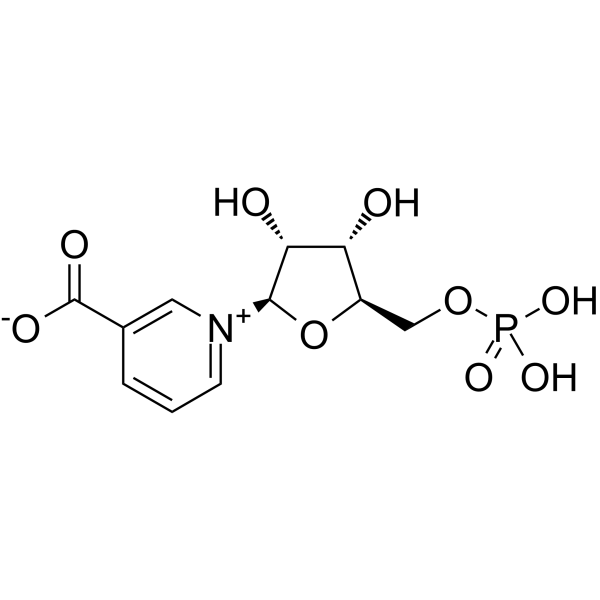
    Nicotinic acid mononucleotide
    1 Publications Verification

    Endogenous Metabolite Sirtuin Neurological Disease Inflammation/Immunology Cancer
    Nicotinic acid mononucleotide acts as a SARM1 inhibitor and a NAD + biosynthesis intermediate, with an IC50 value of 93.3 μM against SARM1. Nicotinic acid mononucleotide exerts axon-protective effects, delays axonal degeneration, elevates NAD + levels, enhances Sirt1 activity, improves myocardial capillary density and alleviates myocardial fibrosis. Nicotinic acid mononucleotide reverses diabetic cardiomyopathy in diabetic mice by increasing myocardial NAD + levels. Nicotinic acid mononucleotide is applicable to research related to cancer, multiple sclerosis, diabetic cardiomyopathy, neurodegenerative diseases and Huntington's disease .
    Nicotinic acid mononucleotide
  • HY-P99780

    BIIB033

    Transmembrane Glycoprotein Neurological Disease Inflammation/Immunology
    Opicinumab (BIIB033) is a human IgG1 monoclonal antibody targeting LINGO-1. Opicinumab binds LINGO-1 to block its negative regulatory signaling, suppress axonal degeneration, enhance axonal regeneration, promote remyelination, and exert neuroprotective effects. Opicinumab maintains axonal protective effects during co-administration with methylprednisolone. Opicinumab can be used for the research of multiple sclerosis, acute optic neuritis, and optic neuritis. .
    Opicinumab
  • HY-114332

    MAP3K JNK Neurological Disease Metabolic Disease
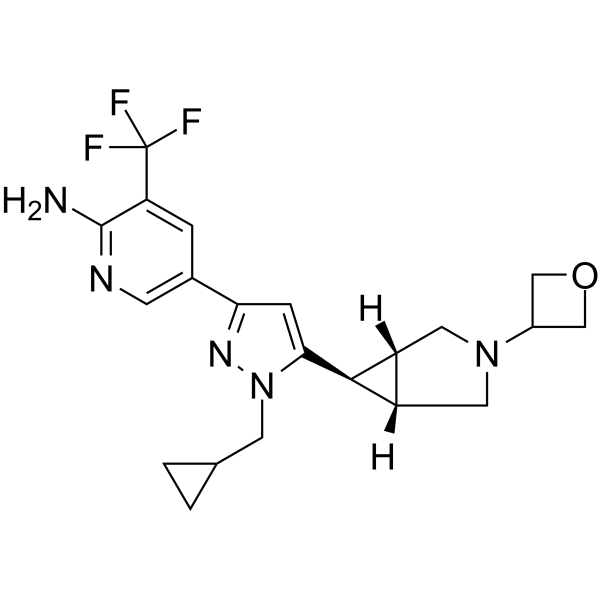
    GNE-8505 is an orally active, blood-brain barrier-permeable selective dual leucine zipper kinase (DLK) inhibitor. GNE-8505 has an IC50 of 0.144 μM for pJNK, and EC50 of 0.457 μM for DRG. GNE-8505 inhibits the DLK/JNK pathway, reduces stress-induced c-Jun phosphorylation levels, decreases neuronal death and suppresses axonal degeneration. GNE-8505 reduces phosphorylated c-Jun levels in the retina, spinal cord and brain tissues of mice. GNE-8505 is applicable to research related to Alzheimer's disease and amyotrophic lateral sclerosis (ALS) .
    GNE-8505
  • HY-145917

    Toll-like Receptor (TLR) Neurological Disease
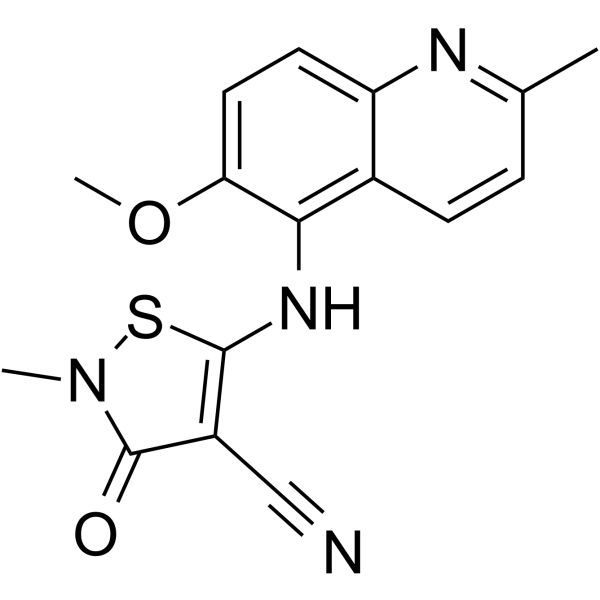
    SARM1-IN-2 (Example 82) is a SARM1 inhibitor (IC50 <1 μM) that inhibits axon regeneration. Axon regeneration refers to the process by which neuronal axons attempt to restore their structure and function after axonal degeneration. SARM1-IN-2 inhibits axon regeneration by reducing or inhibiting the binding of SARM1 to NAD+. SARM1-IN-2 can be used to study axonal degeneration .
    SARM1-IN-2
  • HY-P10227

    ONL-1204

    Fatty Acid Synthase (FASN) Apoptosis Interleukin Related Toll-like Receptor (TLR) NOD-like Receptor (NLR) Caspase Neurological Disease
    Xelafaslatide (ONL-1204) is a Fas receptor antagonist. Xelafaslatide blocks the Fas receptor signaling pathway and inhibits downstream apoptosis and inflammatory pathways. Xelafaslatide suppresses neuroinflammation and microglial activation in glaucoma models, protects retinal ganglion cells and prevents axonal degeneration. Xelafaslatide is applicable to relevant research on glaucoma .
    Xelafaslatide
  • HY-15703
    QNZ46
    1 Publications Verification

    iGluR Neurological Disease
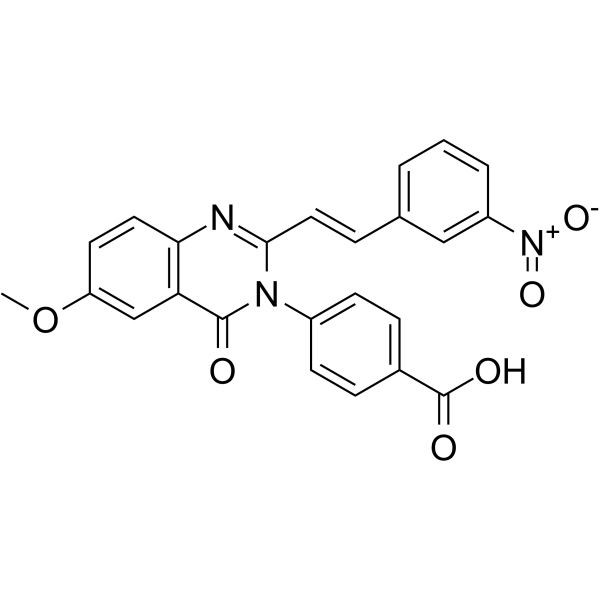
    QNZ46 is a highly selective noncompetitive NMDA receptor antagonist targeting GluN2C/D (IC50=3.9 μM), GluN1/GluN2C (IC50=7.1 μM), and GluN1/GluN2D (IC50=182 μM) subunits. QNZ46 inhibits glutamate-mediated calcium influx, thereby blocking excitotoxicity. QNZ46 is membrane permeable and can cross the blood-brain barrier, where it inhibits myelin damage and axonal degeneration .
    QNZ46
  • HY-172967

    Toll-like Receptor (TLR) Neurological Disease
    SARM1-IN-5 (compound 1-23-a) is a SARM1 inhibitor. SARM1-IN-5 can be used in the study of axonal degeneration related diseases such as Alzheimer’s disease, Parkinson’s disease, amyotrophic lateral sclerosis (ALS), and multiple sclerosis (MS) .
    SARM1-IN-5
  • HY-173276

    Toll-like Receptor (TLR) Neurological Disease
    SARM1-IN-4 (Compound 7) is an orally active SARM1 inhibitor. After being orally administered at a dose of 50 mg/kg in a mouse model, it can reduce the level of plasma neurofilament light chain (NfL). SARM1-IN-4 prevents programmed axonal degeneration by inhibiting the NAD+ hydrolase activity of SARM1, and it can be used in research related to neurodegenerative diseases and neurological disorders (such as multiple sclerosis, amyotrophic lateral sclerosis, Parkinson's disease, and peripheral neuropathies, etc.).
    SARM1-IN-4
  • HY-128700A

    Endogenous Metabolite Sirtuin Metabolic Disease
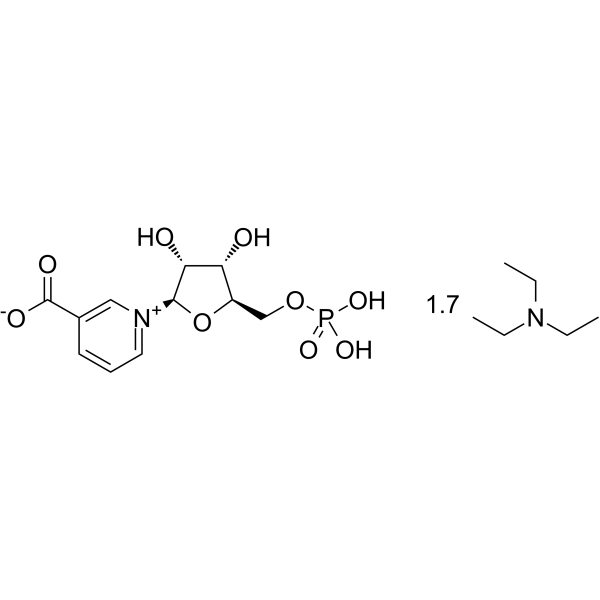
    Nicotinic acid mononucleotide triethylamine acts as a SARM1 inhibitor and a NAD + biosynthesis intermediate, with an IC50 value of 93.3 μM against SARM1. Nicotinic acid mononucleotide triethylamine exerts axon-protective effects, delays axonal degeneration, elevates NAD + levels, enhances Sirt1 activity, improves myocardial capillary density and alleviates myocardial fibrosis. Nicotinic acid mononucleotide triethylamine reverses diabetic cardiomyopathy in diabetic mice by increasing myocardial NAD + levels. Nicotinic acid mononucleotide triethylamine is applicable to research related to cancer, multiple sclerosis, diabetic cardiomyopathy, neurodegenerative diseases and Huntington's disease .
    Nicotinic acid mononucleotide triethylamine
  • HY-175340

    Potassium Channel TSPO Neurological Disease
    Kv7.2/Kv7.3 activator-3 (GRT-X) is an orally active Kv7.2/Kv7.3 and TSPO activator. Kv7.2/Kv7.3 activator-3 activates Kv7.2/Kv7.3, Kv7.4, and Kv7.5 with EC50 values of 0.37, 2.06, and 0.75 μM, respectively, and binds to TSPO with Ki values of 0.07 μM (rat membrane) and 4.60 μM (human U-118 MG cells). Kv7.2/Kv7.3 activator-3 prevents motor neuron degeneration in mice and humans conditioned by ALS/FTD astrocytes. Kv7.2/Kv7.3 activator-3 stimulates dorsal root ganglion axonal growth through TSPO and Kv7.2/3 activation. Kv7.2/Kv7.3 activator-3 has anti-epileptic effects in epileptic seizure models. Kv7.2/Kv7.3 activator-3 reduces pain hypersensitivity in patients with diabetic neuropathy, promotes neuronal survival and regeneration after cervical neuropathy in rats, and accelerates the recovery of normal function of sensory and motor neurons .
    Kv7.2/Kv7.3 activator-3
  • HY-172967A

    Toll-like Receptor (TLR) Neurological Disease Inflammation/Immunology
    (R)-SARM1-IN-5 is the (R)-enantiomer of SARM1-IN-5 (HY-172967). SARM1-IN-5 (compound 1-23-a) is a SARM1 inhibitor. SARM1-IN-5 can be used in the study of axonal degeneration related diseases such as Alzheimer’s disease, Parkinson’s disease, amyotrophic lateral sclerosis (ALS), and multiple sclerosis (MS) .
    (R)-SARM1-IN-5
  • HY-N19801

    Toll-like Receptor (TLR) NF-κB Interleukin Related TNF Receptor Neurological Disease Inflammation/Immunology
    N-Palmitoyl-D-glucosamine is an orally active TLR4 antagonist. N-Palmitoyl-D-glucosamine stably binds MD-2 with, preventing LPS-induced NF-κB signaling, decreases pro-inflammatory cytokines (IL-1β, TNF-α, and IL-6), increases anti-inflammatory IL-10 and IL-1rα, and normalizes miR-20a-5p, miR-106a-5p, and miR-27a-3p levels. N-Palmitoyl-D-glucosamine decreases allodynia and prevents myelino-axonal degeneration of peripheral nerves. N-Palmitoyl-D-glucosamine can be used for the researches of keratitis and peripheral neuropathy .
    N-Palmitoyl-D-glucosamine

Inquiry Online

Your information is safe with us. * Required Fields.

Salutation


Country or Region *

Applicant Name *


Organization Name *

Department *


Email Address *


Product Name *

Cat. No.


Requested quantity *

Phone Number *


Remarks

Inquiry Online

Inquiry Information

Product Name:
Cat. No.:
Quantity:
MCE Japan Authorized Agent:

