
11 Results for "

CGRP release

" in MedChemExpress (MCE) Product Catalog:
Products (11)

11 Results for "CGRP release" in MCE Product Catalog:

6
6 Publications Verification
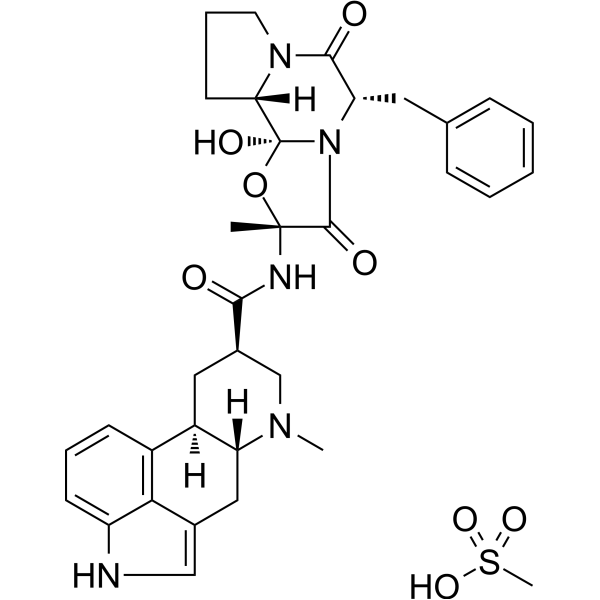
Cat. No.: HY-B0670A
CAS No.: 6190-39-2
Dihydroergotamine mesylate is a blood-brain barrier-permeable semi-synthetic ergot alkaloid, acting as a full agonist of 5-HT1B/1D receptors (Ki values of 0.3 nM and 2.5 nM, respectively; functional IC50 values of 2 nM and 2.2 nM, respectively). Dihydroergotamine mesylate inhibits Forskolin (HY-15371)-stimulated cAMP accumulation, possesses α-adrenergic receptor antagonistic activity and weak dopaminergic agonistic activity. It mediates intracranial cerebrovascular contraction, inhibits the release of neuropeptides such as CGRP/substance P, and suppresses neurogenic inflammation by activating 5-HT1B/1D receptors in the trigeminovascular system. Dihydroergotamine mesylate binds to the catalytic site of Trypanosoma cruzi trypanothione reductase and exhibits trypanocidal activity in vitro. Dihydroergotamine mesylate can be used in studies related to migraine and trypanosome infections .
loading...
    loading...
1
1 Cited Publications
Cat. No.: HY-P1080
CAS No.: 145017-83-0
ω-Agatoxin IVA is a potent, selective P/Q type Ca 2+ (Cav2.1) channel blocker with IC50 values of 2 nM and 90 nM. ω-Agatoxin IVA inhibits glutamate exocytosis and calcium influx elicited by high potassium. ω-Agatoxin IVA inhibits Capsaicin (HY-10448)-induced CGRP release and vasodilation. ω-Agatoxin IVA can be used for the research of neurological and cardiovascular disease .
loading...
    loading...
1
1 Cited Publications
Cat. No.: HY-P1080A
Target:  

Calcium Channel

Research Areas:  

Neurological Disease

ω-Agatoxin IVA TFA is a potent, selective P/Q type Ca 2+ (Cav2.1) channel blocker with IC50 values of 2 nM and 90 nM. ω-Agatoxin IVA TFA inhibits glutamate exocytosis and calcium influx elicited by high potassium. ω-Agatoxin IVA TFA inhibits Capsaicin (HY-10448)-induced CGRP release and vasodilation. ω-Agatoxin IVA TFA can be used for the research of neurological and cardiovascular disease .
loading...
    loading...
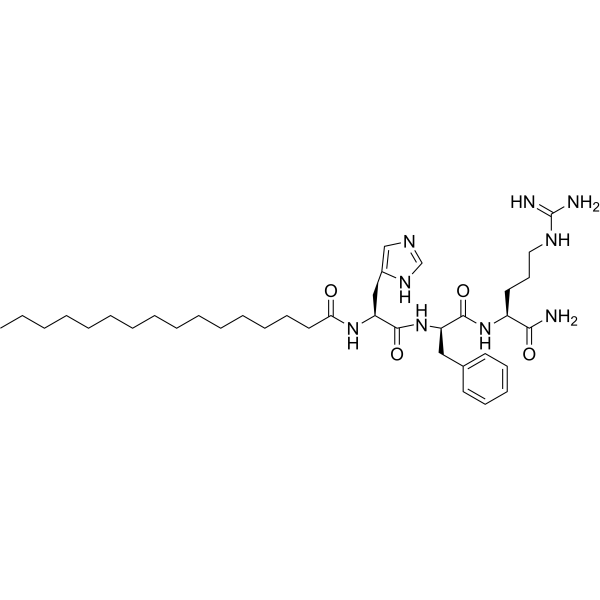
Cat. No.: HY-P5226
CAS No.: 936544-53-5
Palmitoyl tripeptide-8 is an immunomodulatory peptide and neurotransmitter inhibitory peptide. Palmitoyl tripeptide-8 inhibits the activation of the NF-κB pathway and the production of pro-inflammatory cytokines (IL-8, IL-6, and TNF-α). Palmitoyl tripeptide-8 activates the cutaneous opioid system and reduces CGRP release. Palmitoyl tripeptide-8 decreases the number of dilated capillaries, the size of dilated vessels, and the degree of edema in skin explants treated with Substance P (HY-P0201). Palmitoyl tripeptide-8 is used as an active ingredient in cosmetics for sensitive skin. Palmitoyl tripeptide-8 is utilized in research related to sensitive skin .
loading...
    loading...
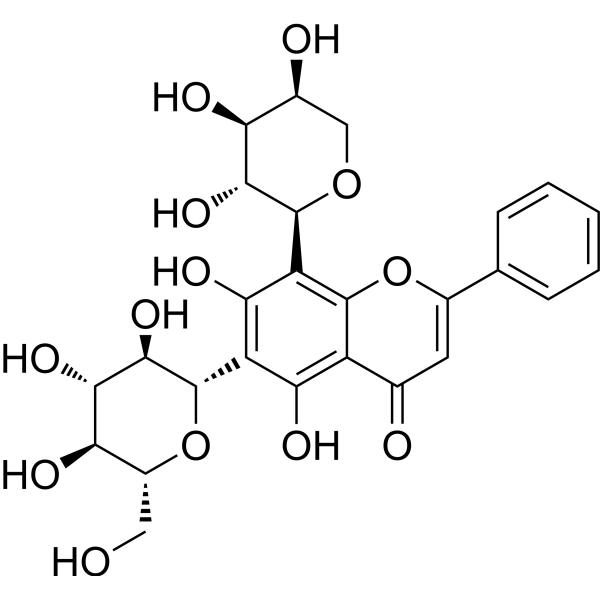
Cat. No.: HY-120294
CAS No.: 185145-34-0
Purity:  99.11%
Chrysin 6-C-glucoside 8-C-arabinoside can inhibit the CGRP releasing and the activation of TRPV1 channel. Chrysin 6-C-glucoside 8-C-arabinoside can be used for anti-migraine research .
loading...
    loading...
Cat. No.: HY-B0670
CAS No.: 511-12-6
Synonyms: DFN-19
Dihydroergotamine (DFN-19) is a blood-brain barrier-permeable semi-synthetic ergot alkaloid, acting as a full agonist of 5-HT1B/1D receptors (Ki values of 0.3 nM and 2.5 nM, respectively; functional IC50 values of 2 nM and 2.2 nM, respectively). Dihydroergotamine inhibits Forskolin (HY-15371)-stimulated cAMP accumulation, possesses α-adrenergic receptor antagonistic activity and weak dopaminergic agonistic activity. It mediates intracranial cerebrovascular contraction, inhibits the release of neuropeptides such as CGRP/substance P, and suppresses neurogenic inflammation by activating 5-HT1B/1D receptors in the trigeminovascular system. Dihydroergotamine binds to the catalytic site of Trypanosoma cruzi trypanothione reductase and exhibits trypanocidal activity in vitro. Dihydroergotamine can be used in studies related to migraine and trypanosome infections .
loading...
    loading...
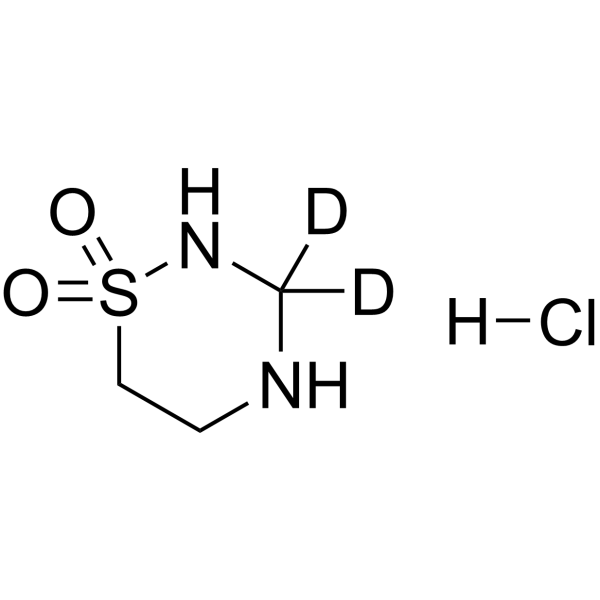
Cat. No.: HY-136820S1
Taurultam-d2 hydrochloride is the d2-labeled Taurultam (HY-136820) hydrochloride. Taurultam is the major active hydrolytic metabolite of Taurolidine (HY-W011522), which selectively activates hTRPA1 to trigger effects in sensory neurons. Taurultam exhibits activity against SARS-CoV-2 variants, influenza A viruses (H1N1, H3N2) and influenza B viruses. Taurultam induces mild tracheal sensory nerve stimulation and CGRP release in mice. Taurultam can be used in studies related to SARS-CoV-2 infection, influenza virus infection, and co-infection with SARS-CoV-2 and influenza A virus.
loading...
    loading...
Cat. No.: HY-187131
CAS No.: 869-06-7
Magnesium malate is an orally active organic acid-chelated magnesium complex. Magnesium malate promotes the release of prostaglandin E2 (PGE2) from macrophages, synergistically stimulates the synthesis/release of calcitonin gene-related peptide (CGRP) from dorsal root ganglion neurons, and upregulates the osteogenic transcription factor RUNX2 in osteoblasts via the Mg 2+-PGE2-CGRP axis, thereby promoting osteoblast proliferation. Magnesium malate can be incorporated into calcium phosphate bone cement as a modifying component to improve compressive strength, shorten setting time and enhance disintegration resistance. Magnesium malate increases serum magnesium levels. Magnesium malate can be used in studies related to bone defects and magnesium deficiency .
loading...
    loading...
Cat. No.: HY-136820
CAS No.: 38668-01-8
Taurultam is the major active hydrolytic metabolite of Taurolidine (HY-W011522), which selectively activates hTRPA1 to trigger effects in sensory neurons. Taurultam exhibits activity against SARS-CoV-2 variants, influenza A viruses (H1N1, H3N2) and influenza B viruses. Taurultam induces mild tracheal sensory nerve stimulation and CGRP release in mice. Taurultam can be used in studies related to SARS-CoV-2 infection, influenza virus infection, and co-infection with SARS-CoV-2 and influenza A virus.
loading...
    loading...
Cat. No.: HY-182539
CAS No.: 1202877-06-2
Target:  

CGRP Receptor

Research Areas:  

Others Neurological Disease

DD04107 is a neuronal exocytosis inhibitor with a rat Syt1-C2B domain binding Kd of 2.4 μM. DD04107 interferes with synaptobrevin-syntaxin-SNAP-25 complex formation and Syt1-SNARE complex interaction to block α-calcitonin gene-related peptide (α-CGRP) exocytotic release from primary sensory neurons. DD04107 blocks inflammatory ion channel recruitment to nociceptor plasma membranes. DD04107 can be used for the research of chronic inflammatory pain, neuropathic pain, osteosarcoma pain, chemotherapy-induced peripheral neuropathy, diabetic neuropathy, inflammatory pain .
loading...
    loading...
Cat. No.: HY-B0670S
Dihydroergotamine-d3 is the d3-labeled Dihydroergotamine (HY-B0670). Dihydroergotamine (DFN-19) is a blood-brain barrier-permeable semi-synthetic ergot alkaloid, acting as a full agonist of 5-HT1B/1D receptors (Ki values of 0.3 nM and 2.5 nM, respectively; functional IC50 values of 2 nM and 2.2 nM, respectively). Dihydroergotamine inhibits Forskolin (HY-15371)-stimulated cAMP accumulation, possesses α-adrenergic receptor antagonistic activity and weak dopaminergic agonistic activity. It mediates intracranial cerebrovascular contraction, inhibits the release of neuropeptides such as CGRP/substance P, and suppresses neurogenic inflammation by activating 5-HT1B/1D receptors in the trigeminovascular system. Dihydroergotamine binds to the catalytic site of Trypanosoma cruzi trypanothione reductase and exhibits trypanocidal activity in vitro. Dihydroergotamine can be used in studies related to migraine and trypanosome infections .
loading...
    loading...
  • 1

