11 Results for "

Cleaved-Parp1

" in MedChemExpress (MCE) Product Catalog:
Products (11)

11 Results for "Cleaved-Parp1" in MCE Product Catalog:

3
3 Cited Publications
Cat. No.: HY-P80448

Host:  

Rabbit

Application:  

WB, ICC/IF, IP, FC

Reactivity:  

Human

loading...
    loading...
Cat. No.: HY-N3677
CAS No.: 14351-29-2
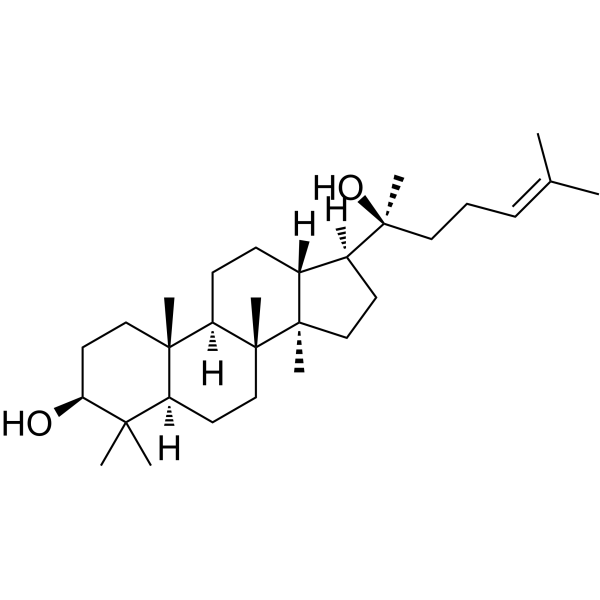
Dammarenediol II is a ginsenoside precursor . Dammarenediol II reduces the activity of O-GlcNAc transferase (OGT) and downregulates the global O-GlcNAcylation level. Dammarenediol II inhibits the phosphorylation of Akt, mTOR and GSK3β. Dammarenediol II inhibits human carboxylesterase activity, VEGF-induced ROS production, stress fiber formation and vascular endothelial cadherin disruption. Dammarenediol II promotes cell apoptosis (apoptosis), increases the levels of cleaved PARP1 and p53, and inhibits retinal microvascular leakage. Dammarenediol II can be used in studies related to liver cancer and diabetic retinopathy [1] .
loading...
    loading...
Cat. No.: HY-176848
Target:  

YTHDF Apoptosis MMP Caspase

Research Areas:  

Cancer

SKLB-Y13 is a selective YTHDF1 inhibitor with an IC50 of 0.76 μM and a KD of 5.097 μM. SKLB-Y13 binds to the Tyr397 and Trp470 residues in the m 6A-binding pocket of YTHDF1, disrupting the interaction between YTHDF1 and m 6A-modified mRNA. SKLB-Y13 inhibits cancer cell proliferation and promotes apoptosis. SKLB-Y13 is applicable to breast cancer-related research [1].
loading...
    loading...
Cat. No.: HY-176128
Research Areas:  

Cancer

BWA-6047 is an oral active PROTAC degrader targeting AR/AR-V7 and GSPT1 with DC50 values of 3.7, 3.0 and 1.2 nM in 22Rv1 cells. BWA-6047 suppresses the expression of AR downstream target genes and and transcriptional activity. BWA-6047 inhibits cancer cells proliferation, causes G1 phase cell cycle arrest and induces apoptosis. BWA-6047 increases cleaved-PARP-1 and cleaved-caspase-3 levels. BWA-6047 reduces growth of LNCaP xenograft tumors in mice models without obvious toxicity. BWA-6047 can be used for the research of prostate cancer [1].
loading...
    loading...
Cat. No.: HY-146817
CAS No.: 2470063-59-1
Research Areas:  

Cancer

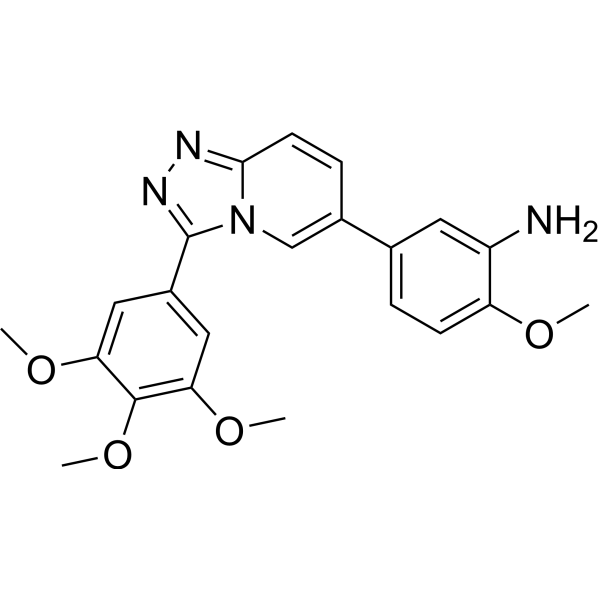
Tubulin polymerization-IN-11 is a potent tubulin polymerization inhibitor with an IC50 value of 3.4 μM. Tubulin polymerization-IN-11 shows antiproliferative activity. Tubulin polymerization-IN-11 induces Apoptosis and cell cycle arrest at G2/M phase. Tubulin polymerization-IN-11 decreases the expression of cyclin B1, p-cdc2, and Bcl-2 protein levels and increases the expression of cleaved PARP .
loading...
    loading...
Cat. No.: HY-168877
FMP is a Platinum(IV) complexe. FMP significantly upregulates the expression of γ-H2AX and p53. FMP increases the production of ROS. FMP markedly upregulates the expressions of Apoptosis-related proteins (DR5, Fas, caspase-8, Cyt-c, caspase-3, cleaved-PARP1, Bax). FMP shows antiproliferative activity against breast cancer [1].
loading...
    loading...
Cat. No.: HY-N14161
CAS No.: 87614-40-2
Diazaquinomycin A (DAQA), a diaza-anthracene antibiotic, is a thymidylate synthase inhibitor. Diazaquinomycin A (DAQA) induces DNA damage, cell cycle arrest, and apoptosis through cleaved-PARP .
loading...
    loading...
Cat. No.: HY-P80625
Synonyms: Parp1; ADPRT; PPOL; Poly [ADP-ribose] polymerase 1; Parp-1; ADP-ribosyltransferase diphtheria toxin-like 1; ARTD1; NAD(+) ADP-ribosyltransferase 1; ADPRT 1; Poly[ADP-ribose] synthase 1

Host:  

Rabbit

Application:  

WB

Reactivity:  

Human

loading...
    loading...
Cat. No.: HY-P80625A
Synonyms: Parp1; ADPRT; PPOL; Poly [ADP-ribose] polymerase 1; Parp-1; ADP-ribosyltransferase diphtheria toxin-like 1; ARTD1; NAD(+) ADP-ribosyltransferase 1; ADPRT 1; Poly[ADP-ribose] synthase 1

Host:  

Rabbit

Application:  

WB

Reactivity:  

Human

loading...
    loading...
Cat. No.: HY-184501
CAS No.: 486440-74-8
Research Areas:  

Cancer

UE01 is an orally active, selective small-molecule modulator targeting both ULK1/ERK1/2. UE01 activates hULK1 with an EC50 of 695.30 nM and a KD of 114.3 nM for ULK1; it inhibits hERK1 with an IC50 of 179.90 nM and a KD of 114 nM for ERK1; it shows weak binding to ERK2 with a KD of 2.8 mM. UE01 induces the conformational transition of ULK1 from an inactive to an active state, enhances the phosphorylation of ULK1 Ser317 and mAtg13 Ser355, and reduces the phosphorylation of ULK1 Ser757. UE01 competitively occupies the ATP-binding pocket of ERK1, inhibits ERK1 kinase activity, and reduces the activity of the ERK1/2 signaling pathway. UE01 induces complete autophagy flux and apoptosis, upregulates Atg5, Atg7, LC3-II/LC3-I, Bax, cytochrome C (Cyt c), Cleaved-Caspase 3, Cleaved-PARP1 and E-cadherin, downregulates p62, Bcl-2, MMP-2 and MMP-9, reduces the phosphorylation of Exo70 Ser250, and promotes the proteasome-dependent degradation of Cav-1, thereby inhibiting EMT-related phenotypes and extracellular matrix degradation. UE01 can be used in studies related to triple-negative breast cancer [1].
loading...
    loading...
Cat. No.: HY-P87903
Synonyms: ADPRT, PPOL, Parp1, Poly [ADP-ribose] polymerase 1, Parp-1, ADP-ribosyltransferase diphtheria toxin-like 1, DNA ADP-ribosyltransferase Parp1, NAD(+) ADP-ribosyltransferase 1, Poly[ADP-ribose] synthase 1, Protein poly-ADP-ribosyltransferase Parp1, ARTD1, ADPRT 1

Host:  

Rabbit

Application:  

WB, IHC-P, ICC/IF, ELISA

Reactivity:  

Human, Mouse, Rat

loading...
    loading...
  • 1

