11 Results for "

DDR pathway

" in MedChemExpress (MCE) Product Catalog:
Products (11)

11 Results for "DDR pathway" in MCE Product Catalog:

1
1 Cited Publications
Cat. No.: HY-13703A
CAS No.: 55661-38-6
Purity:  98.22%
Synonyms: ACNU
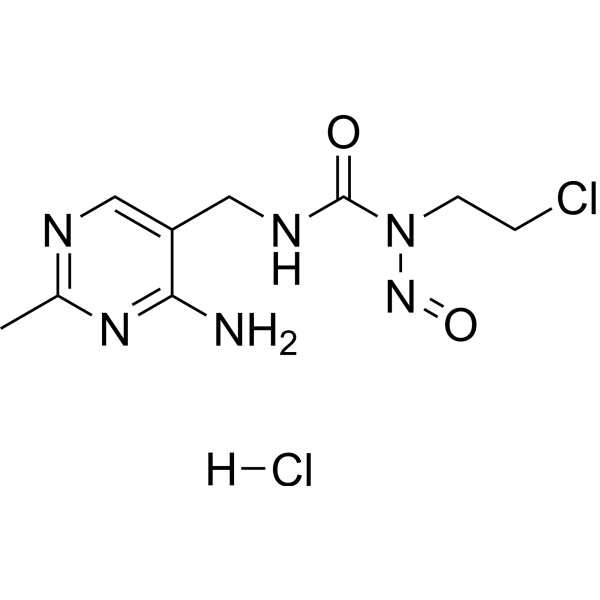
Nimustine hydrochloride (ACNU) is the hydrochloride salt form of Nimustine (HY-13703). Nimustine hydrochloride is an alkylating agent, which induces DNA double-strand breaks (DSBs) and inter-strand crosslinks (ICLs), thereby activating the DNA damage response (DDR) signaling pathway. Nimustine hydrochloride activates p38 MAPK/JNK signaling pathway, and exhibits antitumor activity .
loading...
    loading...
Cat. No.: HY-115531
CAS No.: 1648707-58-7
Purity:  98.84%
Target:  

DNA/RNA Synthesis

Research Areas:  

Cancer

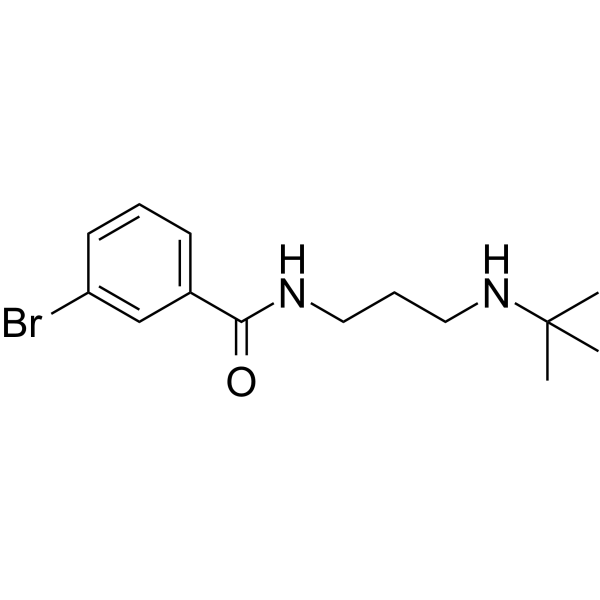
UNC-2170 is a functionally active, fragment-like ligand for 53BP1 (IC50=29 µM; Kd=22 µM). UNC-2170 shows at least 17-fold selectivity for 53BP1 as compared to nine other methyl-lysine (Kme) reader proteins. 53BP1 is a Kme binding protein that plays a central role in DNA Damage Repair (DDR) pathways and is recruited to sites of double-strand breaks (DSB) .
loading...
    loading...
Cat. No.: HY-176184
CAS No.: 3081612-73-6
Research Areas:  

Cancer

PROTAC DDR1 degrader-1 is a potent and selective DDR1-targeting PROTAC degrader. PROTAC DDR1 degrader-1 selectively induces full-length DDR1 degradation via the ubiquitin proteasome system, blocking downstream signaling pathways. PROTAC DDR1 degrader-1 inhibits tumor cell migration and invasion. PROTAC DDR1 degrader-1 exhibits anti-tumor activity in mice. PROTAC DDR1 degrader-1 can be used for the research of DDR1-driven cancers .
loading...
    loading...
Cat. No.: HY-106055
CAS No.: 74817-61-1
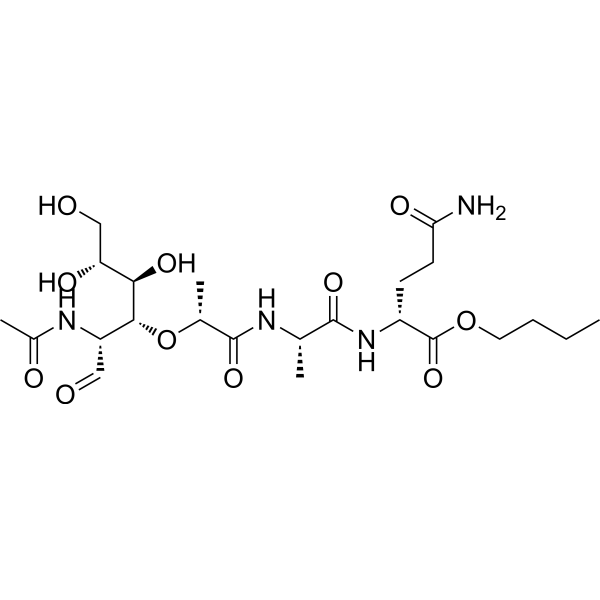
Murabutide is an immunomodulator and also a NOD2 receptor agonist . Murabutide enhances the signal transduction of ATR and NOD2, mediates the activation of the DDR pathway, and thereby repairs radiation-induced DNA double-strand breaks. Murabutide inhibits radiation-induced cell apoptosis and protects cells and mice from radiation-induced toxic damage. Murabutide induces the expression and DNA-binding activity of Oct-1 in macrophages, thereby inhibiting the transcription and replication of HIV-1. Murabutide reduces the expression levels of CD4 and CCR5 on the surface of macrophages, and induces the secretion of β-chemokines, TNF-α and IL-6. Murabutide enhances non-specific viral resistance and targets reticuloendothelial cells. Murabutide can be used in research related to radiation-induced damage and human immunodeficiency virus type 1 infection .
loading...
    loading...
Cat. No.: HY-162384
CAS No.: 3034959-68-4
Research Areas:  

Cancer

EPIC-0628 is an inhibitor of the HOTAIR-EZH2 interaction and promotes ATF3 expression. The long noncoding RNA HOTAIR has been found to regulate glioblastoma (GBM) progression and mediate DNA damage repair (DDR) by interacting with the catalytic subunit EZH2 of PRC2. EPIC-0628 also inhibits the ATF3-p38-E2F1 DDR pathway to inhibit the HR pathway and upregulates CDKN1A (p21) expression, causing cell cycle arrest. EPIC-0628 also synergizes with Temozolomide (TMZ) (HY-17364) to enhance its in vivo potency .
loading...
    loading...
Cat. No.: HY-153858
CAS No.: 2470433-36-2
PHI-501 is a dual inhibitor targeting RAF/DDR. PHI-501 exhibits significant anti-proliferative effects in melanoma cell lines and significantly inhibits the colony formation of drug-resistant cells. PHI-501 strongly inhibits ERK and AKT phosphorylation. PHI-501 downregulates the gene sets in drug-resistant cells of TNFA-NFKB, IL6-JAK-STAT3, and KRAS signaling pathways as well as the epithelial-mesenchymal transition (EMT) signaling pathways. PHI-501 demonstrates significant anti-tumor effects in the SK-MEL3DR xenograft model. PHI-501 can be used for research on the problem of drug resistance in melanoma .
loading...
    loading...
Cat. No.: HY-13703
CAS No.: 42471-28-3
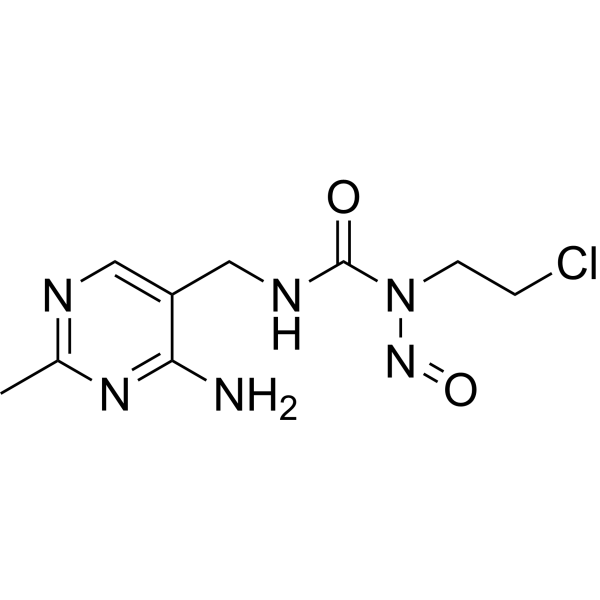
Nimustine is an alkylating agent, which induces DNA double-strand breaks (DSBs) and inter-strand crosslinks (ICLs), thereby activating the DNA damage response (DDR) signaling pathway. Nimustine activates p38 MAPK/JNK signaling pathway, and exhibits antitumor activity .
loading...
    loading...
Cat. No.: HY-N12959
CAS No.: 927406-46-0
Synonyms: DDR
5,4'-Dihydroxy-6,8-dimethoxy-7-O-rhamnosyl flavone (DDR) is an anticancer agent that can be extracted from Indigofera ovata. 5,4'-Dihydroxy-6,8-dimethoxy-7-O-rhamnosyl flavone can inhibit the PI3K/AKT and NF-кB pathways, inhibit the invasion and migration of cancer cells, and has anticancer activity .
loading...
    loading...
Cat. No.: HY-118897
CAS No.: 2173992-60-2
Target:  

DNA/RNA Synthesis

Research Areas:  

Cancer

UNC-2170 maleate is the maleate salt form of UNC-2170 (HY-115531). UNC-2170 maleate is a selective inhibitor for the methyl-lysine binding protein 53BP1, with IC50 of 29 µM and Kd of 22 µM. UNC-2170 maleate shows at least 17-fold selectivity for 53BP1 as compared to nine other methyl-lysine (Kme) reader proteins. 53BP1 is a Kme binding protein that plays a central role in DNA Damage Repair (DDR) pathways and is recruited to sites of double-strand breaks (DSB) .
loading...
    loading...
Cat. No.: HY-170921
Target:  

Deubiquitinase

Research Areas:  

Cancer

USP1-IN-11 (compound 38-P2) is a selective, reversible, and noncompetitive USP1 (Ubiquitin-specific protease 1) inhibitor. USP1-IN-11 activates the DDR (DNA damage repair) pathway, induces cell cycle arrest and cell Apoptosis, and inhibits cell survival. USP1-IN-11 enhances the sensitivity of Olaparib (HY-10162)-resistant cells to Olaparib (HY-10162) and shows a synergetic effect with Andrographolide (HY-N0191) in BRCA-proficient cancer cells. USP1-IN-11 displays significant, dose-dependent antitumor efficacy in the MDA-MB-436 xenograft model .
loading...
    loading...
Cat. No.: HY-181284
CAS No.: 2563902-57-6
BYBC‑1 is a selective G4‑RNA‑targeting ligand with high affinity forKRAS and NRAS G4‑RNAs (Kd = 0.05-0.28 μM). BYBC‑1 stabilizes G4‑RNA structures in KRAS and NRAS mRNA, blocks thePI3K/AKT and MAPK/ERK pathways, activates the DNA damage response (DDR), suppresses energy metabolism, and induces S‑phase arrest and apoptosis. BYBC‑1 exhibits high selectivity over non‑malignant fibroblasts and significantly inhibits the growth of HCT‑116 xenograft tumors in vivo. BYBC‑1 can be used for the study of colorectal cancer .
loading...
    loading...
  • 1

