1. Search Result
Search Result
Results for "

HCC mouse model

" in MedChemExpress (MCE) Product Catalog:

14

Inhibitors & Agonists

1

Inhibitory Antibodies

Cat. No. Product Name Target Research Areas Chemical Structure
  • HY-175646

    Acyltransferase mTOR Ribosomal S6 Kinase (RSK) Apoptosis Cancer
    AGPAT4-IN-1 (Compound CL26) is a covalent AGPAT4 inhibitor with an IC50 of 795 nM. AGPAT4-IN-1 covalently binds to AGPAT4 at Cys 228 and significantly inhibits acyltransferase activity, LPA-to-PA conversion and downstream mTOR/S6K pathways. AGPAT4-IN-1 sensitizes hepatocellular carcinoma (HCC) tumors to Sorafenib (HY-10201) and significantly induces apoptosis with a synergistic response. AGPAT4-IN-1 has antitumor activity and reduces tumorigenicity and stemness in HCC xenograft mouse models .
    AGPAT4-IN-1
  • HY-162650

    ClpP Cancer
    SL44 is an agonist for human caseinolytic protease P (HsClpP), with an EC50 of 1.30 μM. SL44 inhibits the proliferation of LM3 with an IC50 of 3.1 μM. SL44 induces apoptosis in HCC cells, through the degradation of respiratory chain complex subunits. SL44 exhibits antitumor efficacy in mouse models without obvious toxicity (LD50=400 mg/kg). SL44 exhibits good pharmacokinetic characters in rat models .
    SL44
  • HY-130133

    PI3K mTOR Akt Apoptosis Paraptosis p38 MAPK Mitochondrial Metabolism P-glycoprotein CDK MMP HIF/HIF Prolyl-Hydroxylase VEGFR Cancer
    DHW-221 is a potent orally active dual PI3K/mTOR inhibitor, exhibiting low nanomolar potency against all four Class I PI3K isoforms and mTOR (PI3Kα, IC50 = 0.50 nM; PI3Kβ, IC50 = 1.9 nM; PI3Kγ, IC50 = 1.8 nM; PI3Kδ, IC50 = 0.74 nM; mTOR, IC50 = 3.9 nM). DHW-221 exerts antitumor effects by blocking the PI3K/Akt/mTOR pathway and inducing mitochondrial apoptosis and paraptosis (via Endoplasmic Reticulum (ER) stress and MAPK signaling) and arrests cell cycle, thereby inhibiting cell migration, invasion and angiogenesis. DHW-221 inhibits tumor growth in both the A549/Taxol (HY-B0015) and the HCC827 xenograft mouse models. DHW-221 can be used for non-small cell lung cancer (NSCLC), colon and breast cancer research .
    DHW-221
  • HY-100443

    PX-102

    FXR Cancer
    PX20606 is an orally active agonist for farnesoid X receptor (FXR), with EC50 220 nM (mFXR) and 50 nM (hFXR), measured by Gal4-FXR assay. PX20606 induces the expression of tumor suppressor gene NDRG2, inhibits the tumor growth and metastasis in mouse HCC model. PX20606 exhibits hepatoprotective efficacy .
    PX20606
  • HY-P991328

    Notch Cancer
    MAb604.107 is a human monoclonal antibody (mAb) targeting NOTCH1. MAb604.107 inhibits the proliferation and CD34/CD44 expression of primary T-ALL cells. MAb604.107 has anti-tumor activity in four tumor xenograft mouse models: MDA-MB-231, HCC-1806, BT-474, and HCT-116. MAb604.107 can be used in T acute lymphoblastic leukemia research .
    MAb604.107
  • HY-146407

    Apoptosis Cancer
    Anticancer agent 53 is a potent anticancer agent. Anticancer agent 53 shows in vitro cytotoxicity. Anticancer agent 53 induces apoptosis and cell cycle arrest in S/G2/M phases. Anticancer agent 53 shows antitumor activity with no apparent toxicity .
    Anticancer agent 53
  • HY-172881

    Pyruvate Kinase Cancer
    PKM2-IN-10 (Compound 16) is a PKM2 inhibitor. PKM2-IN-10 inhibits the proliferation of A549 and HCC1833 cell lines with IC50 of 3.36 μM and 9.20 μM, respectively. PKM2-IN-10 exhibits antitumor activity in human non-small cell lung cancer (NSCLC) and mouse lung adenocarcinoma models. PKM2-IN-10 can be used in lung cancer research .
    PKM2-IN-10
  • HY-169262

    Phospholipase Apoptosis Cancer
    PLD-IN-1 (Compound 3r) is an orally active inhibitor for phospholipase D with an IC50 of 1.97 μM. PLD-IN-1 reduces the expression of CD24, CD47 and PD-L1, enhances the calreticulin expression, and thus modulates the immune evasion mechanism in lung cancer cells by promoting the phagocytosis of cancer cells by macrophages. PLD-IN-1 inhibits the cell viability of lung cancer cell A549, HCC44, H460 and HCC15 with IC50 of 18.44, 22.31, 24.85 and 21.45 μM, respectively. PLD-IN-1 can induce apoptosis and inhibits migration in cell A549. PLD-IN-1 enhances the level of pro-inflammatory M1 macrophages and decreases the level of anti-inflammatory M2 macrophages, exhibits antitumor efficacy in mouse model .
    PLD-IN-1
  • HY-173060

    ERK Apoptosis Autophagy Cancer
    ERK1/2 inhibitor 13 (Compound 21y) is the orally active inhibitor for ERK that inhibits ERK1 and ERK2 with IC50 of 91.71 nM and 97.87 nM. ERK1/2 inhibitor 13 inhibits the proliferation of MCF-7, 4T1, MDA-MB-468, and HCC1970 (IC50 of 0.67, 2.76, 2.15 and 1.68 μM), inhibits the cancer cell migration, induces apoptosis and autophagy in MCF-7. ERK1/2 inhibitor 13 exhibits antitumor and anti-metastatic effect in 4T1 xenograft mouse model .
    ERK1/2 inhibitor 13
  • HY-143881

    FGFR Cancer
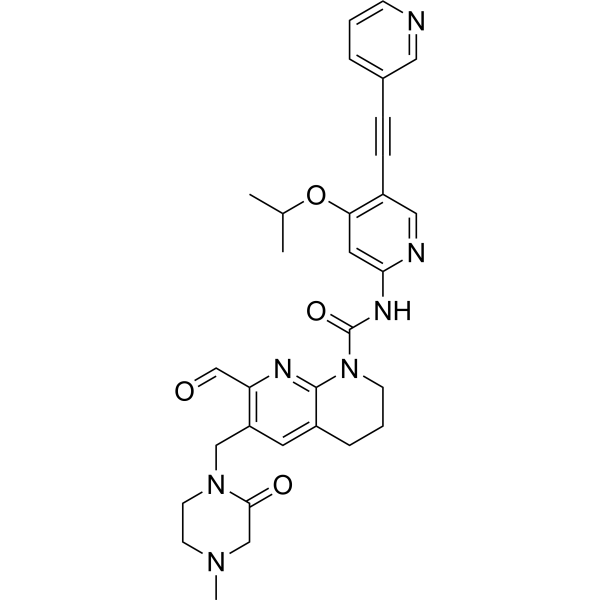
    FGFR4-IN-6 (Compound 9ka) is a covalently reversible FGFR4 inhibitor with an IC50 value of 5.4 nM. FGFR4-IN-6 also exhibits good oral pharmacokinetic properties. FGFR4-IN-6 induces significant tumor regressions in a xenograft mouse model of Hep3B2.1-7 HCC cell line without an obvious sign of toxicity . FGFR4-IN-6 is a click chemistry reagent, it contains an Alkyne group and can undergo copper-catalyzed azide-alkyne cycloaddition (CuAAc) with molecules containing Azide groups.
    FGFR4-IN-6
  • HY-176957

    Wee1 Cancer
    PKMYT1-IN-11 (Example 1) is a PKMYT1 inhibitor with an IC50 of 4.49 nM. PKMYT1-IN-11 inhibits the proliferation of HCC1569 cells. When combined with Gemcitabine (HY-17026), PKMYT1-IN-11 shows a significant anti-tumor effect in the OVCAR3 xenograft mouse model. PKMYT1-IN-11 can be used for the study of various cancers such as breast cancer and ovarian cancer .
    PKMYT1-IN-11
  • HY-180281

    Zinc Finger Protein Apoptosis PI3K Akt Cancer
    PLAGL2-IN-1 is a inhibitor of pleiomorphic adenoma-like protein 2 (PLAGL2) with a Kd of 2.23 µM. PLAGL2-IN-1 suppresses PLAGL2 transcriptional activity, induces G0/G1 cell cycle arrest, and apoptosis, thereby inhibiting hepatocellular carcinoma (HCC) cell proliferation. PLAGL2-IN-1 disrupts extracellular matrix organization and suppresses the PI3K-AKT pathway by reducing AKT phosphorylation. PLAGL2-IN-1 inhibits tumor growth in an HCCLM3 xenograft mouse model. PLAGL2-IN-1 can be used for the research of HCC .
    PLAGL2-IN-1
  • HY-179430

    Mps1 Cancer
    TTK-IN-5 is an orally active covalent threonine tyrosine kinase (TTK) inhibitor with selectivity (IC50 = 8.918 nM). TTK-IN-5 exhibits anti-proliferative potencies against MDA-MB-231, A2780, HCT116, HCC1569 and MKN1 cell lines (IC50 values of 0.113 μM, 0.476 μM, 3.136 μM, 3.649 μM, and 1.856 μM, respectively). TTK-IN-5 potently suppresses tumor growth without notable toxicity in A2780 and MDA-MB-231 xenograft mouse models. TTK-IN-5 can be used for the research of cancer such as breast cancer and ovarian cancer .
    TTK-IN-5
  • HY-179381

    FGFR Cancer
    FGFR4-IN-24 is a selective irreversible covalent FGFR4 inhibitor (IC50 = 1.2 nM). FGFR4-IN-24 shows much weaker activity against the other three FGFR family kinases (FGFR1-3). FGFR4-IN-24 inhibits the FGF19/FGFR4 signaling pathway, effectively suppressing the proliferation of the HuH-7 HCC cell line (GI50 = 17 nM). FGFR4-IN-24 exhibits significant antitumor activity in a HuH-7 mouse xenograft model. FGFR4-IN-24 can be used for the research of hepatocellular carcinoma .
    FGFR4-IN-24

Inquiry Online

Your information is safe with us. * Required Fields.

Salutation


Country or Region *

Applicant Name *


Organization Name *

Department *


Email Address *


Product Name *

Cat. No.


Requested quantity *

Phone Number *


Remarks

Inquiry Online

Inquiry Information

Product Name:
Cat. No.:
Quantity:
MCE Japan Authorized Agent:

