
28 Results for "

basophil

" in MedChemExpress (MCE) Product Catalog:
Products (28)

28 Results for "basophil" in MCE Product Catalog:

14
14 Publications Verification
Cat. No.: HY-B0539
CAS No.: 100643-71-8
Synonyms: Sch34117
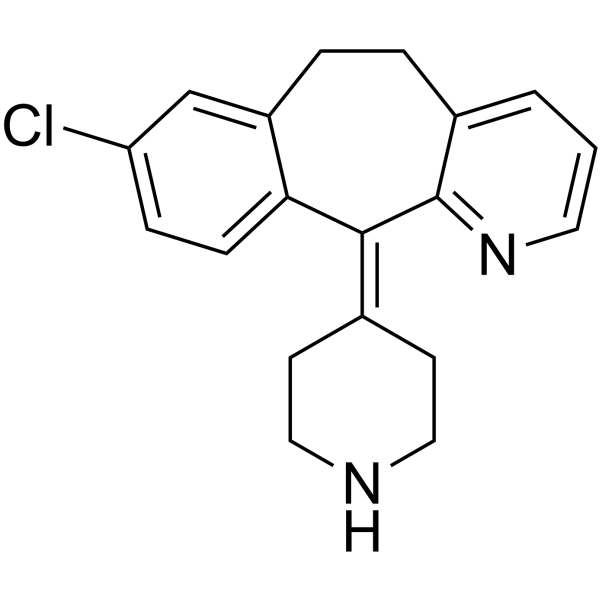
Desloratadine (Sch34117) is an orally active and selective H1 receptor antagonist (Ki=0.9 nM) with anti-inflammatory and anti-allergic activities. Desloratadine inhibits the release of histamine and LTC4 from human basophils and targets the regulatory signals of IL-4 and IL-13 production in basophils. Desloratadine significantly alleviates SAR symptoms in patients with concurrent asthma and can be used in the study of seasonal allergic rhinitis and chronic idiopathic urticaria .
loading...
    loading...
5
5 Cited Publications
Cat. No.: HY-15322
CAS No.: 1370261-96-3
Purity:  99.38%
Synonyms: P505-15; PRT-2607; BIIB-057
Target:  

Syk Apoptosis Caspase

Research Areas:  

Inflammation/Immunology Cancer

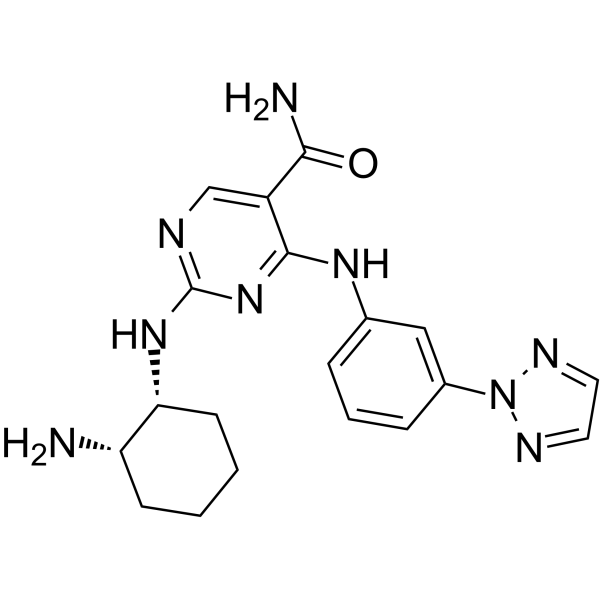
PRT062607 (P505-15; PRT-2607) is an orally active ATP-competitive Syk inhibitor with an IC50 value of 1 nM, and exhibits at least 80-fold selectivity over other kinases. PRT062607 blocks B cell antigen receptor-mediated activation, Fcε receptor 1-mediated basophil degranulation and microglial phagocytosis, and induces caspase-dependent apoptosis and microglial death. PRT062607 inhibits tumor growth and peripheral nerve injury-induced mechanical allodynia, and prevents neuronal loss. PRT062607 can be used in research related to rheumatoid arthritis, chronic lymphocytic leukemia, non-Hodgkin's lymphoma, neurodegenerative diseases and neuropathic pain .
loading...
    loading...
3
3 Cited Publications
Cat. No.: HY-W004260
CAS No.: 506-30-9
Synonyms: Eicosanoic acid
Arachidic acid is an orally bioavailable membrane fluidity modulator and receptor/ion channel effector. Arachidic acid does not activate arachidonic acid-sensitive K + channels in rat midbrain and hypothalamic neurons. Arachidic acid alleviates age-related spatial cognitive impairment. Arachidic acid is applicable for research related to age-related spatial cognitive impairment .
loading...
    loading...
1
1 Cited Publications
Cat. No.: HY-P99300
CAS No.: 1322627-61-1
Synonyms: QGE 031; Anti-IGHE Recombinant Antibody

Target:  

Fc Receptor (FcR)

Research Areas:  

Inflammation/Immunology

Ligelizumab (QGE 031) is a humanized high-affinity anti-immunoglobulin IgE monoclonal antibody. Ligelizumab selectively inhibits the binding of IgE to the high-affinity receptor FcεRI, while the inhibitory effect on the low-affinity receptor CD23 is weak. Ligelizumab can inhibit the activation of effector cells such as mast cells and Basophil, while reducing the production of IgE by B cells, and restoring the IFN-α production and regulatory T cell (Treg) induction function of plasmacytoid dendritic cells (pDC). Ligelizumab can be used in the study of allergic diseases (such as chronic spontaneous urticaria, allergic asthma) .
loading...
    loading...
Cat. No.: HY-16420
CAS No.: 575474-82-7
Target:  

Syk

Research Areas:  

Inflammation/Immunology

R112 is a fast and reversible inhibitor of spleen tyrosine kinase (Syk) kinase. R112 inhibits Syk kinase activity with an IC50 value of 226 nM and a Ki value of 96 nM. R112 inhibits IgE-FcεRI signaling pathway. R112 can be used for the research of allergic rhinitis .
loading...
    loading...
Cat. No.: HY-P1111
CAS No.: 222018-18-0
Target:  

Src Interleukin Related

Research Areas:  

Inflammation/Immunology

Lyn peptide inhibitor (YGYRLRRKWEEKIPNP-NH2) is a potent, cell-permeable Lyn kinase inhibitor that inhibits Lyn-coupled signaling pathways associated with the IL-5 receptor while preserving the integrity of other signals. Lyn peptide inhibitor blocks the activation of Lyn and inhibits the binding of Lyn tyrosine kinase to the βc subunit of the IL-3/GM-CSF/IL-5 receptor. Lyn peptide inhibitor can be used in the research of eosinophilic diseases such as asthma and allergy .
loading...
    loading...
Cat. No.: HY-123205
CAS No.: 60607-34-3
Purity:  99.56%
Synonyms: KW-4354
Oxatomide (KW-4354) is an orally active dual antagonist of the H1-histamine receptor and the P2X7 receptor, as well as an inhibitor of serotonin. Oxatomide possesses antihistaminic, antiallergic and anti-inflammatory activities. Oxatomide can be used in the research of allergic diseases .
loading...
    loading...
Cat. No.: HY-122376
CAS No.: 28434-00-6
Purity:  98.16%
Synonyms: D-Trans-Allethrin; Esbiol
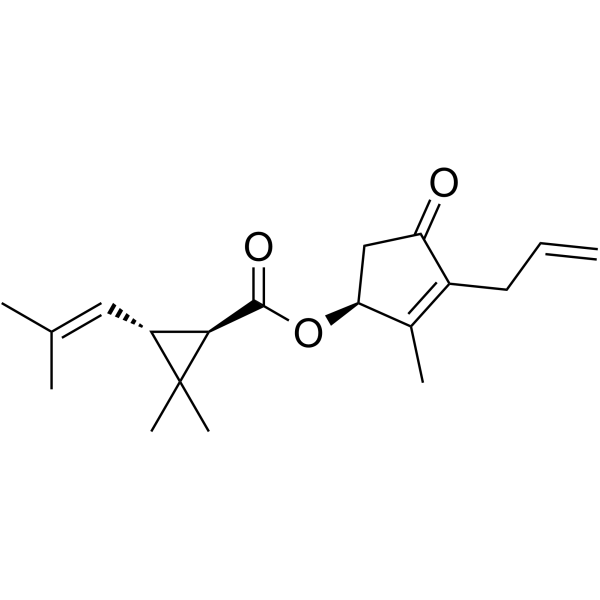
S-Bioallethrin (D-Trans-Allethrin) is a pyrethroid insecticide. S-Bioallethrin disrupts nerve function by modifying the gating kinetics of transitions between the conducting and nonconducting states of voltage-gated sodium channels. S-Bioallethrin also causes inhibition of lymphocyte proliferation and induces histamine release from human basophils .
loading...
    loading...
Cat. No.: HY-B0926B
CAS No.: 131-49-7
Synonyms: N-Methyl-D-glucamine diatrizoate
Diatrizoate meglumine (N-Methyl-D-glucamine diatrizoate) is an orally active, water-soluble, poorly absorbable iodinated contrast agent. Diatrizoate meglumine is widely used as an adjuvant for radiological diagnosis and can also be applied to studies of small bowel obstruction in non-malignant conditions .
loading...
    loading...
Cat. No.: HY-125726
CAS No.: 151057-28-2
Synonyms: (3'-sulfo)Galβ-Cer(d18:1/24:1); N-Nervonoyl Sulfatide; C24:1 Sulfatide
Sulfo galactosylceramide (N-Nervonoyl Sulfatide; C24:1 Sulfatide) is a glycolipid and the major sulfolipid species in mature myelin. Sulfo galactosylceramide interacts with C-type lectins and immunoglobulin-like receptors, with the highest affinity for LMIR5. Sulfo galactosylceramide induces MCP-1 production by basophils but not mast cells, and increases NFAT activation via LMIR5. Sulfo galactosylceramide alleviates symptoms and improves survival in a mouse model of chronic relapsing-remitting experimental autoimmune encephalomyelitis (EAE), and reduces inflammatory lesions and the number of infiltrating mononuclear cells in the lumbar spinal cord of EAE mice.
loading...
    loading...
Cat. No.: HY-124146
CAS No.: 1319738-39-0
Target:  

Syk

Research Areas:  

Inflammation/Immunology

BI1002494 is an orally active, potent, and selective spleen tyrosine kinase (SYK) inhibitor. BI 1002494 exhibits an IC50 of 115 nM in inhibiting high-affinity IgE receptor-mediated mast cell and basophil degranulation. BI1002494 can be utilized in immunology reesearch .
loading...
    loading...
Cat. No.: HY-120541
CAS No.: 1196994-11-2
Purity:  99.55%
Target:  

Histamine Receptor

Research Areas:  

Inflammation/Immunology

ST-1006 is a potent histamine H4 receptor agonist with a pKi value of 7.94. ST-1006 has anti-inflammatory effect .
loading...
    loading...
Cat. No.: HY-P991592
CAS No.: 2755114-30-6

Target:  

Inhibitory Antibodies

Research Areas:  

Inflammation/Immunology

UB-221 is a humanized IgG1 monoclonal antibody inhibitor targeting IgE. UB-221 significantly decreases IgE synthesis by stabilization of membrane-bound CD23 on B lymphocytes and inhibits FcԑRI-mediated basophil activation and degranulation. UB-221 reduces IgE level in cynomolgus macaques and human IgE (ε, κ)-transgenic (hIGHE-knockin) mice. UB-221 can be used for asthma and chronic spontaneous urticaria (CSU) research .
loading...
    loading...
Cat. No.: HY-P990214
Anti-Mouse IL-3 Antibody (MP2-8F8) is an anti-mouse IL-3 IgG1 monoclonal antibody. Anti-Mouse IL-3 Antibody (MP2-8F8) relieves joint inflammation by reducing synovial leukocyte infiltration and cytokine levels. Anti-Mouse IL-3 Antibody (MP2-8F8) can reduce the accumulation of basophils. Anti-Mouse IL-3 Antibody (MP2-8F8) can be used for researches on inflammation or infection conditions such as arthritis and parasitic infections .
loading...
    loading...
Cat. No.: HY-120541A
CAS No.: 1196994-12-3
Target:  

Histamine Receptor

Research Areas:  

Inflammation/Immunology

ST-1006 maleate is a potent histamine H4 receptor agonist with a pKi value of 7.94. ST-1006 maleate has anti-inflammatory effect .
loading...
    loading...
Cat. No.: HY-N11691
CAS No.: 67526-94-7
Synonyms: Thapsigargicine
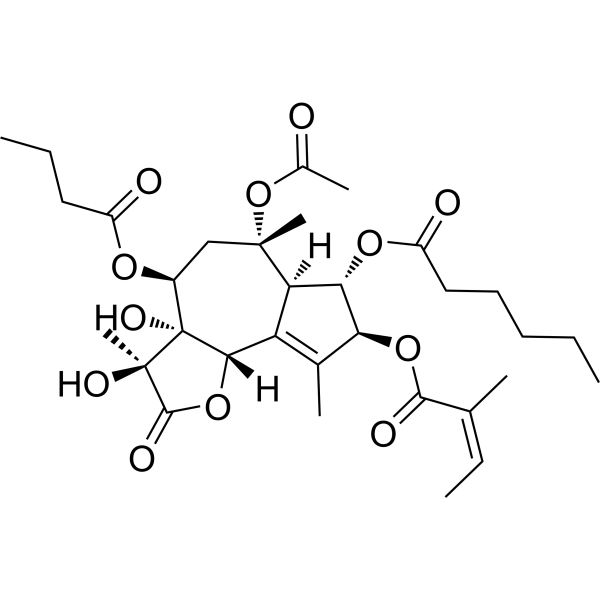
Thapsigargicin (Thapsigargicine) is a activator of mast cells and leukocytes. Thapsigargicin induces histamine release from rat peritoneal mast cells and human basophil leukocytes. Thapsigargicin increases the cytoplasmic free calcium level in intact human blood platelets .
loading...
    loading...
Cat. No.: HY-174763
Target:  

mRNA

Research Areas:  

Inflammation/Immunology

Human CCL2 mRNA encodes the human C-C motif chemokine ligand 2 (CCL2) protein. CCL2 displays chemotactic activity for monocytes and basophils but not for neutrophils or eosinophils. It has been implicated in the pathogenesis of diseases characterized by monocytic infiltrates, like psoriasis, rheumatoid arthritis and atherosclerosis.
loading...
    loading...
Cat. No.: HY-174607
Target:  

mRNA

Research Areas:  

Inflammation/Immunology

Human IL33 mRNA encodes the human interleukin 33 (IL33) protein, a cytokine that binds to the IL1RL1/ST2 receptor. IL33 is involved in the maturation of Th2 cells and the activation of mast cells, basophils, eosinophils and natural killer cells.
loading...
    loading...
Cat. No.: HY-174770
Target:  

mRNA

Research Areas:  

Inflammation/Immunology

Human CCL13 mRNA encodes the human C-C motif chemokine ligand 13 (CCL13) protein, a cytokine that displays chemotactic activity for monocytes, lymphocytes, basophils and eosinophils, but not neutrophils. CCL13 also plays a role in accumulation of leukocytes during inflammation and may be involved in the recruitment of monocytes into the arterial wall during artherosclerosis.
loading...
    loading...
Cat. No.: HY-174756
Target:  

mRNA

Research Areas:  

Inflammation/Immunology

Human CCL26 mRNA encodes the human C-C motif chemokine ligand 26 (CCL26) protein, a cytokine that displays chemotactic activity for normal peripheral blood eosinophils and basophils. CCL26 also has antimicrobial activity, displaying an antibacterial effect on S. pneumoniae, S. aureus, Non-typeable H. influenzae, and P. aeruginosa.
loading...
    loading...

