
27 Results for "

central nervous system (CNS) diseases

" in MedChemExpress (MCE) Product Catalog:
Products (27)

27 Results for "central nervous system (CNS) diseases" in MCE Product Catalog:

2
2 Cited Publications
Cat. No.: HY-P1333
CAS No.: 80448-90-4
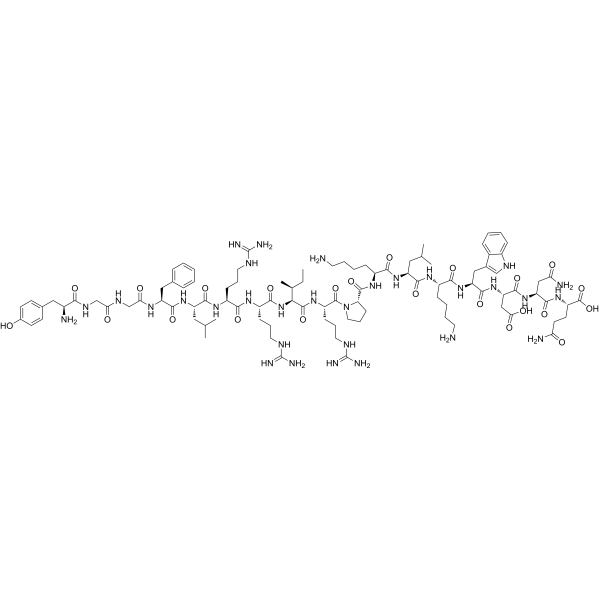
Dynorphin A is an endogenous opioid peptide involved in inhibitory neurotransmission in the central nervous system (CNS). Dynorphin A is a highy potent kappa opioid receptor (KOR) agonist, and is also an agonist for other opioid receptors, such as mu (MOR) and delta (DOR). Dynorphin A can induce neuronal death, and can be used in the research of neurological disease .
loading...
    loading...
1
1 Cited Publications
Cat. No.: HY-111263
CAS No.: 868592-56-7
Purity:  99.11%
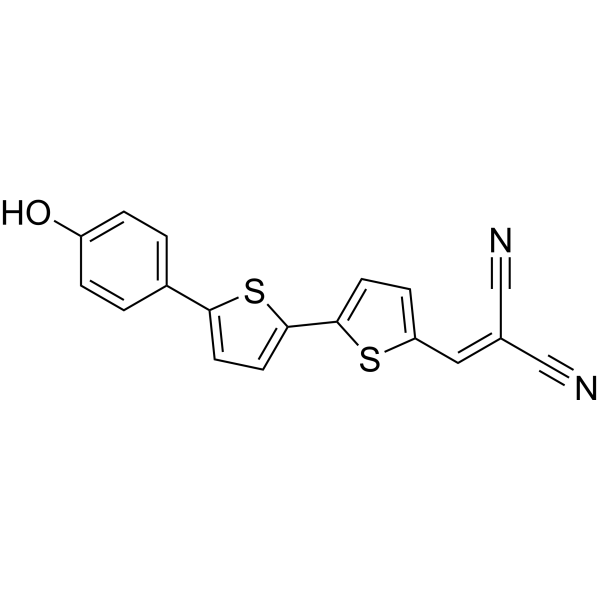
NIAD-4 is a blood-brain barrier permeable fluorophore for optical imaging of amyloid-β (Aβ) in the central nervous system (CNS) for Alzheimer’s disease (AD). NIAD-4 binds to the same Aβ site with the binding affinity (Ki) of 10 nM .
loading...
    loading...
Cat. No.: HY-149555
CAS No.: 2278265-85-1
Purity:  99.94%
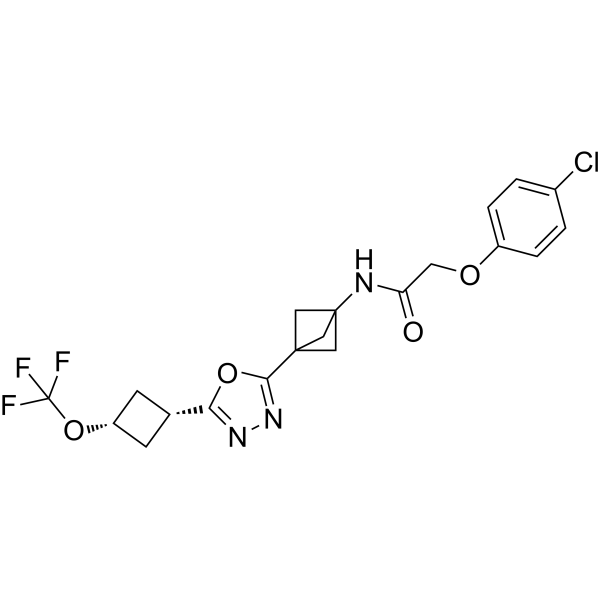
DNL343 is a potent, selective, orally active and brain-penetrant activator of eukaryotic initiation factor eIF2B. DNL343 inhibits the activity of the integrated stress response (ISR) in the central nervous system (CNS) and reverses neurodegeneration and neuroinflammation. DNL343 also prevents motor dysfunction and premature death in eIF2B loss-of-function (LOF) mutant mice. DNL343 can be used in the study of neurodegenerative diseases .
loading...
    loading...
Cat. No.: HY-132806
CAS No.: 2230009-48-8
Purity:  99.93%
Synonyms: RG-7816; RO-7017773
Target:  

GABA Receptor

Research Areas:  

Neurological Disease

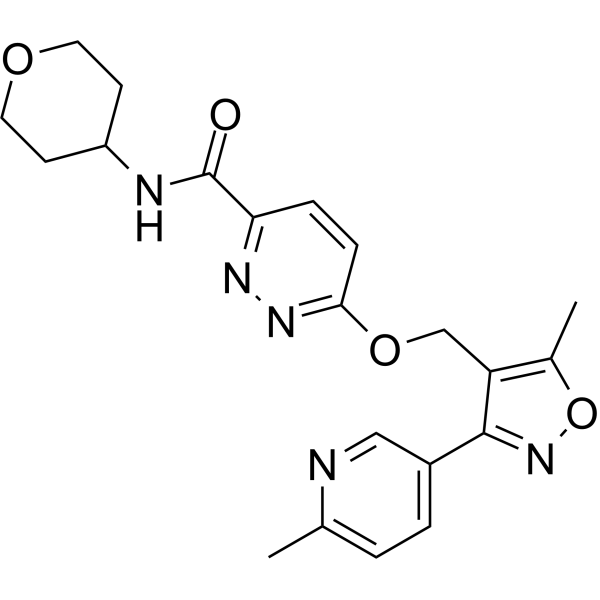
Alogabat is a positive allosteric modulator (PAM) and agonist (Ki <100 nM) of the GABAA α5 receptor, targeting the α5β3γ2 subunit with a Ki of 8.7 nM. Alogabat increases the expression level of α5β3γ2 in oocytes (1.97-fold). GABAA has been implicated in cognitive impairment associated with central nervous system (CNS) disorders, brain cancer (including brain tumors such as medulloblastoma), and can be used in the study of mild cognitive impairment (MCI), amnestic MCI (aMCI), age-associated memory impairment (AAMI), age-related cognitive decline (ARCD), dementia, Alzheimer's disease (AD), prodromal AD, post-traumatic stress disorder (PTSD), schizophrenia, bipolar disorder, amyotrophic lateral sclerosis (ALS), cognitive impairment associated with cancer treatment, mental retardation, Parkinson's disease (PD), autism spectrum disorder, fragile X, Rett syndrome, obsessive-compulsive behavior, and substance addiction .
loading...
    loading...
Cat. No.: HY-137952
CAS No.: 875755-39-8
Research Areas:  

Neurological Disease

NS8593 is an SK channel (small conductance Ca 2+-activated K+ channels) inhibitor. NS8593 reversibly inhibited recombinant SK3-mediated currents (human SK3 and rat SK3). NS8593 inhibits all the SK1-3 subtypes Ca 2+-dependently (Kd = 0.42, 0.60, and 0.73 μM, respectively, at 0.5 μM Ca 2+). NS8593 does not affect the Ca 2+-activated K channels of intermediate and large conductance (hlk and hBK channels, respectively). NS8593 can also inhibit TRPM7 (melastatin-related TRP cation channel 7) (IC50 = 1.6 mM). NS8593 can be used for the study of central nervous system (CNS) related diseases .
loading...
    loading...
Cat. No.: HY-145887
CAS No.: 1488090-21-6
Purity:  99.82%
Target:  

Bcr-Abl

Research Areas:  

Cancer

BCR-ABL1-IN-1 (Example 74) is the inhibitor for ABL1 (64-515) with IC50 of 8.7 nM. BCR-ABL1-IN-1 can be used in research on diseases related to the central nervous system (CNS) .
loading...
    loading...
Cat. No.: HY-122647
CAS No.: 1976050-09-5
Synonyms: VU0652957; VU2957
Target:  

mGluR

Research Areas:  

Neurological Disease

Valiglurax (VU0652957) is a potent, orally active and selective mGlu4 positive allosteric modulator with EC50 values of 64.6 nM and 197 nM for hmGlu4/Gqi5 and rmGlu4 GIRK, respectively. Valiglurax is a central nervous system (CNS) penetrant. Valiglurax can be used in research of Parkinson's disease .
loading...
    loading...
Cat. No.: HY-160446
CAS No.: 2407658-21-1
Bet-in-24 (example 2) is a bromodomain and extra-terminal (BET) inhibitor. BET-IN-24 can be used in the study of virology, heart failure, inflammation, central nervous system (CNS) diseases and many cancers
loading...
    loading...
Cat. No.: HY-162232
CAS No.: 3042819-62-2
Target:  

mGluR

Research Areas:  

Neurological Disease

mGluR2 agonist 1 (Compound 5b) is a potent and selective metabotropic glutamate 2 receptor (mGluR) agonist with an EC50 of 82 nM. mGluR2 agonist 1 can be used for the research of central nervous system (CNS) diseases .
loading...
    loading...
Cat. No.: HY-175372
Target:  

Histamine Receptor

Research Areas:  

Neurological Disease

H3R antagonist 7 (compounds 4) is a histamine subtype 3 receptor (H3R) antagonist with a Ki of 3.15 nM. H3R antagonist 7 is a potential PET radioligand for the study of central nervous system (CNS) diseases .
loading...
    loading...
Cat. No.: HY-W186242
CAS No.: 223500-15-0
PDE4-IN-16 (compound 27) is a PDE4 inhibitor with an IC50 value of 3.61 μM. PDE4-IN-16 can be used for the research of inflammatory diseases and central nervous system (CNS) disorders involving elevated levels of cytokines .
loading...
    loading...
Cat. No.: HY-163806
CAS No.: 2820208-97-5
Target:  

HDAC

Research Areas:  

Neurological Disease Cancer

NT376 is a high potency and selectivity inhibitor of class-IIa Histone deacetylases (HDAC) with an IC50 value of 32 nM, similar to NT160 (HY-149285) (IC50= 46 nM) in HT-29 cells. NT376 is proming for research of various cancers and in the diseases of the central nervous system (CNS) such as Alzheimer’s and Huntington’s diseases .
loading...
    loading...
Cat. No.: HY-P10937
CAS No.: 2891466-35-4
Target:  

Aquaporin

Research Areas:  

Inflammation/Immunology

AQP4 (205-215) is a fragment of Aquaporin-4 (AQP4). AQP4 is a neuromyelitis optica autoantigen that is upregulated and presented in B cells after engagement of CD40. AQP4 is associated with autoimmune inflammatory diseases of the central nervous system (CNS), neuromyelitis optica (NMO) .
loading...
    loading...
Cat. No.: HY-P10937A
Target:  

Aquaporin

Research Areas:  

Inflammation/Immunology

AQP4 (205-215) TFA is a fragment of Aquaporin-4 (AQP4). AQP4 is a neuromyelitis optica autoantigen that is upregulated and presented in B cells after engagement of CD40. AQP4 is associated with autoimmune inflammatory diseases of the central nervous system (CNS), neuromyelitis optica (NMO) .
loading...
    loading...
Cat. No.: HY-P1333A
Dynorphin A TFA is an endogenous opioid peptide involved in inhibitory neurotransmission in the central nervous system (CNS). Dynorphin A TFA is a highy potent kappa opioid receptor (KOR) agonist, and is also an agonist for other opioid receptors, such as mu (MOR) and delta (DOR). Dynorphin A TFA can induce neuronal death, and can be used in the research of neurological disease .
loading...
    loading...
Cat. No.: HY-161331
CAS No.: 2653349-51-8
Target:  

Cholinesterase (ChE)

Research Areas:  

Neurological Disease

S16–1029 is a selective and orally active butyrylcholinesterase (BChE) inhibitor with IC50s of 11.35 nM and 48.1 nM for eqBChE and hBChE, respectively. S16–1029 could cross the blood-brain barrier (BBB) and reach the central nervous system (CNS). S16–1029 can be used for Alzheimer's disease (AD) research .
loading...
    loading...
Cat. No.: HY-176784
CAS No.: 163913-87-9
Target:  

Others

Human MOG-specifying DNA is located at chromosome 6 within the human leukocyte antigen (HLA) gene locus. Human MOG-specifying DNA is exclusively expressed in the central nervous system (CNS) on the surface of myelin sheaths and oligodendrocytes (ODCs) processes, with unique methylation patterns in ODCs. Human MOG-specifying DNA can be used for inflammatory demyelinating diseases such as multiple sclerosis (MS) research .
loading...
    loading...
Cat. No.: HY-P1625
CAS No.: 103614-28-4
Synonyms: Dynorphin A ethylamide (1-9)
Target:  

Opioid Receptor

Research Areas:  

Neurological Disease

Daeatal (Dynorphin A ethylamide (1-9)) is an ethylamine-modified dynorphin fragment that can be used in the study of analgesia, addiction, depression, etc. Dynorphin A is an endogenous opioid peptide involved in inhibitory neurotransmission in the central nervous system (CNS). Dynorphin A is a highy potent kappa opioid receptor (KOR) agonist, and is also an agonist for other opioid receptors, such as mu (MOR) and delta (DOR). Dynorphin A can induce neuronal death, and can be used in the research of neurological disease .
loading...
    loading...
Cat. No.: HY-P11133
CAS No.: 157674-89-0
Target:  

Inhibitory Antibodies

Research Areas:  

Neurological Disease

Leukokinin 1 is a member of the leucokinin peptide family. Leukokinin 1 operates by binding to and activating specific G-protein-coupled receptors (GPCRs). Leukokinin 1 plays a wide role in the central nervous system (CNS) of molluscs. Leukokinin 1 can be used for research on neurological disease .
loading...
    loading...
Cat. No.: HY-171052
CAS No.: 1220645-15-7
Target:  

5-HT Receptor

5-HT6R antagonist 5 (compound 1.2.12(4)) is a potent competitive 5-HT6R antagonist with an IC50 of 4.19 nM. 5-HT6R antagonist 5 can be used for research in various central nervous system (CNS) diseases, cognitive and neurodegenerative diseases .
loading...
    loading...

