22 Results for "

crystal structure

" in MedChemExpress (MCE) Product Catalog:
Products (22)

22 Results for "crystal structure" in MCE Product Catalog:

Cat. No.: HY-154487
CAS No.: 25637-84-7
Research Areas:  

Neurological Disease

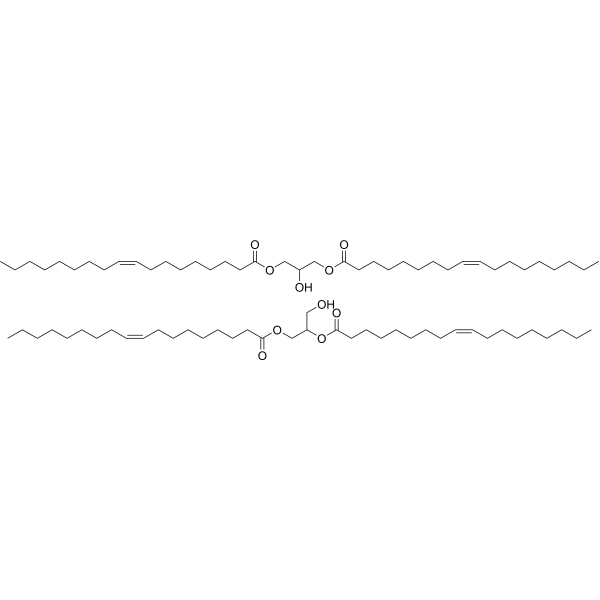
Glycerol dioleate is a lipid capable of forming Lyotropic Liquid Crystal (LLC). When formulated with phosphatidylcholine and exposed to aqueous media, glycerol dioleate constructs an inverted hexagonal (HII) phase structure with sustained-release properties. The in-situ forming gel prepared by optimizing glycerol dioleate with phosphatidylcholine and N-methyl-2-pyrrolidone enables stable release of Risperidone (HY-11018) for up to 60 days in vitro and in vivo. Glycerol dioleate causes minimal side effects in rabbits, making it an ideal carrier component for the development of antischizophrenia agents .Note: Lyotropic liquid crystals (Lyotropic Liquid Crystal, LLC) are ordered fluid phases self-assembled by amphipathic molecules (e.g., lipids, surfactants) in solvents (usually water) at specific concentrations .
loading...
    loading...
Cat. No.: HY-130086
CAS No.: 1314378-11-4
Purity:  99.29%
Target:  

ADC Linkers

Research Areas:  

Cancer

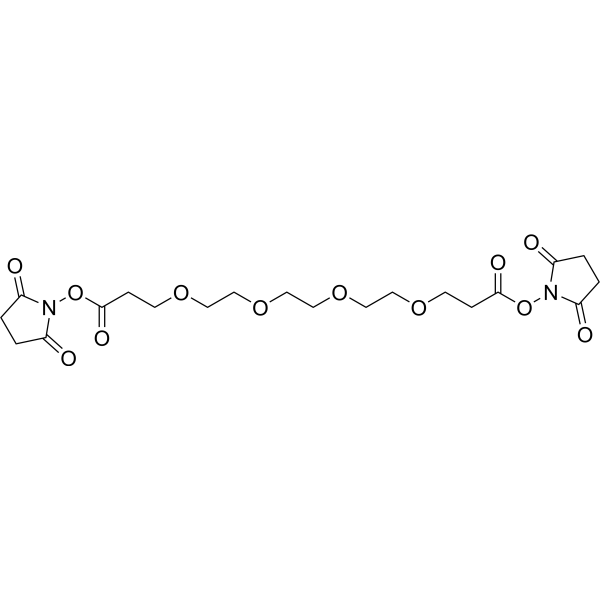
Bis-PEG4-NHS ester is a crosslinking reagent and amine-reactive modulator .Bis-PEG4-NHS ester reacts with primary amine groups on liposome surfaces via amide bond formation to covalently attach dibenzylcyclooctyne groups, with a hydrophilic PEG4 spacer reducing steric hindrance for subsequent click chemistry .Bis-PEG4-NHS ester enables site-specific antibody coupling to liposome surfaces via copper-free strain-promoted alkyne-azide cycloaddition click chemistry without disrupting liposome structure in minimal organic solvent volumes .Bis-PEG4-NHS ester undergoes hydrolysis during annealing to form -COOH groups that interact with PbI and FAI to enhance perovskite structural integrity, passivate defects, and modulate nucleation kinetics to regulate crystal growth .Bis-PEG4-NHS ester enhances device efficiency and long-term stability when used as an antisolvent additive for p-i-n perovskite solar cells .
loading...
    loading...
Cat. No.: HY-157553
CAS No.: 863599-15-9
Purity:  99.79%
Target:  

FAK

Research Areas:  

Cancer

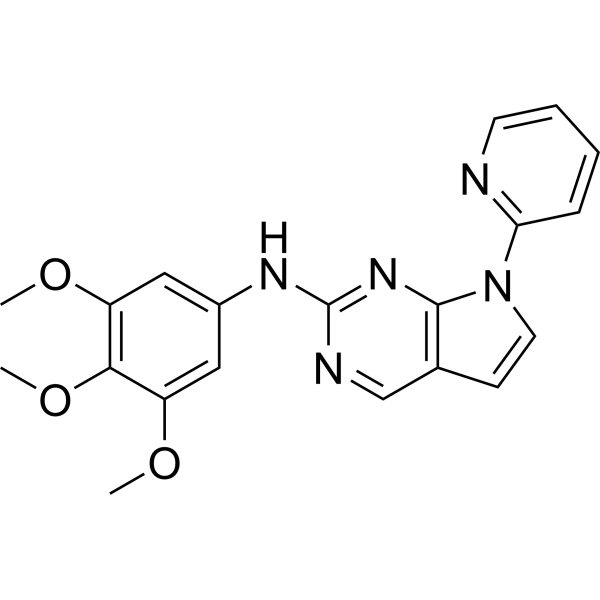
FAK-IN-19 (ligand3) is an inhibitor in a co-crystal structure with FAK. FAK-IN-19 has anticancer effects .
loading...
    loading...
Cat. No.: HY-B0560B
CAS No.: 7727-43-7
Synonyms: Baryta white
Research Areas:  

Others

Barium sulfate (Baryta white) is a poorly soluble inorganic barium salt that can serve as an oral radiocontrast agent. Barium sulfate precipitates in the form of crystals with a porous internal structure. Barium sulfate is a mineral scale compound. Barium sulfate can be used in research on diagnostic imaging .
loading...
    loading...
Cat. No.: HY-157659
CAS No.: 1422389-91-0
Target:  

WDR5

Research Areas:  

Others

WDR5-MLL1 antagonist 1 (compound 47) is a compound optimized through protein crystal structure guidance. It has stronger antagonistic activity against WDR5-MLL interaction with a dissociation constant (Kd) of 0.3μM.
loading...
    loading...
Cat. No.: HY-Y1359
CAS No.: 693-98-1
Synonyms: 2-Methyl-1H-imidazole
Target:  

Drug Intermediate MOFs

Research Areas:  

Others

2-Methylimidazole (2-Methyl-1H-imidazole) is a nitrogen-containing MOF ligand that serves as a laccase-mimicking activity enhancer and a morphology regulator for copper-based metal-organic frameworks. 2-Methylimidazole promotes the formation of natural laccase-like nanoenzyme structures, accelerates electron transfer and enhances catalytic activity. During hydrothermal synthesis, 2-Methylimidazole inhibits the vertical growth of crystals, thus enabling the preparation of two-dimensional nanosheet morphology .
loading...
    loading...
Cat. No.: HY-Y1359S
CAS No.: 1173022-19-9
Synonyms: 2-Methyl-1H-imidazole-d6
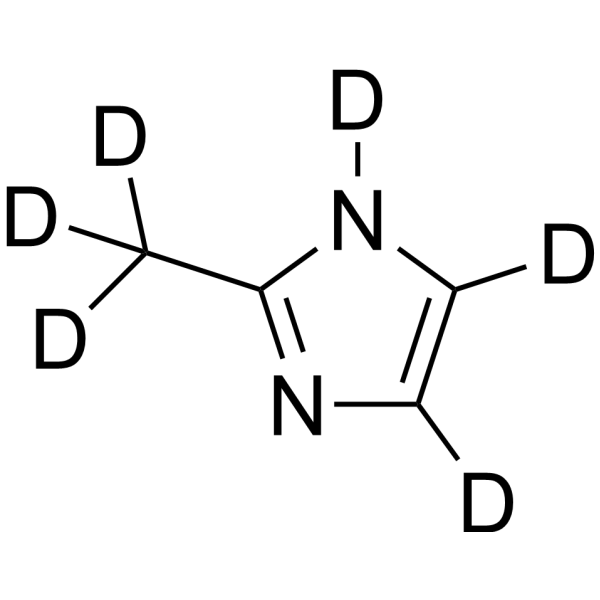
2-Methylimidazole-d6 is the deuterium labeled 2-Methylimidazole. 2-Methylimidazole (2-Methyl-1H-imidazole) is a nitrogen-containing MOF ligand that serves as a laccase-mimicking activity enhancer and a morphology regulator for copper-based metal-organic frameworks. 2-Methylimidazole promotes the formation of natural laccase-like nanoenzyme structures, accelerates electron transfer and enhances catalytic activity. During hydrothermal synthesis, 2-Methylimidazole inhibits the vertical growth of crystals, thus enabling the preparation of two-dimensional nanosheet morphology .
loading...
    loading...
Cat. No.: HY-N3213
CAS No.: 3682-04-0
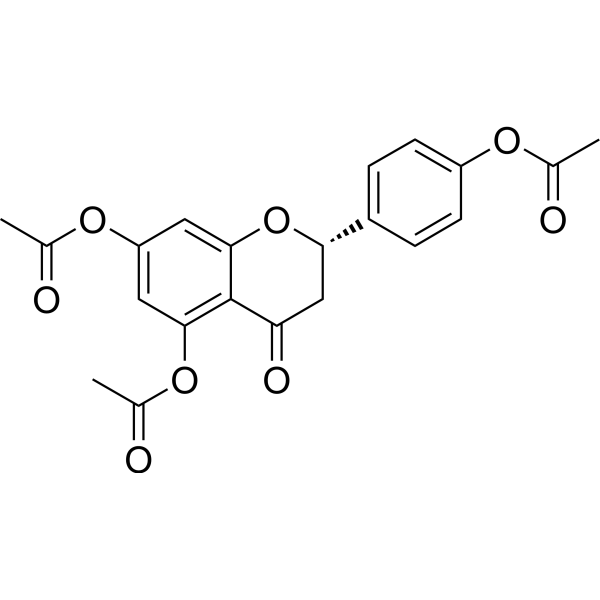
Naringenin triacetate is a flavonoid isolated from plant, exhibits a good binding affinity with multiple crystal structures of first bromodomain BRD4 (BRD4 BD1) .
loading...
    loading...
Cat. No.: HY-121125
CAS No.: 64274-28-8
Aucubigenin, the aglycone of the iridoid glycoside aucubin, has been characterized through X-ray diffraction analysis. Its crystal structure reveals monoclinic symmetry with specific conformations adopted by its cyclopentane and pyran rings. The study also determined the absolute configurations of both aucubin and aucubigenin. Significant O-H O hydrogen bonding interactions were observed in the crystal lattices of both compounds, highlighting their structural stability and potential for intermolecular interactions .
loading...
    loading...
Cat. No.: HY-157294B
CAS No.: 960248-81-1
Synonyms: GSK47866A
Research Areas:  

Others

(Rac)-GSK866 (GSK47866A) is a non-steroidal glucocorticoid receptor (GR) ligand. The crystal structure of (Rac)-GSK866 bound to the GR LBD (3E7C) can be used as a model to study the mechanism of action of ligands of the same class .
loading...
    loading...
Cat. No.: HY-122079
CAS No.: 5335-97-7
Target:  

Ras

Research Areas:  

Cancer

NSC1011 is a potent Ras converting enzyme 1 endoprotease (Rce1) inhibitor with an IC50 value of 6.9 µM for HsRce1 (crystal structure of the human Rce1). NSC1011 induces mislocalizing EGFR-H-Ras, EGFR-N-Ras, and EGFR-K-Ras .
loading...
    loading...
Cat. No.: HY-W010361
CAS No.: 10581-12-1
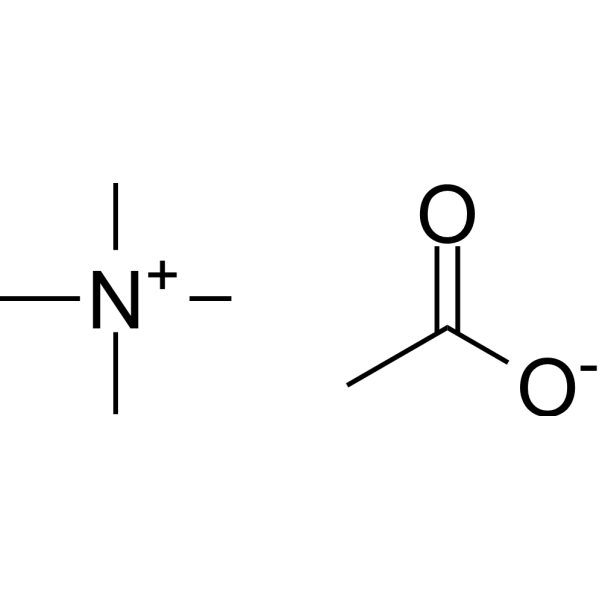
Tetramethylammonium acetate is an organic compound commonly used as a phase transfer catalyst in organic synthesis reactions, especially those involving charged species or polar reagents. It can facilitate the transfer of reactants between two immiscible phases, such as water and organic solvents, by forming stable ion pairs. Additionally, Tetramethylammonium acetate has been used to prepare a variety of organic compounds, including esters, amides, and carboxylic acids. Due to its unique physicochemical properties, it has also been investigated for its potential use in developing new materials such as ionic liquids and liquid crystals. "x" in the formula represents the number of water molecules in the crystal structure, which can vary depending on the preparation method.
loading...
    loading...
Cat. No.: HY-Y1359R
CAS No.: 693-98-1
Synonyms: 2-Methyl-1H-imidazole (Standard)
Research Areas:  

Others

2-Methylimidazole (Standard) is the analytical standard of 2-Methylimidazole. This product is intended for research and analytical applications. 2-Methylimidazole (2-Methyl-1H-imidazole) is a nitrogen-containing MOF ligand that serves as a laccase-mimicking activity enhancer and a morphology regulator for copper-based metal-organic frameworks. 2-Methylimidazole promotes the formation of natural laccase-like nanoenzyme structures, accelerates electron transfer and enhances catalytic activity. During hydrothermal synthesis, 2-Methylimidazole inhibits the vertical growth of crystals, thus enabling the preparation of two-dimensional nanosheet morphology .
loading...
    loading...
Cat. No.: HY-168385
CAS No.: 66908-04-1
Target:  

Drug Derivative

Research Areas:  

Others

1,3-Dimyristoyl-2-oleoylglycerol is a crystal structure of the beta1 polymorphs of mono-unsaturated triacylglycerols .
loading...
    loading...
Cat. No.: HY-125630
CAS No.: 191-48-0
Research Areas:  

Others

Decacyclene is a large polycyclic aromatic hydrocarbon with a triple symmetry. Decacyclene is a three-blade molecular propeller in the solid state, and crystal structure analysis shows that the molecule has a non-planar twisted form, and the crystal is chiral, which may correspond to the enantiomers of the Decacyclene propeller. Decacyclene can be used for research in chemical synthesis and materials science .
loading...
    loading...
Cat. No.: HY-120757
CAS No.: 153314-49-9
Target:  

Virus Protease

Research Areas:  

Others

LP-130 is a statin-based inhibitor that is a universal inhibitor with nanomolar inhibitory activity against all tested retroviral proteases. Crystal structure studies of its binding to different retroviral proteases have shown that it can adapt to different active site regions to achieve inhibition.
loading...
    loading...
Cat. No.: HY-120631A
CAS No.: 841302-51-0
Target:  

Dipeptidyl Peptidase

Research Areas:  

Others

BMS-538305 hydrochloride is a potent and selective inhibitor of dipeptidyl peptidase IV (DPP-IV), exhibiting strong biological activity by forming a reversible covalent complex with the enzyme. BMS-538305 hydrochloride demonstrates its mechanism of action through the covalent attachment between the nitrile carbon of the inhibitor and the enzyme residue S630, as unveiled by the X-ray crystal structure analysis.
loading...
    loading...
Cat. No.: HY-116255
CAS No.: 2059892-29-2
Research Areas:  

Others

MS453 is a potent and highly selective SETD8 inhibitor with an IC50 value of 804 nM. MS453 specifically modifies a cysteine residue close to the inhibitor binding site. MS453 is selective for 28 other methyltransferases. The crystal structure of MS453 reveals its binding mode to SETD8, providing an atomic-level view for the development of high-quality chemical probes for SETD8 .
loading...
    loading...
Cat. No.: HY-189085
CAS No.: 1186659-59-5
Target:  

IGF-1R

Research Areas:  

Cancer

IGF-1R-IN-6 is an IGF-1R inhibitor and a co-crystal ligand in the kinase structure of PDB 3EKK. IGF-1R-IN-6 occupies the kinase binding pocket. IGF-1R-IN-6 can be used in cancer research .
loading...
    loading...
Cat. No.: HY-184616
Nanomaterials with sizes ranging from 1 to 100 nm are generally referred to as nanocrystals. The preparation of platinum nanocrystals with controllable morphology was first reported in 1996. Pt, Ag, Au, Rh, and other nanocrystals have been synthesized using various methods. Platinum has a face-centered cubic (fcc) structure, but unlike Ag, Au, and Pd, it rarely forms twins; most platinum nanocrystals are single-crystal structures. XFJ116 platinum nanoparticles were prepared via a chemical reduction method, exhibiting uniform size and good dispersibility, and can also provide platinum nanoparticles with amino and carboxyl terminator modifications.
loading...
    loading...

