
1. Search Result
Search Result
Results for "

dual functional

" in MedChemExpress (MCE) Product Catalog:

29

Inhibitors & Agonists

1

Screening Libraries

2

Biochemical Assay Reagents

1

Natural
Products

1

Click Chemistry

1

Oligonucleotides

Targets Recommended:
Cat. No. Product Name Target Research Areas Chemical Structure
  • HY-135140

    Biochemical Assay Reagents Others
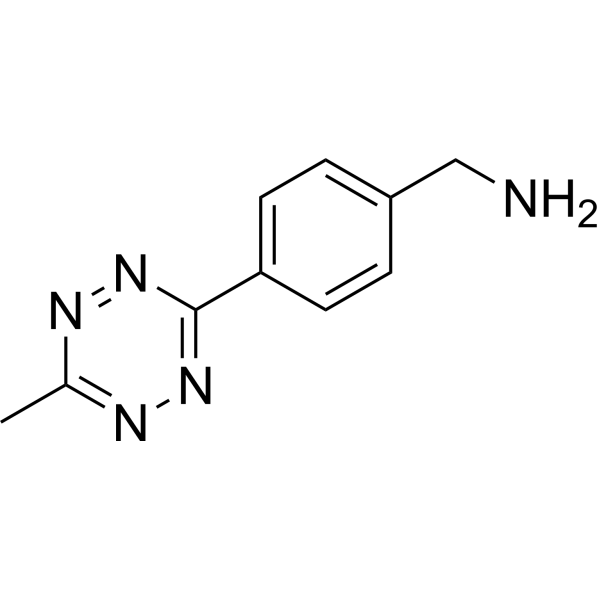
    Methyltetrazine-amine, a tetrazine compound, is used for the site-specific dual functionalization of the resulting bioconjugates .
    Methyltetrazine-amine
  • HY-153229
    Firefly luciferase mRNA-LNP
    1 Publications Verification

    mRNA Biochemical Assay Reagents Others
    Firefly luciferase mRNA-LNP is a lipid nanoparticle (LNP) containing firefly luciferase mRNA. Firefly luciferase mRNA-LNP exhibits a stable nanostructure, in which LNP plays a key role in effectively protecting and transporting mRNA to cells. Luciferase is a bioluminescent reporter gene for gene regulation and functional studies. Firefly Luciferase mRNA-LNP expresses firefly luciferase protein after entering the cells, which is often used for promoter activity detection or dual fluorescent molecular complementation experiments. Firefly luciferase mRNA-LNP is studied in research for RNA delivery, cell viability, and translation efficiency .
    Firefly luciferase mRNA-LNP
  • HY-A0191

    (+)-Brompheniramine; (S)-Brompheniramine

    Endogenous Metabolite Histamine Receptor TRP Channel Neurological Disease Metabolic Disease Inflammation/Immunology
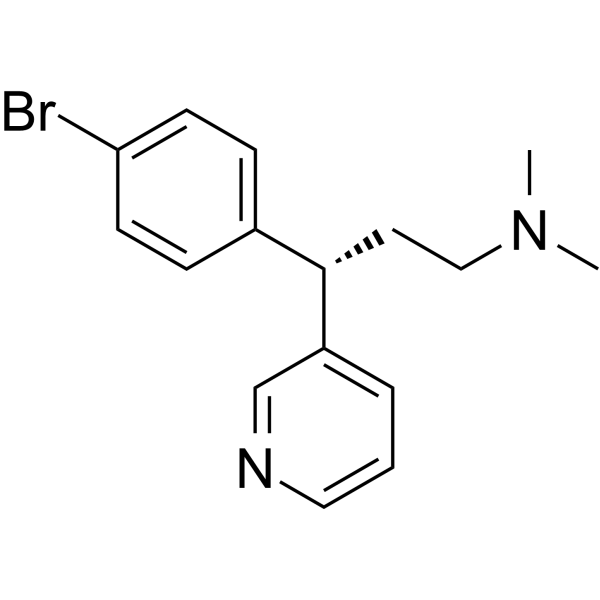
    Dexbrompheniramine ((+)-Brompheniramine; (S)-Brompheniramine) is a dual inhibitor of histamine H1 receptor and TRPV1 receptor that can cross the blood-brain barrier. Dexbrompheniramine exerts its effects by functionally blocking H1 receptor activity and dose-dependently inhibiting TRPV1-mediated calcium responses, including Capsaicin (HY-10448)-induced responses. The combination of Dexbrompheniramine with Cimetidine (HY-14289) eliminates histamine-induced and sham-feeding-induced drinking behavior, whereas Dexbrompheniramine alone does not induce thirst or alter sham-feeding behavior in rats. Dexbrompheniramine can be used in the research of chronic cough and related pathological mechanisms .
    Dexbrompheniramine
  • HY-135140A

    Biochemical Assay Reagents Others
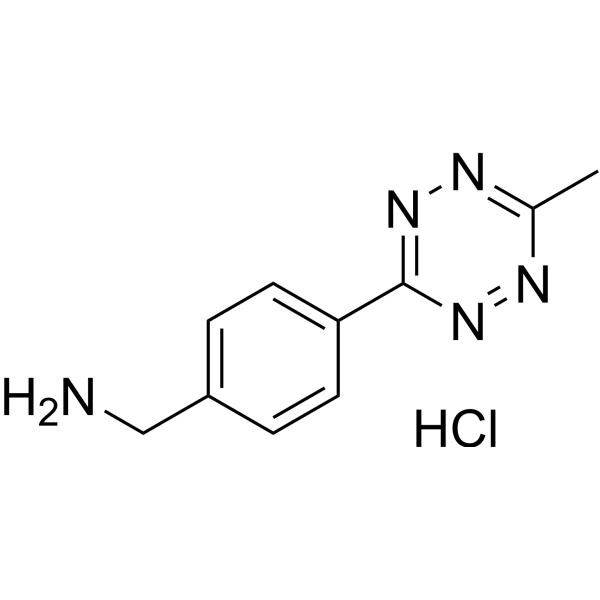
    Methyltetrazine-Amine hydrochloride is a tetrazine compound. Methyltetrazine-Amine hydrochloride can be used for the site-specific dual functionalization of the resulting bioconjugates. Methyltetrazine-Amine hydrochloride can be added during protein precipitation in experiments using trans-cyclooctene .
    Methyltetrazine-amine hydrochloride
  • HY-178040

    Acetyl-CoA Carboxylase Pyruvate Carboxylase (PC) Parasite Insecticide Infection
    Insecticidal agent 26 (Compound A11), a spiro insecticidal agent, is a dual-functional inhibitor of pest Acetyl-CoA carboxylase (ACC) and Pyruvate carboxylase (PC). Insecticidal agent 26 has potent insecticidal activity against Sogatella furcifera with a LC50 of 11.0  μg/mL, with significant biosafety to bees. Insecticidal agent 26 can be used for management of white-backed planthoppers (WBPs) .
    Insecticidal agent 26
  • HY-178026

    HPPD Protoporphyrinogen IX oxidase Others
    HPPD/PPO-IN-1 (Compound B14) is dual-functional inhibitor of HPPD and PPO with IC50s of 0.12  μM and 0.51 μM for Arabidopsis thaliana HPPD and Nicotiana tabacum PPO, respectively. HPPD/PPO-IN-1 has broad-spectrum herbicidal activity against weeds with a crop safety to peanuts and cotton. HPPD/PPO-IN-1 can be used for the development of environmentally friendly herbicides .
    HPPD/PPO-IN-1
  • HY-178716

    Phosphatase IFNAR STAT JAK Cancer
    PTPN2/1-IN-4 (Compound WS35) is an orally active, dual-functional inhibitor of PTPN1 and PTPN2 with IC50s of 12.8 and 5.8 nM for PTPN1 and PTPN2, respectively. PTPN2/1-IN-4 modulates the IFNγ-JAK-STAT signaling pathway and significantly augments CD8+ T-cell tumor infiltration. PTPN2/1-IN-4 has potent anticancer activity, robustly inhibiting tumor growth both as a monotherapy and in combination with an anti-PD-1 antibody in B16-OVA syngeneic mouse models .
    PTPN2/1-IN-4
  • HY-122462

    PNU-159548

    DNA/RNA Synthesis Cancer
    Ladirubicin (PNU-159548) is a derivative of Daunorubicin (HY-13062A). Ladirubicin exhibits DNA intercalation and DNA alkylating properties, inhibits DNA replication and transcription, causes DNA damage, and thereby exhibits antitumor efficacy. Ladirubicin exhibits the potential to penetrate the blood-brain barrier (BBB) for its high lipophilicity. Ladirubicin exhibits toxicity through suppression of bone marrow activity .
    Ladirubicin
  • HY-179562

    Btk Cancer
    BTK degrader-2 (Example 2) is a BTK dual-functional degrading agent, which causes the degradation of BTK through the ubiquitin-proteasome pathway. BTK degrader-2 can be used for the study of B-cell-related diseases .
    BTK degrader-2
  • HY-175607

    Cholinesterase (ChE) nAChR Infection Neurological Disease
    AChE/nAChR-IN-1 (Compound 1a) is dual-functional inhibitor of AChE and nAChR. AChE/nAChR-IN-1 has potent toxicity and larvicidal effectiveness against Culex pipiens larvae with a LC50 of 4 ng/mL. AChE/nAChR-IN-1 can be used as larvicides for mosquito-borne diseases research .
    AChE/nAChR-IN-1
  • HY-178017

    Cholinesterase (ChE) Carbonic Anhydrase Neurological Disease
    BChE/hCA II-IN-1 (Compound 20) is a dual-functional inhibitor of Butyrylcholinesterase (BChE) and human carbonic anhydrase II (hCA II) with IC50s of 76.50 and 10.69  μM for BChE and hCA II, respectively. BChE/hCA II-IN-1 can be used for neurodegenerative diseases like Alzheimer's and glaucoma research .
    BChE/hCA II-IN-1
  • HY-175605

    Glycosidase Amylases Metabolic Disease
    α-Amylase/α-Glucosidase-IN-21 (Compound 4) is a dual-functional inhibitor of α-Glucosidase and α-Amylase with IC50s of 0.27 and  0.19 µg/mL for α-Glucosidase and α-Amylase, respectively. α-Amylase/α-Glucosidase-IN-21 has an antidiabetic activity.α-Amylase/α-Glucosidase-IN-21 can be used for diabetes mellitus research .
    α-Amylase/α-Glucosidase-IN-21
  • HY-175875

    Molecular Glues Zinc Finger Protein Drug Derivative Cardiovascular Disease Cancer
    HRZ-01-082-5 is an analog of Glutarimide (HY-I0466). HRZ-01-082-5 is a dual-functional molecular glue degrader of SALL4 and OSR1 with a DC50 4.8  nM for OSR1. HRZ-01-082-5 significantly induced SALL4 and OSR1 degradation through CRBN. HRZ-01-082-5 can be used for heart and urogenital development, as well as cancers research .
    HRZ-01-082-5
  • HY-A0191A

    (+)-Brompheniramine maleate; (S)-Brompheniramine maleate

    TRP Channel Histamine Receptor Inflammation/Immunology
    Dexbrompheniramine ((+)-Brompheniramine; (S)-Brompheniramine) maleate is a dual inhibitor of histamine H1 receptor and TRPV1 receptor that can cross the blood-brain barrier. Dexbrompheniramine maleate exerts its effects by functionally blocking H1 receptor activity and dose-dependently inhibiting TRPV1-mediated calcium responses, including Capsaicin (HY-10448)-induced responses. The combination of Dexbrompheniramine maleate with Cimetidine (HY-14289) eliminates histamine-induced and sham-feeding-induced drinking behavior, whereas Dexbrompheniramine maleate alone does not induce thirst or alter sham-feeding behavior in rats. Dexbrompheniramine maleate can be used in the research of chronic cough and related pathological mechanisms .
    Dexbrompheniramine maleate
  • HY-179560

    Polo-like Kinase (PLK) MDM-2/p53 Cancer
    PMV6-PEG4-BI2536 is a p53-Y220C-PLK1 dual-functional compound, composed of a high-affinity p53-Y220C mutant binder (Kd ≈ 2.5 nM) and a potent PLK1 kinase inhibitor (IC50 = 0.83 nM). PMV6-PEG4-BI2536 triggers TP53 Y220C cell G2/M arrest and apoptosis through PLK1 mislocalization and kinase inhibition, independent of p53 transcriptional reactivation. PMV6-PEG4-BI2536 can be used for the study of TP53 mutant cancers .
    PMV6-PEG4-BI2536
  • HY-120785A

    ROR Inflammation/Immunology
    SR1555 hydrochloride is the hydrochloride salt form of SR1555 (HY-120785). SR1555 hydrochloride is an inverse agonist for retinoic acid receptor-related orphan nuclear receptor γ (RORγ) with an IC50 of 1 μM. SR1555 hydrochloride inhibits the development and function of pro-inflammatory TH17 cell, increases the frequency of anti-inflammatory T regulatory (Treg) cells. SR1555 hydrochloride can be used for research about autoimmune diseases .
    SR1555 hydrochloride
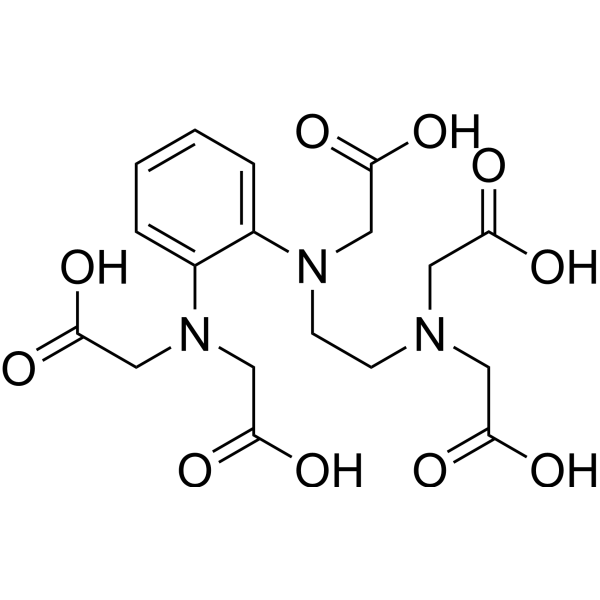
  • HY-W127819

    Biochemical Assay Reagents Others
    Phenyleneethylenetriamine Pentaacetic Acid is a precursor of a dual functional chelating agent .
    Phenyleneethylenetriamine pentaacetic acid
  • HY-175219

    Carbonic Anhydrase Cancer
    CA-II/Dkk1-IN-1 (Compound 5d) is a dual-functional inhibitor of CA-II and Dkk1 with a IC50 of 6.90  nM for CA-II. CA-II/Dkk1-IN-1 has significantly antioxidant activity and superior DNA binding capacity. CA-II/Dkk1-IN-1 can be used for cancers research, such as esophageal, renal, and lung cancer .
    CA-II/Dkk1-IN-1
  • HY-175635

    EGFR VEGFR Cancer
    EGFR/VEGFR2-IN-6 (Compound 3k) is a dual-functional inhibitor of EGFR and VEGFR2 with IC50s of 10.53 and 3.37 μM for EGFR and VEGFR2, respectively. EGFR/VEGFR2-IN-6 has significant anti-proliferation activity against breast cancer cells, and induces G0/G1 cell cycle arrest and cell apoptosis, especially early apoptosis. EGFR/VEGFR2-IN-6 can be used for cancers research .
    EGFR/VEGFR2-IN-6
  • HY-175805

    EGFR HDAC Apoptosis Cancer
    EGFR/HDAC-IN-2 (Compound 38) is dual-functional inhibitor of EGFR and HDAC3 with IC50s of 20.34 and 1.09 nM for CDK9 and HDAC3, respectively. EGFR/HDAC-IN-2 has superior anti-proliferative activity against cancer cells, inhibits cell migration and induces late-stage cell apoptosis. EGFR/HDAC-IN-2 significantly inhibits triple-negative breast cancer (TNBC) tumor growth in xenograft mouse models. EGFR/HDAC-IN-2 can be used for cancers like TNBC research .
    EGFR/HDAC-IN-2
  • HY-172891

    CDK HDAC Apoptosis Cancer
    CDK9/HDAC1/HDAC3-IN-1 is dual-functional inhibitor of CDK9 and HDAC. CDK9/HDAC1/HDAC3-IN-1 inhibits the protein activity of CDK9/HDAC/HDAC3 with IC50 s of 0.17  μM, 1.73  μM and 1.11 μM for CDK9, HDAC1, and HDAC3, respectively. CDK9/HDAC1/HDAC3-IN-1 inhibits cancer cells by inducing cell apoptosis and cell cycle arrest in the G2/M phase, as well as tumor growth in a murine TNBC MDA-MB-231 xenograft model. CDK9/HDAC1/HDAC3-IN-1 has a broad-spectrum anti-cancer activity, such as breast cancer, cervical cancer, and liver cancer .
    CDK9/HDAC1/HDAC3-IN-1
  • HY-117947

    Histone Methyltransferase Cancer
    (R)-OR-S1 is an isomer of OR-S1. The dual ZH1/2 inhibitors OR-S1 and OR-S2 exhibit strong inhibitory activity against both EZH1 and EZH2. OR-S1 and OR-S2 are highly selective methyltransferase inhibitors against EZH1 and EZH2, and they have very similar molecular features. Therefore, we investigated the effect of OR-S1 on acute myeloid leukemia (AML). We found that OR-S1 was able to induce cell differentiation and apoptosis in AML cells. These findings encouraged us to investigate whether functional LT-HSCs could survive PRC2-targeted therapy with OR-S1 or OR-S1 combined with cytarabine. The results showed that OR-S1 did not cause significant myelosuppression, and BM cells treated with the combination therapy were able to undergo normal hematopoiesis even 4 months after treatment. Therefore, temporary inhibition of EZH1 and EZH2 is clinically tolerable, making this combination therapy suitable for AML patients. AML is generally believed to originate from myeloid progenitor cells that inherit a large number of biological properties.
    (R)-OR-S1
  • HY-180370

    NitroSynapsin; YQW-036; NMI-6979

    iGluR Drug Derivative Cardiovascular Disease Neurological Disease
    Nitromemantine (NitroSynapsin) is a nitrate derivative of Memantine (HY-B0591) and is a dual-functional NMDAR antagonist. Nitromemantine exhibits significant efficacy in rodent models of cerebral infarction through a dual mechanism of blocking channels and regulating receptors via NO/redox regulation. Nitromemantine can target ischemic neurons under hypoxic conditions and enhance its activity. Nitromemantine inhibits the current induced by NMDA, with its IC50 being 2.4 μM. Nitromemantine can be used for the study of cerebral ischemic stroke .
    Nitromemantine
  • HY-179657

    PROTACs MALT1 Histone Acetyltransferase Neurological Disease
    PROTAC MLT Degrader 1 (M-PRORAC) is an asymmetric dual-functional degrader based on MLT PROTAC. PROTAC MLT Degrader 1 significantly reduces the protein level of p300 in the cell. PROTAC MLT Degrader 1 can be used in Alzheimer's disease research (pink: MLT ligand (HY-B0075); blue: CRBN ligand (HY-41547); black: linker (HY-140208)) .
    PROTAC MLT Degrader 1
  • HY-181839

    Discoidin Domain Receptor Inflammation/Immunology
    DDR1/2 IN-4 (Compound 37) is a selective dual DDR1 and DDR2 kinase inhibitor, with a pKi of 8.6 for DDR1 and a pKi of 8.2 for DDR2. DDR1/2 IN-4 functionally inhibits the kinase activities of DDR1 and DDR2. DDR1/2 IN-4 inhibits the release of MCP-1. DDR1/2 IN-4 can be used in studies related to idiopathic pulmonary fibrosis .
    DDR1/2 IN-4
  • HY-175987

    Bacterial Infection
    Antimycobacterial agent-12 (Compound Ec42), a derivative of Platensimycin (HY-127146), is a dual-functional inhibitor KasA and KasB. Antimycobacterial agent-12 has antibacterial activity with a MICs of 2, 2 and 4 μg/mL against Staphylococcus aureus ATCC 29213, Mycobacterium smegmatis and its Isoniazid (HY-B0329)-resistant strain, respectively. Antimycobacterial agent-12 has a superior antimycobacterial activity in M. smegmatis-infected mouse models. Antimycobacterial agent-12 can be used for tuberculosis research .
    Antimycobacterial agent-12
  • HY-181759

    Ligands for Target Protein for PROTAC Epigenetic Reader Domain Histone Acetyltransferase Cancer
    CBP/p300/BRD4 ligand-1 is a small-molecule inhibitor targeting CBP, p300, and BRD4. CBP/p300/BRD4 ligand-1 competitively binds to the functional domains of target proteins without disrupting key interactions. CBP/p300/BRD4 ligand-1 can be used for the construction of dual-target PROTAC degraders (HY-181758) in studies related to prostate cancer and other cancers .
    CBP/p300/BRD4 ligand-1
  • HY-181710

    mTOR PI3K Cancer
    LASSBio-2337 is a dual pan-PI3K/mTOR inhibitor with an mTOR IC50 of 5.8 μM.LASSBio-2337 functionally modulates mTOR and all PI3K isoforms.LASSBio-2337 acts as a cytotoxic agent in leukemia cells, including multidrug-resistant populations.LASSBio-2337 spares nontumor human peripheral blood mononuclear cells.LASSBio-2337 displays moderate PAMPA-GIT permeability.LASSBio-2337 shows low metabolic stability in rat liver microsomes.LASSBio-2337 is aqueous insoluble.LASSBio-2337 can be used for the research of acute lymphoblastic leukemia, chronic myelogenous leukemia, breast cancer .
    LASSBio-2337
  • HY-181774

    Phosphodiesterase (PDE) Endocrinology
    PDE4/5-IN-1 is a selective phosphodiesterase 4/5 (PDE4/5) dual inhibitor. PDE4/5-IN-1 functionally inhibits PDE5, PDE4B2, and PDE4D2 activity. PDE4/5-IN-1 relaxes isolated rat prostate tissue, enhances nitric oxide-induced relaxation in isolated rat prostate tissue, and reduces alpha-1 adrenoceptor-mediated contractile responses in isolated rat prostate tissue. PDE4/5-IN-1 inhibits proliferation of human hyperplastic prostate cells. PDE4/5-IN-1 can be used for the research of benign prostatic hyperplasia .
    PDE4/5-IN-1

Inquiry Online

Your information is safe with us. * Required Fields.

Salutation


Country or Region *

Applicant Name *


Organization Name *

Department *


Email Address *


Product Name *

Cat. No.


Requested quantity *

Phone Number *


Remarks

Inquiry Online

Inquiry Information

Product Name:
Cat. No.:
Quantity:
MCE Japan Authorized Agent:

