1. Search Result
Search Result
Results for "

fungal cell membrane permeability

" in MedChemExpress (MCE) Product Catalog:

11

Inhibitors & Agonists

3

Fluorescent Dyes

1

Biochemical Assay Reagents

2

Peptides

1

Natural
Products

Cat. No. Product Name Target Research Areas Chemical Structure
  • HY-111391
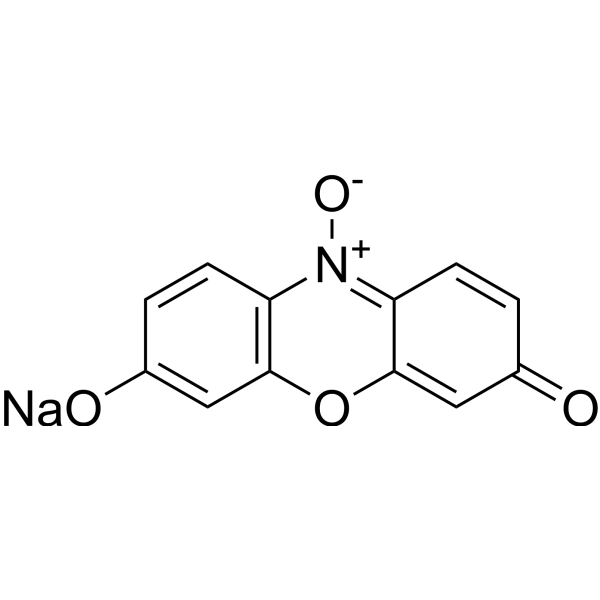
    Resazurin sodium
    5 Publications Verification

    Diazoresorcinol sodium

    Bacterial Fluorescent Dye Infection
    Resazurin sodium (Diazoresorcinol sodium) is a non-toxic, stable, membrane-permeable blue non-fluorescent dye (faintly fluorescent). Resazurin sodium is used as a redox indicator, can be reduced to pink, highly fluorescent Resorufin (Ex=530-560 nm, Em=590 nm) in living cells. Resazurin sodium can be used for the detection of cell viability, toxicity, proliferation, migration and invasion in cells (human, plant and animal, bacterial and fungal) .
    Resazurin sodium
  • HY-111391A

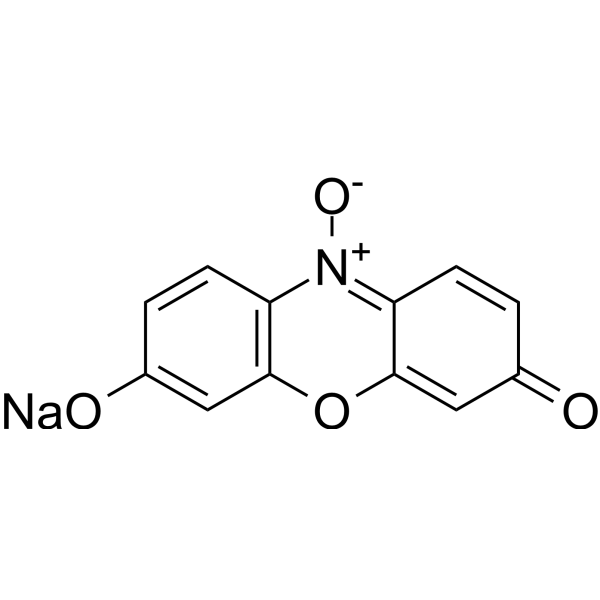
    Diazoresorcinol sodium, indicator

    Bacterial Fluorescent Dye Others
    Resazurin (Diazoresorcinol) sodium, indicator is a non-toxic, stable, membrane-permeable blue non-fluorescent dye (faintly fluorescent). Resazurin sodium, indicator is used as a redox indicator, can be reduced to pink, highly fluorescent Resorufin (Ex=530-560 nm, Em=590 nm) in living cells. Resazurin sodium, indicator can be used for the detection of cell viability, toxicity, proliferation, migration and invasion in cells (human, plant and animal, bacterial and fungal) .
    Resazurin sodium, indicator
  • HY-118540

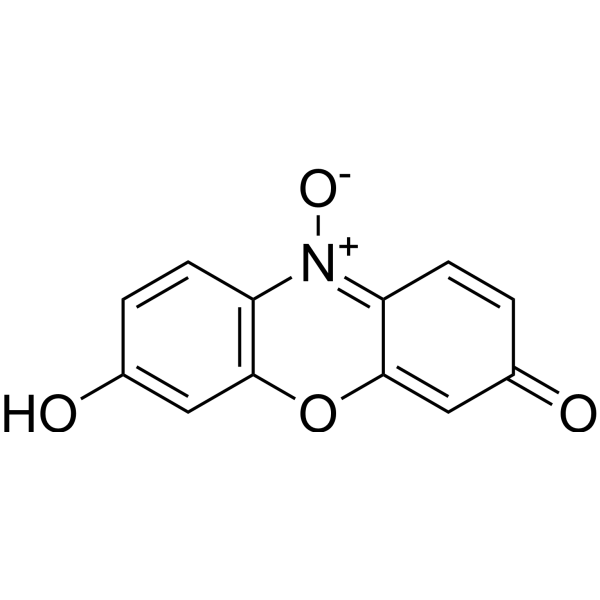
    Diazoresorcinol

    Fluorescent Dye Bacterial Infection
    Resazurin (Diazoresorcinol) is a water-soluble, non-toxic, stable, membrane-permeable blue non-fluorescent dye (faintly fluorescent). Resazurin is used as a redox indicator, can be reduced to pink, highly fluorescent Resorufin (Ex=530-560 nm, Em=590 nm) in living cells. Resazurin can be used for the detection of cell viability, toxicity, proliferation, migration and invasion in cells (human, plant and animal, bacterial and fungal) .
    Resazurin
  • HY-DY1051

    Bacterial Fluorescent Dye Infection
    Resazurin sodium (Diazoresorcinol sodium) (solution) is a non-toxic, stable, membrane-permeable blue non-fluorescent dye (faintly fluorescent). Resazurin sodium is used as a redox indicator, can be reduced to pink, highly fluorescent Resorufin (Ex=530-560 nm, Em=590 nm) in living cells. Resazurin sodium can be used for the detection of cell viability, toxicity, proliferation, migration and invasion in cells (human, plant and animal, bacterial and fungal) .
    Solvent and Concentration: Sterile water: 10 mM
    Resazurin sodium (solution)
  • HY-159666

    Antibiotic Fungal Infection
    Nystatin A1 is a polyene macrolide antifungal antibiotic that can be isolated from Streptomyces noursei. Nystatin A1 binds to ergosterol on the fungal cell membrane, increasing the permeability of the cell membrane and causing leakage of cell contents, thereby inhibiting the growth and reproduction of fungi .
    Nystatin A1
  • HY-P11021

    Fungal Antibiotic Infection
    ToAP2 is a potent antimicrobial peptide. ToAP2 affects C. albicans membrane permeability and produces changes in fungal cell morphology .
    ToAP2
  • HY-P11021A

    Fungal Antibiotic Infection
    ToAP2 TFA is a potent antimicrobial peptide. ToAP2 TFA affects C. albicans membrane permeability and produces changes in fungal cell morphology .
    ToAP2 TFA
  • HY-172804

    Succinate Dehydrogenase Fungal Apoptosis Infection
    SDH-IN-26 (Compound C3) is a succinate dehydrogenase (SDH) inhibitor. SDH-IN-26 exhibits significant inhibitory activity against multiple phytopathogenic fungi, such as Rhizoctonia solani and Botrytis cinerea, with an EC50 value of 0.270 μg/mL against Rhizoctonia solani. SDH-IN-26 damages the integrity of the fungal cell membrane, increases membrane permeability, disrupts cell structure, and reduces the number of mitochondria, thus affecting the normal growth of mycelia. SDH-IN-26 leads to a decrease in mitochondrial membrane potential, and induces cell apoptosis. SDH-IN-26 is promising for research of plant diseases caused by fungi .
    SDH-IN-26
  • HY-N17503

    Fungal Infection
    Medicagenic acid 3-O-glucoside is a monosaccharide-chain triterpenoid saponin antifungal agent that can be isolated from the roots of Medicago sativa. Against Pyricularia oryzae, Medicagenic acid 3-O-glucoside has a MIC of 0.03 mg/mL and a MFC of 0.125 mg/mL. Medicagenic acid 3-O-glucoside alters the permeability of fungal cell membranes, causing cell rupture and inhibiting fungal growth. Medicagenic acid 3-O-glucoside can be used in studies related to rice blast .
    Medicagenic acid 3-O-glucoside
  • HY-W715389

    Fungal Infection
    Coumoxystrobin is a methoxyacrylate strobilurin fungicide with anti-fungal activity. Coumoxystrobin exhibits inhibitory activity against mycelial growth of Magnaporthe oryzae, increases cell membrane permeability, and reduces respiration. Coumoxystrobin shows protective activity against Magnaporthe oryzae in detached barley leaves. Coumoxystrobin reduces ATP activity of Chlorella vulgaris, thereby causing algal death. Coumoxystrobin can be used in studies related to rice blast disease .
    Coumoxystrobin
  • HY-W715812

    Fungal Apoptosis Caspase Reactive Oxygen Species (ROS) MDM-2/p53 SOD Bcl-2 Family PERK JNK p38 MAPK Cardiovascular Disease Infection Endocrinology Cancer
    Bromuconazole is a triazole fungicide with oral efficacy and blood-brain barrier permeability . Bromuconazole protects crops from various fungal contaminations. Bromuconazole exhibits cytotoxicity against a variety of cancer cells, induces G0/G1 cell cycle arrest and inhibits DNA synthesis in cancer cells, and triggers cytoskeletal structural disorder, genotoxic damage, apoptotic (apoptosis) cell death, and mitochondrial membrane depolarization. Bromuconazole activates caspase-3, induces excessive production of ROS, p53 and Bax, lipid peroxidation, increased activities of SOD and CAT, and downregulates Bcl-2. By upregulating p-ERK1/2 and p-JNK, Bromuconazole disrupts the MAPK signaling pathway, impairs the cellular stress response of human trophoblast cells and endometrial cells, and damages the implantation process . Bromuconazole is applicable to research related to glioma, colon cancer, reproductive injury (implantation dysfunction), and cardiac dysfunction .
    Bromuconazole

Inquiry Online

Your information is safe with us. * Required Fields.

Salutation


Country or Region *

Applicant Name *


Organization Name *

Department *


Email Address *


Product Name *

Cat. No.


Requested quantity *

Phone Number *


Remarks

Inquiry Online

Inquiry Information

Product Name:
Cat. No.:
Quantity:
MCE Japan Authorized Agent:

