22 Results for "

plasma exposure

" in MedChemExpress (MCE) Product Catalog:
Products (22)

22 Results for "plasma exposure" in MCE Product Catalog:

7
7 Cited Publications
Cat. No.: HY-D1063
CAS No.: 207399-07-3
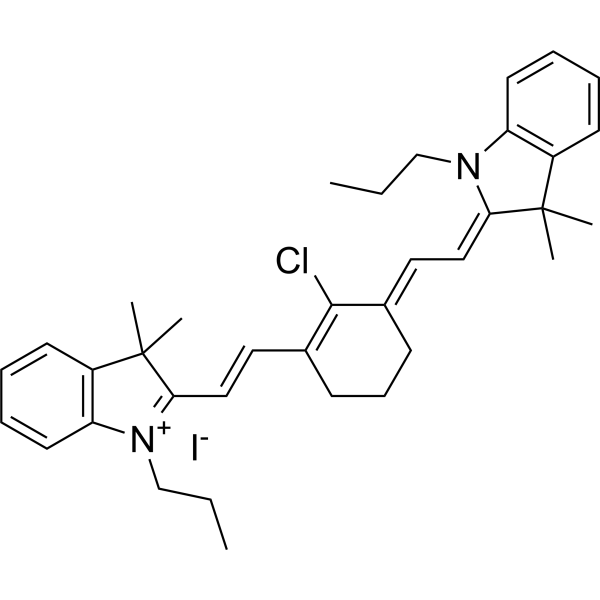
IR-780 is a near-infrared fluorescent probe for in vivo imaging of tumor cells. IR-780 is transported into tumor cells via OATPs and ABCB10, with uptake dependent on glycolytic activity and plasma membrane potential. IR-780 preferentially accumulates in tumor cell mitochondria, including those of drug-resistant cancer cells, without chemical conjugation. IR-780 generates reactive oxygen species (ROS), induces hyperthermia and apoptosis, inhibits tumor growth and recurrence, and modulates HSP70 expression upon ultrasound or 808 nm laser exposure. IR-780 acts as a sonosensitizer, photodynamic and photothermal agent, and drug delivery carrier, with low acute imaging-dose toxicity and rapid vital organ clearance. IR-780 can be used for the research of cancer, such as breast cancer, lung cancer, and non-small cell lung cancer (NSCLC) .
loading...
    loading...
Cat. No.: HY-136924
CAS No.: 259270-28-5
Purity:  99.84%
Target:  

FAAH

Research Areas:  

Others

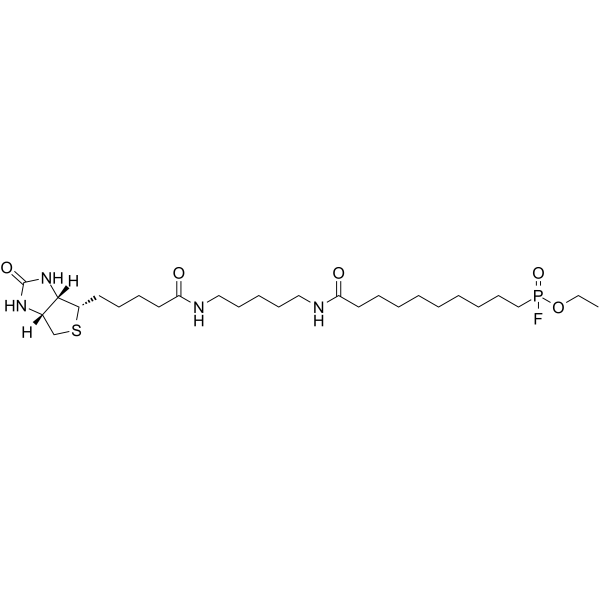
FP-biotin is a potent organophosphorus toxicant, well-suited for searching for new biomarkers of organophosphorus toxicants exposure. FP-Biotin quantifies FAAH, ABHD6, and MAG-lipase activity. FP-biotin is used for studies with plasma because biotinylated peptides are readily purified by binding to immobilized avidin beads .
loading...
    loading...
Cat. No.: HY-B0815S
CAS No.: 285138-81-0
Target:  

Cholinesterase (ChE)

Research Areas:  

Neurological Disease

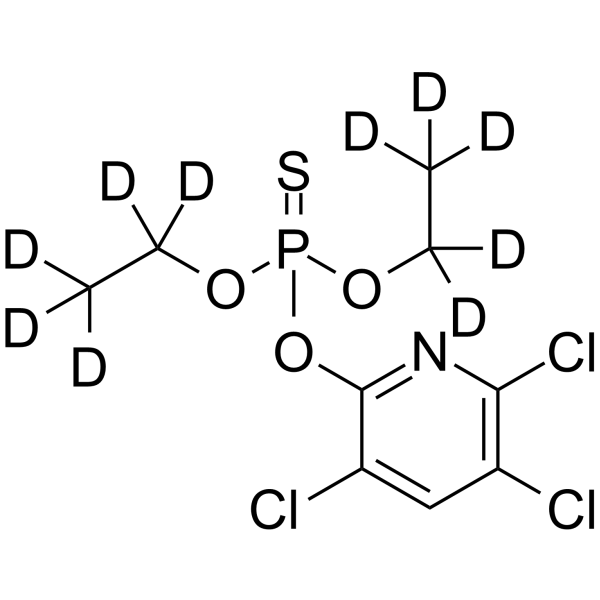
Chlorpyrifos-d10 is the deuterium labeled Chlorpyrifos. Chlorpyrifos is an organophosphate insecticide that is classified as a phosphorothionate. The oxon metabolite of Chlorpyrifos is an inhibitor of acetylcholinesterase (AChE), affecting neurological function in insects, humans, and other animals. The Chlorpyrifos oxon (CPO) metabolite is hydrolyzed by the plasma enzyme paraoxonase 1 (PON1), and susceptibility to neurotoxicity associated with CPO exposure is mitigated by PON1 overexpression.
loading...
    loading...
Cat. No.: HY-149917
Target:  

PROTACs Itk

Research Areas:  

Cancer

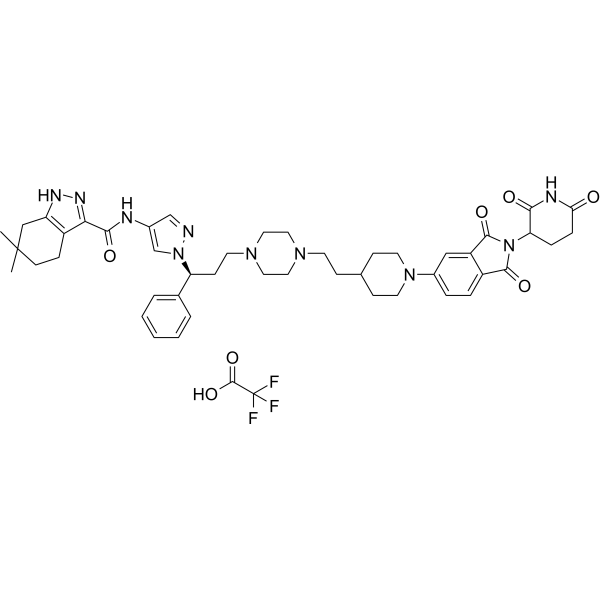
PROTAC ITK degrader 1 is a highly selective degrader of interleukin-2-inducible T-cell kinase (ITK; DC50=3.6 nM in vivo in mice), with good plasma exposure levels. PROTAC ITK degrader 1 induces rapid, and prolonged ITK degradation and suppresses IL-2 secretion (EC50=35.2 nM, Jurkat cells) stimulated by anti-CD3 antibodyin vivo .
loading...
    loading...
Cat. No.: HY-162459
CAS No.: 3036368-70-1
Research Areas:  

Inflammation/Immunology

cGAS-IN-3 (compound 30d-S) is an orally active cyclic GMP-AMP synthase (Cyclic GMP-AMP Synthase/cGAS) inhibitor with good plasma exposure and low clearance. cGAS-IN-3 has anti-inflammatory activity and can significantly reduce lung inflammation in rats .
loading...
    loading...
Cat. No.: HY-155672
CAS No.: 5972-45-2
Purity:  99.5%
Target:  

5-HT Receptor

Research Areas:  

Neurological Disease

JPC0323 is a dual 5-HT2C/5-HT2A receptor positive allosteric modulator. JPC0323 has on-target properties, acceptable plasma exposure and brain penetration. JPC0323 can be used for the research of neurological disease .
loading...
    loading...
Cat. No.: HY-175863
2-PMPA prodrug 1 is an orally active prodrug of 2-PMPA (HY-100788), a glutamate carboxypeptidase II (GCPII) inhibitor. 2-PMPA prodrug 1 effectively delivers 2-PMPA into the bloodstream and produces sustained 2-PMPA exposure in plasma. 2-PMPA prodrug 1 can be used in the research of GCPII-related peripheral diseases, including prostate cancer and inflammatory bowel disease .
loading...
    loading...
Cat. No.: HY-157455
CAS No.: 2902679-53-0
Target:  

Androgen Receptor

Research Areas:  

Cancer

AR antagonist 5 (compound 30a) is a selective androgen receptor (AR) antagonist with an IC50 value of 134.8 nM. AR antagonist 5 has favorable pharmacokinetic properties and shows a high skin exposure and low plasma exposure [1.
loading...
    loading...
Cat. No.: HY-170945
CAS No.: 143899-90-5
Research Areas:  

Neurological Disease

Antidepressant agent 9 (Compound 24) is an orally active and BBB-penetrable NMDAR and SERT inhibitor with IC50 values of 3.50 μM and 1044 nM, respectively. Antidepressant agent 9 has good metabolic stability and plasma exposure. Antidepressant agent 9 can exert antidepressant-like activity in the mouse forced swim test .
loading...
    loading...
Cat. No.: HY-153993
CAS No.: 4918-96-1
Target:  

Bacterial

Research Areas:  

Endocrinology

Pyrocatechol sulfate is a dietary phenolic metabolite and uremic toxin. Pyrocatechol sulfate can be derived from diet and gut Bacterial metabolism. Plasma levels of Pyrocatechol sulfate are sensitive to alcohol exposure and withdrawal, and are negatively correlated with anxiety, depression, and craving for alcohol in severe alcohol use disorder. Pyrocatechol sulfate can be used in studies related to chronic kidney disease and severe alcohol use disorder .
loading...
    loading...
Cat. No.: HY-158627
CAS No.: 1612785-68-8
Target:  

5-HT Receptor

Research Areas:  

Others

JPC0323 Oleate is a derivative of JPC0323 (HY-155672). JPC0323 is a dual 5-HT2C/5-HT2A receptor positive allosteric modulator. JPC0323 has on-target properties, acceptable plasma exposure and brain penetration. JPC0323 can be used for the research of neurological disease .
loading...
    loading...
Cat. No.: HY-169310
CAS No.: 2878473-51-7
Target:  

ATM/ATR

Research Areas:  

Cancer

ATM Inhibitor-11 (Compound 1) is an inhibitor for ATM with an IC50 of 0.32 nM. ATM Inhibitor-11 inhibits the KAP1 phosphorylation with an IC50 of 0.97 nM. ATM Inhibitor-11 exhibits high exposure in the brain, heart and plasma of ICR mouse. ATM Inhibitor-11 exhibits anti-tumor efficacy in NCI-H441 xenograft mouse model .
loading...
    loading...
Cat. No.: HY-171895
CAS No.: 774603-05-3
Synonyms: 12-Nitro-9-cis,12-cis-octadecadienoic acid
12-Nitrolinoleate (12-Nitro-9-cis,12-cis-octadecadienoic acid) is an activator for peroxisome proliferator-activated receptor γ (PPARγ). 12-Nitrolinoleate is a nitrated form of linoleic acid. 12-Nitrolinoleate can be formed upon exposure to acidified nitrate and found in human red blood cells and plasma. 12-Nitrolinoleate can activate PPARγ-dependent gene expression in MCF-7 cells expressing PPARγ with an EC50 = 0.045 μM. 12-Nitrolinoleate is able to inhibit LPS (HY-D1056)-induced NF-κB transcription in RAW 264.7 cells. 12-Nitrolinoleate can inhibit IL-6, TNF-α and CCL2 induced by LPS .
loading...
    loading...
Cat. No.: HY-N18979A
CAS No.: 117405-49-9
trans-p-Coumaric acid 4-O-β-D-glucopyranoside is an orally active phenolic glycoside and hydroxycinnamic acid derivative with high plasma exposure following oral administration in mice. trans-p-Coumaric acid 4-O-β-D-glucopyranoside can be used in studies related to allergic contact dermatitis .
loading...
    loading...
Cat. No.: HY-153993A
Target:  

Bacterial

Research Areas:  

Endocrinology

Pyrocatechol sulfate TEA is a dietary phenolic metabolite and uremic toxin. Pyrocatechol sulfate TEA can be derived from diet and gut Bacterial metabolism. Plasma levels of Pyrocatechol sulfate TEA are sensitive to alcohol exposure and withdrawal, and are negatively correlated with anxiety, depression, and craving for alcohol in severe alcohol use disorder. Pyrocatechol sulfate TEA can be used in studies related to chronic kidney disease and severe alcohol use disorder .
loading...
    loading...
Cat. No.: HY-182761
Antiviral agent 81 is an orally bioavailable N-acylated remdesivir derivative and RdRp inhibitor with 45.3% oral bioavailability (based on active metabolite GS-441524 exposure), plasma half-life >8 h, and reduced CYP3A4 inhibition. Antiviral agent 81 exhibits activity against Coronaviridae, Flaviviridae, and Pneumoviridae, and shows no activity against Orthomyxoviridae, Herpesviridae, and Alphaviridae. Antiviral agent 81 can be used for the research of viral infections .
loading...
    loading...
Cat. No.: HY-171823
CAS No.: 2715104-45-1
Research Areas:  

Metabolic Disease

PROTAC HMGCR Degrader-1 is an orally active HMGCR PROTAC degrader with IC50 of 1.32 μM. PROTAC HMGCR Degrader-1 is a lactone prodrug of PROTAC HMGCR Degrader-2 (HY-181134). PROTAC HMGCR Degrader-1 achieves high plasma exposure of the active ingredient leading to robust HMGCR degradation and demonstrating promising cholesterol-lowering efficacy in vivo. PROTAC HMGCR Degrader-1 can be used for hyperlipidemia research .
loading...
    loading...
Cat. No.: HY-181929
CAS No.: 2549180-90-5
Synonyms: H018
Target:  

JAK

Research Areas:  

Inflammation/Immunology

RAI-20 (H018) is an orally active JAK1/JAK2 dual inhibitor (IC50=15.1 and 22.7 nM). RAI-20 exhibits excellent pharmacokinetic properties, including plasma stability, systemic exposure, and a long half-life. In a collagen-induced arthritis rat model, RAI-20 shows significant anti-inflammatory and anti-arthritic activities, effectively reducing paw swelling volume and arthritis index. RAI-20 can be used for research on the pathogenesis of rheumatoid arthritis .
loading...
    loading...
Cat. No.: HY-181049
Target:  

Dopamine Receptor

Research Areas:  

Neurological Disease

FMJ-01-054 is a selective dopamine D4 Receptor (D4R) antagonist with a Ki od 77.7 nM. FMJ-01-054 shows subtype selectivity over D2R and D3R. FMJ-01-054 inhibits D4R-mediated β-arrestin recruitment and cAMP production with IC50 values of 3800 nM and 134 nM, respectively. FMJ-01-054 has desirable plasma half-life and brain exposure in rats. FMJ-01-054 can be used for the research of neurological disorders .
loading...
    loading...
Cat. No.: HY-138135
CAS No.: 1030825-28-5
Synonyms: Fidaxomicin metabolite OP-1118
Research Areas:  

Infection

OP-1118 (Fidaxomicin metabolite OP-1118) is an orally active dual inhibitor of NF-κB and ERK1/2, with low systemic plasma exposure, no accumulation, and primary excretion via feces. By inhibiting the phosphorylation of NF-κB and ERK1/2 and reducing the expression of pro-inflammatory cytokines, OP-1118 exerts significant anti-inflammatory, cytoprotective, anti-apoptotic and antibacterial activities. In Clostridium difficile infection models, OP-1118 effectively blocks toxin-mediated intestinal inflammation, cell rounding, histological damage and apoptosis, and its protective effect can be reversed by PMA (HY-18739) .
loading...
    loading...

