13 Results for "

rodent channels

" in MedChemExpress (MCE) Product Catalog:
Products (13)

13 Results for "rodent channels" in MCE Product Catalog:

4
4 Cited Publications
Cat. No.: HY-108593
CAS No.: 202821-81-6
Synonyms: BMS-A
Target:  

Potassium Channel

Research Areas:  

Neurological Disease

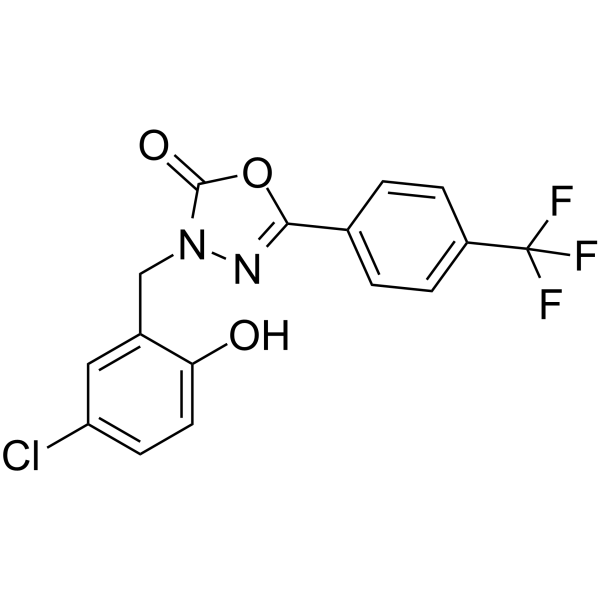
BMS 191011 (BMS-A) is a potent BKCa channel opener (large-conductance Ca 2+-activated potassium channel). BMS-191011 shows neuroprotective activities in rodent models of stroke .
loading...
    loading...
Cat. No.: HY-162351
CAS No.: 3034437-44-7
Research Areas:  

Metabolic Disease

EBP-IN-1 is an orally active, blood-brain barrier-permeable inhibitor of emopamil binding protein (EBP). EBP-IN-1 has an IC50 of 8.2 μM against human ERG potassium channels (in CHO background). By inhibiting the sterol isomerase activity of EBP, EBP-IN-1 causes the accumulation of Zymostenol (HY-113345), and exhibits strong target binding in the brain after repeated administration in rodents. EBP-IN-1 also promotes oligodendrocyte formation in human cortical organoids and can be used in research related to multiple sclerosis .
loading...
    loading...
Cat. No.: HY-17612
CAS No.: 1092977-61-1
Synonyms: NW-3509
Target:  

Sodium Channel

Research Areas:  

Neurological Disease

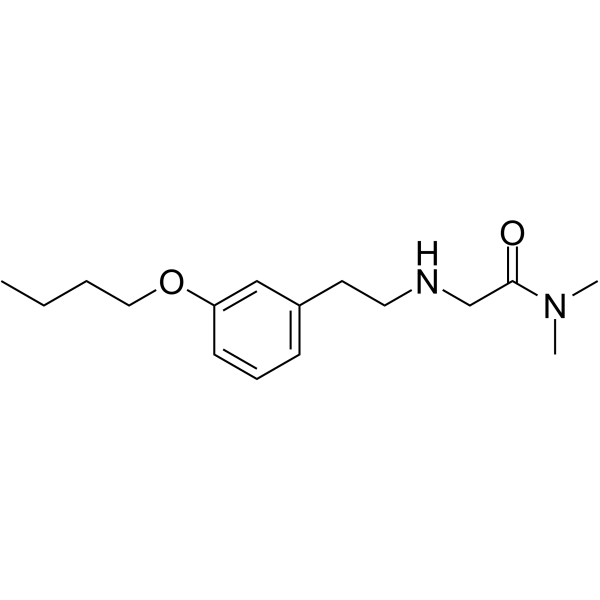
Evenamide (NW-3509) is an orally available voltage-gated sodium channel (VGSC) blocker (Ki=0.4 µM) for the research of schizophrenia. Evenamide shows efficacy in a broad spectrum of rodent models of psychosis, mania, depression, and aggressiveness .
loading...
    loading...
Cat. No.: HY-117948
CAS No.: 1560968-49-1
Research Areas:  

Cancer

ML399 is a Menin-MLL1 protein-protein interaction inhibitor with an IC50 of 90 nM. ML399 inhibits the proliferation of transformed mouse bone marrow cells. ML399 binds to the hERG potassium channel, exhibits superior in vitro physicochemical, drug metabolism and pharmacokinetic (DMPK) parameters, and has an extended half-life in rodents. ML399 can be used for research on acute myeloid leukemia and acute lymphoblastic leukemia .
loading...
    loading...
Cat. No.: HY-175668
CAS No.: 2756581-81-2
Target:  

Potassium Channel

Research Areas:  

Neurological Disease

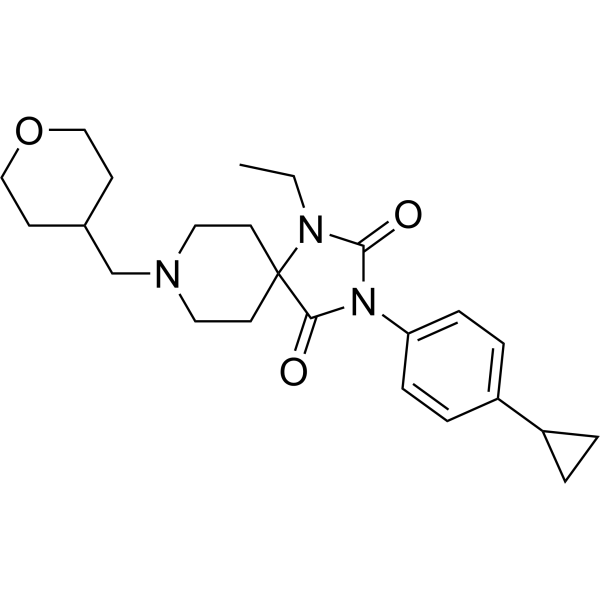
IDOR-1104-0086 is an orally active Kv7 potassium channel opener with an EC50 of 210 nM that can cross blood-brain barrier. IDOR-1104-0086 displays strong selectivity against the hERG channel with an IC20 of 25 μM. IDOR-1104-0086 exhibits efficacy in two rodent models of epilepsy and a favorable tolerability profile. IDOR-1104-0086 can used for the study of epilepsy .
loading...
    loading...
Cat. No.: HY-12596
CAS No.: 871824-55-4
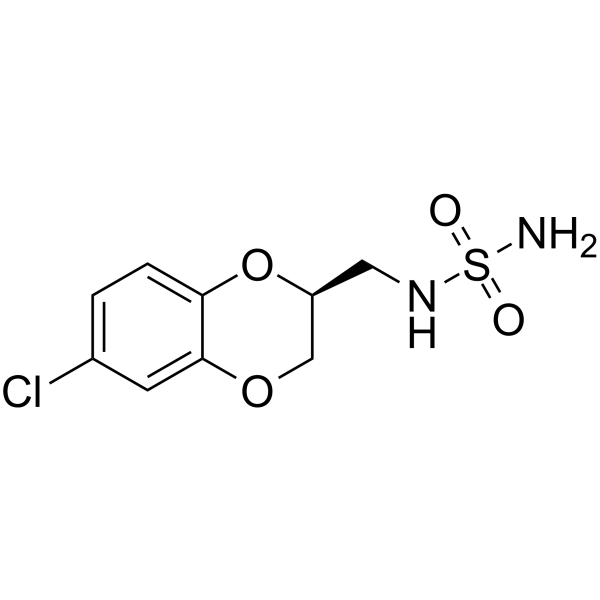
JNJ-26489112, a CNS-active agent, exhibits broad-spectrum anticonvulsant activity in rodents against audiogenic, electrically-induced, and chemically-induced seizures. JNJ-26489112 inhibits voltage-gated Na + channels and N-type Ca 2+ channels, and is effective as a K + channel opener. JNJ-26489112 has very weak inhibition of CA-II (IC50=35 μM) and CA-I (18 μM) .
loading...
    loading...
Cat. No.: HY-16923
CAS No.: 221019-25-6
Synonyms: BIII-890; BIII-890 CL free acid
Target:  

Sodium Channel

Research Areas:  

Neurological Disease

Crobenetine (BIII-890), a benzomorphan derivative, is a potent, selective, and highly use-dependent Na + channel blocker. Crobenetine displaces [3H]BTX from site 2 of the Na + channel (IC50=49 nM) in rat brain synaptosomes, yet exhibits only low binding affinity for other receptors and ion channels. Crobenetine protects brain tissue from the deleterious effects of focal cerebral ischemia in rodents .
loading...
    loading...
Cat. No.: HY-133195
CAS No.: 13669-70-0
Synonyms: Fenazoxine
Target:  

Sodium Channel

Research Areas:  

Neurological Disease

Nefopam (Fenazoxine) is an orally active, non-opioid and non-steroidal centrally acting analgesic agent. Nefopam blocks voltage-sensitive sodium channels (IC50=27 μM) and modulates glutamatergic transmission in rodents. Nefopam can be used in studies of neuropathic pain, anticonvulsant, as well as the prevention of postoperative shivering and hiccups .
loading...
    loading...
Cat. No.: HY-16923A
CAS No.: 221018-88-8
Synonyms: BIII-890 hydrochloride; BIII-890 CL
Target:  

Sodium Channel

Research Areas:  

Neurological Disease

Crobenetine hydrochloride (BIII-890 hydrochloride) is the hydrochloride form of Crobenetine (HY-16923). Crobenetine hydrochloride is a selective inhibitor for Na + channel. Crobenetine hydrochloride displaces 3HBTX from site 2 of the Na + channel (IC50=49 nM) in rat brain synaptosomes, exhibits only low binding affinity for other receptors and ion channels. Crobenetine hydrochloride protects brain tissue from the deleterious effects of focal cerebral ischemia in rodents .
loading...
    loading...
Cat. No.: HY-17612A
CAS No.: 1092977-06-4
Synonyms: NW-3509 hydrochloride
Target:  

Sodium Channel

Research Areas:  

Neurological Disease

Evenamide hydrochloride is an orally available voltage-gated sodium channel (VGSC) blocker (Ki=0.4 μM) for the research of schizophrenia. Evenamide hydrochloride shows efficacy in a broad spectrum of rodent models of psychosis, mania, depression, and aggressiveness .
loading...
    loading...
Cat. No.: HY-15056
CAS No.: 118215-82-0
Target:  

TRP Channel

Research Areas:  

Inflammation/Immunology

AMG 9090 is characterized as a compound that acts as a partial agonist of rat TRPA1 channels, demonstrating pharmacological activity in pain and inflammation models. TRPA1 is pivotal in sensing reactive compounds, triggering pain responses in humans and rodents. AMG 9090, along with other trichloro(sulfanyl)ethyl benzamides (TCEB compounds), shows differential effects on human and rat TRPA1 channels: it acts as a potent antagonist of human TRPA1 activated by AITC and noxious cold, whereas it behaves as a partial agonist at rat TRPA1. This suggests AMG 9090's potential as a therapeutic agent targeting TRPA1-mediated pain and inflammation, with additional inhibitory activity against TRPM8 noted .
loading...
    loading...
Cat. No.: HY-180370
CAS No.: 765890-91-3
Synonyms: NitroSynapsin; YQW-036; NMI-6979
Nitromemantine (NitroSynapsin) is a nitrate derivative of Memantine (HY-B0591) and is a dual-functional NMDAR antagonist. Nitromemantine exhibits significant efficacy in rodent models of cerebral infarction through a dual mechanism of blocking channels and regulating receptors via NO/redox regulation. Nitromemantine can target ischemic neurons under hypoxic conditions and enhance its activity. Nitromemantine inhibits the current induced by NMDA, with its IC50 being 2.4 μM. Nitromemantine can be used for the study of cerebral ischemic stroke .
loading...
    loading...
Cat. No.: HY-182517
CAS No.: 2225980-49-2
Target:  

TRP Channel

Research Areas:  

Inflammation/Immunology

AG1529 is a TRPV1 inhibitor and capsaicinoid-based soft agent with a human TRPV1 IC50 of 0.9-0.93 μM. AG1529 reversibly blocks capsaicin-evoked TRPV1 activation, binds to the TRPV1 capsaicin binding site, moderately affects pH-induced TRPV1 gating, and does not alter voltage- or heat-mediated TRPV1 responses. AG1529 suppresses TRPV1-mediated neuronal excitability, reduces capsaicin- and pH-evoked neuronal firing, abolishes histaminergic and inflammation-mediated TRPV1 sensitization. AG1529 exhibits anti-nociceptive and antipruritic effects, attenuates in vivo hyperalgesia and pruritus, dose-dependently reduces acute histaminergic itch in rodents, and mildly blocks hTRPA1 and hTRPM8 channel activity. AG1529 undergoes hydrolysis and dermal deactivation, minimizes TRPV1-associated side reactions, does not evoke capsaicin-like burning sensation, and does not disrupt physiological thermal regulation. AG1529 can be used for the research of inflammatory cutaneous nociception and acute histaminergic pruritus .
loading...
    loading...
  • 1

