1. Search Result
Search Result
Results for "

thiobarbituric acid reactive substances

" in MedChemExpress (MCE) Product Catalog:

7

Inhibitors & Agonists

4

Natural
Products

Targets Recommended:
Cat. No. Product Name Target Research Areas Chemical Structure
  • HY-121271

    Others Inflammation/Immunology
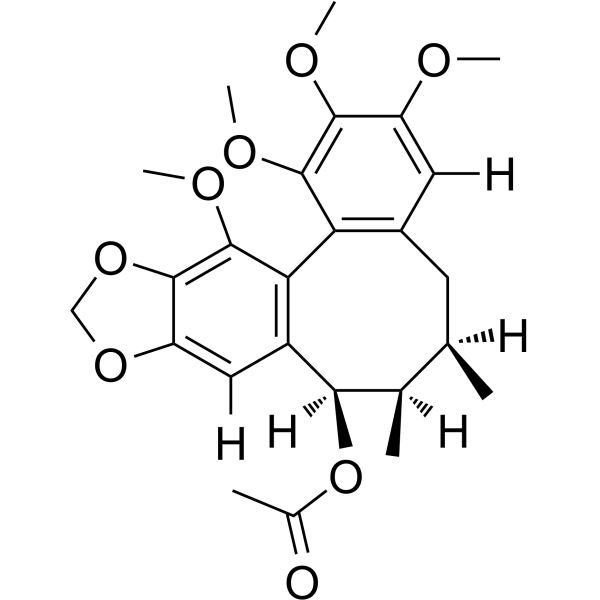
    Kadsurin, a natural compound from the stems of Kadsura heteroclita (Schizandraceae), results in significant decreases of CCL4- induced lipid-peroxidation products, such as thiobarbituric acid reactive substances (TBA-RS), conjugated dienes and fluorescent products in the liver of mice .
    Kadsurin
  • HY-W587784

    PPAR Metabolic Disease
    Norbixin is a carotenoid that has been found in B. orellana.It binds to PPARγ in a cell-free assay (Ki = 1.15 μM) . Norbixin attenuates hyperglycemia, hyperinsulinemia, and insulin resistance, as well as decreases serum lipid levels and cardiac levels of thiobarbituric acid reactive substances (TBARS) and glutathione (GSH) in a rat model of cardio-metabolic syndrome .
    Norbixin
  • HY-W402074

    Butenolide

    Mitochondrial Metabolism Reactive Oxygen Species (ROS) Metabolic Disease
    5-Acetamide-Butenolide (Butenolide) is a mycotoxin with pro-oxidant activity, which is found in Fusarium. 5-Acetamide-Butenolide disrupts the mitochondrial membrane potential in primary neonatal rat cardiomyocytes. 5-Acetamide-Butenolide also induces the production of thiobarbituric acid reactive substances (TBARS) in isolated rat myocardial mitochondria. 5-Acetamide-Butenolide increases the production of reactive oxygen species (ROS), decreases the levels of GSH and reduces the viability of HepG2 cells .
    5-Acetamide-Butenolide
  • HY-130743

    Bis-eugenol; Dehydrodieugenol

    Parasite Infection
    Dieugenol is a neolignan that has been found in N. leucantha and has antioxidative and antiprotozoal activities. It inhibits the formation of thiobarbituric acid reactive substances (TBARS) and scavenges superoxide anions, but not hydroxyl radicals, in cell-free assays. It has anti-trypanosomal activity against T. cruzi amastigotes and trypomastigotes (IC50s=15.1 and 11.5 μM, respectively) but is cytotoxic to NCTC L-929 fibroblasts with a 50% cytotoxic concentration (CC50) value of 58.2 μM.2 Dieugenol (15 μM) disrupts the integrity of the T. cruzi trypomastigote plasma membrane but does not induce the production of reactive oxygen species (ROS) in trypomastigotes or LPS-stimulated and unstimulated isolated mouse peritoneal macrophages.
    Dieugenol
  • HY-103388

    COX TGF-β Receptor Glutathione Peroxidase Inflammation/Immunology
    NCX 466 is an orally active COX-1 and COX-2 inhibitor that exhibits anti-inflammatory and analgesic effects. Additionally, NCX 466 acts as a NO donor, exerting anti-inflammatory and antioxidant effects by improving microcirculation. NCX 466 significantly reduces the levels of transforming growth factor-β (TGF-β) and oxidative stress markers (such as thiobarbituric acid reactive substances (TBARS) and 8-hydroxy-2'-deoxyguanosine (8-OHdG)), and it decreases leukocyte recruitment during inflammation by reducing myeloperoxidase (MPO) activity, thereby preventing bleomycin (HY-108345)-induced pulmonary fibrosis in mice .
    NCX 466
  • HY-W747910A

    Drug Metabolite Inflammation/Immunology
    S584 dihydrochloride is a catechol metabolite of the oral-effective Piribedil (HY-12707), with anti-lipid peroxidation activity. S584 dihydrochloride significantly inhibits lipid peroxidation in rat synaptosomes under basal conditions and Fe³⁺ stimulation. S584 dihydrochloride significantly antagonizes the increase in thiobarbituric acid reactive substances (TBARS) in the brains of mice exposed to high oxygen and under normal air conditions .
    S584 dihydrochloride
  • HY-N19646

    Glycosidase Tyrosinase Metabolic Disease
    [8]-Dehydrogingerdione is a Hydroxyphenylalkanone. [8]-Dehydrogingerdione can be isolated from the seeds of Aframomum melegueta and the rhizomes of Curcuma xanthorrhia. [8]-Dehydrogingerdione acts as an inhibitor of α-glucosidase and Tyrosinase, with an IC50 value of 19.5 μM against α-glucosidase and an approximate IC50 value of 100 μM against tyrosinase. [8]-Dehydrogingerdione can be used in diabetes-related research .
    [8]-Dehydrogingerdione

Inquiry Online

Your information is safe with us. * Required Fields.

Salutation


Country or Region *

Applicant Name *


Organization Name *

Department *


Email Address *


Product Name *

Cat. No.


Requested quantity *

Phone Number *


Remarks

Inquiry Online

Inquiry Information

Product Name:
Cat. No.:
Quantity:
MCE Japan Authorized Agent:

