



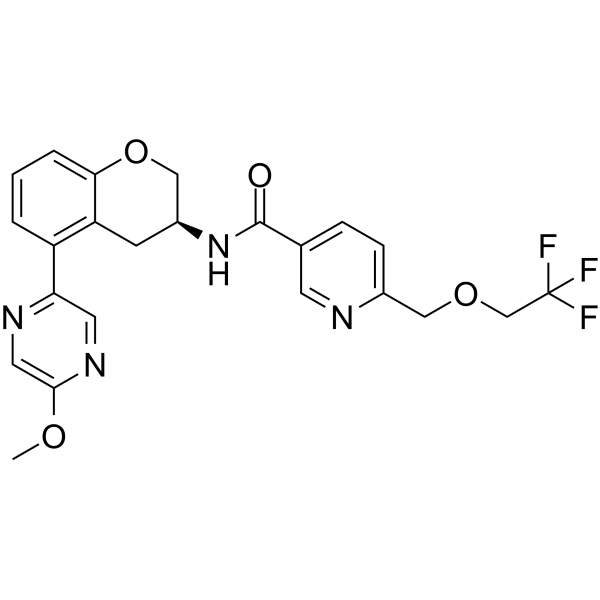
AZD-3161
AZD-3161 is a potent and selective blocker of NaV1.7 channel, with a pIC50 of 7.1. AZD-3161 can be used for the research of neuropathic and inflammatory pain.
For research use only. We do not sell to patients.
- CAS No.: 1369501-46-1
- Formula: C23H21F3N4O4
- Molecular Weight:474.43
-
Storage:
Please store the product under the recommended conditions in the Certificate of Analysis.

To place orders, for customer services and technical support, please contact: MedChemExpress USA
Tel: 609-228-6898 E-mail: [email protected] [email protected]


-
 Biological Activity
-
Chemical Information
- Protocols
- Purity & Documentation
- References
-
 Help & FAQs




Biological Activity
Description
IC50 & Target
pIC50: 7.1 (NaV1.7 channel)[1]
In Vitro
AZD-3161 (compound 29) is selective for NaV1.7 over NaV1.5 and hERG, with pIC50s of 7.1, 4.9 and 4.9, respectively[1].
AZD-3161 inhibits Adenosine Transporter (AT) and Cannabinoid B1 (CB1) receptor, with IC50s of 1.8 μM and 5 μM, respectively[1].
MedChemExpress (MCE) has not independently confirmed the accuracy of these methods. They are for reference only.
In Vivo
AZD-3161 (3 μmol/kg; i.v.) exhibits long half-life (2.2 h) and Vss (4.2 L/kg)[1].
AZD-3161 (10 μmol/kg; p.o.) exhibits high oral bioavailability (44%), long half-life (4.8 h) and Cmax (0.30 μmol/L)[1].
MedChemExpress (MCE) has not independently confirmed the accuracy of these methods. They are for reference only.
Clinical Trial
| NCT Number | Sponsor | Condition | Start Date |
Phase

|
|---|---|---|---|---|
| NCT01329991 | Plexxikon| | 2011-05 | PHASE1 |


Chemical Information
-
CAS No. 1369501-46-1
-
Molecular Weight 474.43
-
Formula C23H21F3N4O4
-
SMILES
O=C(C1=CC=C(COCC(F)(F)F)N=C1)N[C@@H]2COC3=CC=CC(C4=NC=C(OC)N=C4)=C3C2
-
Shipping
Room temperature in continental US; may vary elsewhere.
-
Storage
Please store the product under the recommended conditions in the Certificate of Analysis.


Purity & Documentation
References
[1]. Kers I, et, al. Structure and activity relationship in the (S)-N-chroman-3-ylcarboxamide series of voltage-gated sodium channel blockers. Bioorg Med Chem Lett. 2012 Sep 1; 22(17): 5618-24. [Content Brief]
[2]. Bagal SK, et, al. Recent progress in sodium channel modulators for pain. Bioorg Med Chem Lett. 2014 Aug 15; 24(16): 3690-9. [Content Brief]

Calculators
Concentration (start) × Volume (start) = Concentration (final) × Volume (final)


AZD-3161 Related Classifications
HY-117714 Related Classifications
 Powered by Bioz