



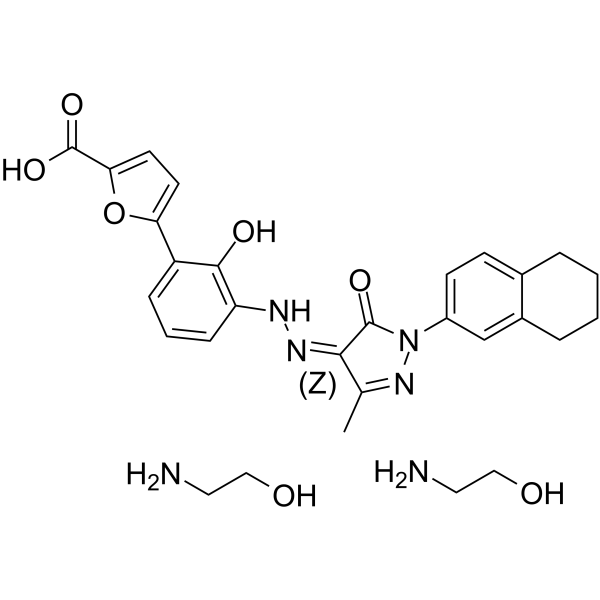
Rafutrombopag diolamine
Rafutrombopag (Hetrombopag) diolamine is an orally active nonpeptide thrombopoietin receptor (TPOR/MPL) agonist. Rafutrombopag diolamine can chelate iron and alleviate iron overload while promoting haematopoiesis. Rafutrombopag diolamine specifically stimulates proliferation and differentiation of human TPOR-expressing cells, including 32D-MPL and human hematopoietic stem cells through stimulation of STAT, PI3K and ERK signalling pathways. Rafutrombopag diolamine effectively up-regulates G1-phase-related proteins, including p-RB, Cyclin D1 and CDK4/6, normalizes progression of the cell cycle, and prevents apoptosis by modulating BCL-XL/BAK expression in 32D-MPL cells. Rafutrombopag diolamine protects cardiomyocyte survival from oxidative stress damage as an enhancer of stem cells. Rafutrombopag diolamine can be used for the study of immune thrombocytopenia and oxidative stress-related cardiovascular disease.
For research use only. We do not sell to patients.
- CAS No.: 1257792-42-9
- Formula: C29H36N6O7
- Molecular Weight:580.64
-
Storage:
Please store the product under the recommended conditions in the Certificate of Analysis.

To place orders, for customer services and technical support, please contact: MedChemExpress USA
Tel: 609-228-6898 E-mail: [email protected] [email protected]


-
 Biological Activity
-
Chemical Information
- Purity & Documentation
- References
-
 Help & FAQs




Biological Activity
|
CDK4 |
CDK6 |
PI3K |
Rafutrombopag (0.01-1000 nM, 0-7 days) diolamine stimulates intracellular TPO signalling pathways and promotes 32D-MPL (EC50 = 0.4 nM) and BaF3/h TPOP ( EC50 = 1.2 nM) cell proliferation in a TPOR-dependent manner[1][2].
Rafutrombopag (0.01-10 μM, 0-10 days) promotes proliferation (EC50 = 2.3 nM) and differentiation of human cord blood-derived CD34+ cells[1][2].
Rafutrombopag (0-3 μM, 24-72 h) diolamine normalizes cell-cycle progression and prevents apoptosis in 32D-MPL cells and rat cardiac myocytes[1].
Rafutrombopag (0.01-1000 nM, 30 min-72 h) diolamine interacts specifically with TPOR and exerts an additive agonistic effect with rhTPO[1].
Rafutrombopag (0.3-3 μM, 12 h) diolamine enhances the beneficial effects of human UCB MNCs in increasing the survival of injured cardiomyocytes during free oxygen radical stress by enhancing human UCB MNCs viability and increasing the secretion of paracrine factors[2].
Rafutrombopag (3-30 μM) diolamine has anti-inflammatory activity and significantly reduces the production of NO and TNF-a in LPS (HY-D1056) stimulated macrophage RAW264.7 cells[2].
MedChemExpress (MCE) has not independently confirmed the accuracy of these methods. They are for reference only.
-
Cell Line:32D-MPL cells
-
Concentration:0.3.1 and 3 nM
-
Incubation Time:24 h
-
Result:Caused cells to re-enter the cell cycle, increasing the proportion of cells in G2 and S phases and decreasing the proportion of cells in G1 phase.
Reversed the decrease in G1-phase-related proteins, including p-RB, Cyclin D and CDK4/6, induced by cytokine withdrawal.
-
Cell Line:32D-MPL cells
-
Concentration:0.3.1 and 3 nM
-
Incubation Time:72 h
-
Result:Reduced the apoptosis effect.
Increased expression of the antiapoptotic family members BCL-XL and MCL-1, and decreased expression of proapoptotic BAK.
-
Cell Line:32D-MPL cells
-
Concentration:0.1, 1, 3, 10, 30, 100 nM
-
Incubation Time:0, 0.5, 1, 2, 4, 8, 12, 24h
-
Result:Induced phosphorylation of the major components of TPO‐mediated signalling, including STAT3, STAT5, ERK1/2, and AKT.
Stimulated the phosphorylation of these TPOR downstream effectors in a concentration-dependent manner.
-
Cell Line:32D-MPL cells
-
Concentration:0.3.1 and 3 μM
-
Incubation Time:12 h
-
Result:Increased myocyte viability by 20.3%, 43.7% and 46.8% at 0.3, 1 and 3 μM, respectively.
Showed weak antioxidant activity, and increased the myocyte viability by 15.7%.
Rafutrombopag (18 mg/kg, p.o., once daily for 12 days) diolamine significantly stimulates proliferation and prevents apoptosis of 32D-MPL cells in hollow fibres in a time-dependent manner in mice[1].
MedChemExpress (MCE) has not independently confirmed the accuracy of these methods. They are for reference only.
-
Animal Model:32D-MPL cell-containing hollow fibres assay established in mice[1]
-
Dosage:18 mg/kg
-
Administration:Oral administration (p.o.), once daily for 12 days
-
Result:Significantly stimulated proliferation and prevented apoptosis of 32D-MPL cells in hollow fibres in a time-dependent manner.
Reached the number of 32D-MPL cells a maximum after 3 days and then decreased within 12 days.
Had no effect on the counts of white blood cells, reticulocytes, or platelets in the peripheral blood.
| NCT Number | Sponsor | Condition | Start Date |
Phase

|
|---|---|---|---|---|
| NCT01329991 | Plexxikon| | 2011-05 | PHASE1 |


Chemical Information
-
CAS No. 1257792-42-9
-
Molecular Weight 580.64
-
Formula C29H36N6O7
-
SMILES
O=C1N(N=C(/C1=N/NC2=C(C(C3=CC=C(C(O)=O)O3)=CC=C2)O)C)C4=CC=C(CCCC5)C5=C4.NCCO.NCCO
-
Shipping
Room temperature in continental US; may vary elsewhere.
-
Storage
Please store the product under the recommended conditions in the Certificate of Analysis.


Purity & Documentation
References
[1]. Xie C, et al. Pharmacological characterization of hetrombopag, a novel orally active human thrombopoietin receptor agonist. J Cell Mol Med. 2018 Nov;22(11):5367-5377. [Content Brief]
[2]. Zhou N, et al. Hetrombopag, a Thrombopoietin Receptor Agonist, Protects Cardiomyocyte Survival from Oxidative Stress Damage as an Enhancer of Stem Cells. Cardiovasc Drugs Ther. 2016 Dec;30(6):567-577. [Content Brief]

Calculators
Concentration (start) × Volume (start) = Concentration (final) × Volume (final)


Rafutrombopag diolamine Related Classifications
HY-125101A Related Classifications
 Powered by Bioz