



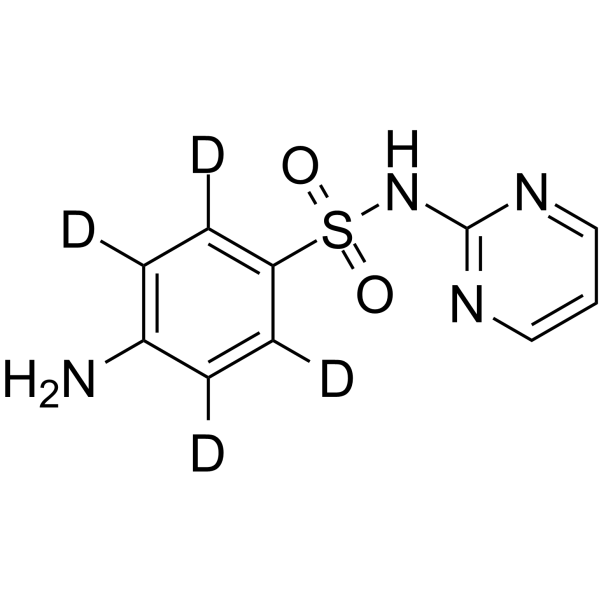
Sulfadiazine-d4
Based on 1 Customer Validation
Sulfadiazine-d4 is a deuterium labeled Sulfadiazine (HY-B0273). Sulfadiazine is an orally active sulfonamide antibiotic. Sulfadiazine competitively inhibits p-aminobenzoic acid in the folic-acid-metabolism cycle, inhibiting multiplication of most Gram-positive and many Gram-negative bacteria. Sulfadiazine persists in soil long-term, and exerts selective pressure for sulfonamide-resistant microbial populations. Sulfadiazine targets Toxoplasma gondii DHPS enzyme. Sulfadiazine can be used for the research of congenital toxoplasmosis and bacterial infection.
For research use only. We do not sell to patients.
- Purity : 99.31%
- CAS No.: 1020719-78-1
- Formula: C10H6D4N4O2S
- Molecular Weight:254.30
-
Storage:Powder -20°C, 3 years , 4°C, 2 years ; In solvent -80°C, 6 months , -20°C, 1 month

To place orders, for customer services and technical support, please contact: MedChemExpress USA
Tel: 609-228-6898 E-mail: [email protected] [email protected]


-
 Biological Activity
-
Chemical Information
-
Solvent & Solubility
- Protocols
- Purity & Documentation
- References
-
 Help & FAQs




Biological Activity
Description
In Vitro
Stable heavy isotopes of hydrogen, carbon, and other elements have been incorporated into drug molecules, largely as tracers for quantitation during the drug development process. Deuteration has gained attention because of its potential to affect the pharmacokinetic and metabolic profiles of drugs.
MedChemExpress (MCE) has not independently confirmed the accuracy of these methods. They are for reference only. Further protocols information, click here.
Application
1. This compound can be used as a tracer
2. This compound can be used as an internal standard for quantitative analysis by NMR, GC-MS, or LC-MS.


Chemical Information
-
CAS No. 1020719-78-1
-
Unlabeled CAS 68-35-9
-
Appearance Solid
-
Molecular Weight 254.30
-
Formula C10H6D4N4O2S
-
Color Off-white to light brown
-
SMILES
O=S(C1=C([2H])C([2H])=C(N)C([2H])=C1[2H])(NC2=NC=CC=N2)=O
-
Shipping
Room temperature in continental US; may vary elsewhere.
-
Storage
Powder -20°C 3 years 4°C 2 years In solvent -80°C 6 months -20°C 1 month


Solvent & Solubility
In Vitro:
DMSO : ≥ 50 mg/mL (196.62 mM; Hygroscopic DMSO has a significant impact on the solubility of product, please use newly opened DMSO)
* "≥" means soluble, but saturation unknown.
Please refer to the solubility information to select the appropriate solvent. Once prepared, please aliquot and store the solution to prevent product inactivation from repeated freeze-thaw cycles.
Storage method and period of stock solution: -80°C, 6 months; -20°C, 1 month. When stored at -80°C, please use it within 6 months. When stored at -20°C, please use it within 1 month.
Please refer to the solubility information to select the appropriate solvent. Once prepared, please aliquot and store the solution to prevent product inactivation from repeated freeze-thaw cycles.
Storage method and period of stock solution: -80°C, 6 months; -20°C, 1 month. When stored at -80°C, please use it within 6 months. When stored at -20°C, please use it within 1 month.
Concentration (start) × Volume (start) = Concentration (final) × Volume (final)

Protocols
-
Research Protocol for Infectious Diseases
Infectious-disease experiments test how pathogens interact with host barriers, innate immune receptors, inflammatory signaling, pathogen replication, and tissue injury; pattern-recognition receptors such as TLRs, RIG-I-like receptors, NOD-like receptors, and inflammasomes detect microbial molecules and activate NF-κB, interferon, and cytokine responses. The central hypothesis is that infection severity reflects the balance between pathogen burden and host response: protective inflammation restricts pathogen growth, whereas excessive or mislocalized inflammation contributes to tissue damage and disease phenotype. Unresolved questions include which host pathways are protective versus pathogenic, why some infection models fail to translate to human disease, and which combined readouts best predict clinically relevant infection outcomes.
-
Gram Staining of Tissue Sections
Gram staining of tissue sections is a histochemical technique used to differentiate Gram-positive and Gram-negative bacteria within histological specimens based on differences in bacterial cell wall structure and dye retention, adapted from classical bacteriological Gram staining into tissue-compatible “histological Gram stain” variants. In tissue applications, modifications of the Brown-Hopps and Brown-Brenn methods are commonly used to improve differentiation of microorganisms embedded within host connective tissue and to reduce overstaining or loss of Gram-negative signal, which are known limitations of earlier approaches. The principle relies on crystal violet-iodine complex retention in Gram-positive organisms and subsequent decolorization and counterstaining steps that allow contrast visualization of Gram-negative organisms against tissue background.


Purity & Documentation
-
Data Sheet (285 KB)
-
SDS (557 KB)
- English - EN (557 KB)
- Français - FR (557 KB)
- Deutsch - DE (557 KB)
- Norwegian - NO (557 KB)
- Español - ES (557 KB)
- Swedish - SV (557 KB)
- Italian - IT (557 KB)
- Korean - KR (557 KB)
- Portuguese - PT (557 KB)
-
Handling Instructions (2659 KB)
References
[1]. Kopmann C, et al. Abundance and transferability of antibiotic resistance as related to the fate of sulfadiazine in maize rhizosphere and bulk soil. FEMS Microbiol Ecol. 2013 Jan;83(1):125-34. [Content Brief]
[2]. Silva LA, et al. Efficacy of sulfadiazine and pyrimetamine for treatment of experimental toxoplasmosis with strains obtained from human cases of congenital disease in Brazil. Exp Parasitol. 2019 Jul;202:7-14. [Content Brief]


Complete Stock Solution Preparation Table
Please refer to the solubility information to select the appropriate solvent. Once prepared, please aliquot and store the solution to prevent product inactivation from repeated freeze-thaw cycles.
Storage method and period of stock solution: -80°C, 6 months; -20°C, 1 month. When stored at -80°C, please use it within 6 months. When stored at -20°C, please use it within 1 month.
| Optional Solvent | Concentration Solvent Mass | 1 mg | 5 mg | 10 mg | 25 mg |
|---|---|---|---|---|---|
| DMSO | 1 mM | 3.9324 mL | 19.6618 mL | 39.3236 mL | 98.3091 mL |
| 5 mM | 0.7865 mL | 3.9324 mL | 7.8647 mL | 19.6618 mL | |
| 10 mM | 0.3932 mL | 1.9662 mL | 3.9324 mL | 9.8309 mL | |
| 15 mM | 0.2622 mL | 1.3108 mL | 2.6216 mL | 6.5539 mL | |
| 20 mM | 0.1966 mL | 0.9831 mL | 1.9662 mL | 4.9155 mL | |
| 25 mM | 0.1573 mL | 0.7865 mL | 1.5729 mL | 3.9324 mL | |
| 30 mM | 0.1311 mL | 0.6554 mL | 1.3108 mL | 3.2770 mL | |
| 40 mM | 0.0983 mL | 0.4915 mL | 0.9831 mL | 2.4577 mL | |
| 50 mM | 0.0786 mL | 0.3932 mL | 0.7865 mL | 1.9662 mL | |
| 60 mM | 0.0655 mL | 0.3277 mL | 0.6554 mL | 1.6385 mL | |
| 80 mM | 0.0492 mL | 0.2458 mL | 0.4915 mL | 1.2289 mL | |
| 100 mM | 0.0393 mL | 0.1966 mL | 0.3932 mL | 0.9831 mL |


Sulfadiazine-d4 Related Classifications
HY-B0273S Related Classifications
 Powered by Bioz