



T2AA
Based on 2 publication(s) in Google Scholar
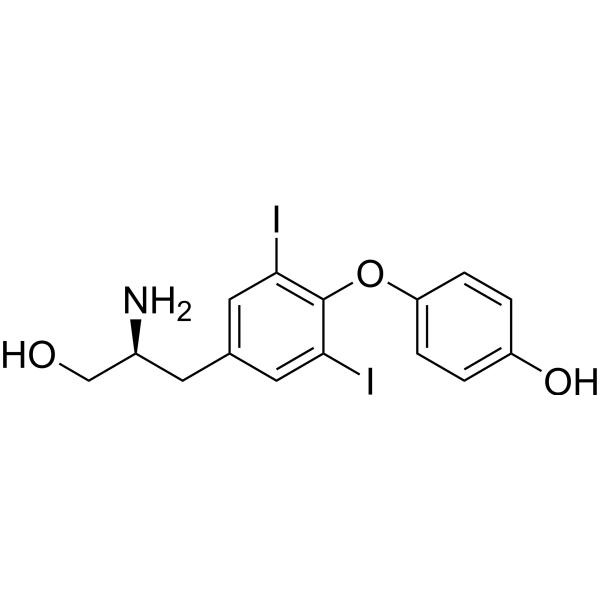
T2AA is a monoubiquitinated proliferating cell nuclear antigen (PCNA) inhibitor that prevents DNA repair, increases double-strand break (DSB) formation and promotes necroptosis and cell cycle arrest in G1 phase.
For research use only. We do not sell to patients.
- Purity : 99.04%
- CAS No.: 1380782-27-3
- Formula: C15H15I2NO3
- Molecular Weight:511.09
-
Storage:Powder -20°C, 3 years , 4°C, 2 years ; In solvent -80°C, 6 months , -20°C, 1 month

To place orders, for customer services and technical support, please contact: MedChemExpress USA
Tel: 609-228-6898 E-mail: [email protected] [email protected]


-
 Biological Activity
-
Chemical Information
-
Solvent & Solubility
- Protocols
- Purity & Documentation
- References
-
 Help & FAQs


Publications Citing Use of MedChemExpress (MCE) T2AA
MoreAll DNA/RNA Synthesis Isoforms
More

Biological Activity
Description
In Vitro
T2AA (15 μM, 72 h) inhibits interstrand DNA crosslink (ICL) repair, it can prevent the disassembly of DNA double-strand break (DSB) formed as an ICL repair intermediate, and has the ability to inhibit DSB repair[1].
MedChemExpress (MCE) has not independently confirmed the accuracy of these methods. They are for reference only.


Chemical Information
-
CAS No. 1380782-27-3
-
Appearance Solid
-
Molecular Weight 511.09
-
Formula C15H15I2NO3
-
Color White to off-white
-
SMILES
IC(C=C(C[C@H](N)CO)C=C1I)=C1OC2=CC=C(O)C=C2
-
Shipping
Room temperature in continental US; may vary elsewhere.
-
Storage
Powder -20°C 3 years 4°C 2 years In solvent -80°C 6 months -20°C 1 month


Publications (2)
-
Journal Impact Factor
-
Most Recent
-
Sci Adv
A genetic screen for modifiers of cohesin clustering identifies regulators of genome folding. [Abstract]2026 Jan 30;12(5):eadx5130. PMID: 41616049 -
Environ Sci Technol
IodoFinder: Machine Learning-Guided Recognition of Iodinated Chemicals in Nontargeted LC-MS/MS Analysis. [Abstract]2025 Mar 11;59(9):4530-4539. PMID: 40015982


Solvent & Solubility
In Vitro:
DMSO : 100 mg/mL (195.66 mM; Need ultrasonic; Hygroscopic DMSO has a significant impact on the solubility of product, please use newly opened DMSO)
Please refer to the solubility information to select the appropriate solvent. Once prepared, please aliquot and store the solution to prevent product inactivation from repeated freeze-thaw cycles.
Storage method and period of stock solution: -80°C, 6 months; -20°C, 1 month. When stored at -80°C, please use it within 6 months. When stored at -20°C, please use it within 1 month.
Please refer to the solubility information to select the appropriate solvent. Once prepared, please aliquot and store the solution to prevent product inactivation from repeated freeze-thaw cycles.
Storage method and period of stock solution: -80°C, 6 months; -20°C, 1 month. When stored at -80°C, please use it within 6 months. When stored at -20°C, please use it within 1 month.
Concentration (start) × Volume (start) = Concentration (final) × Volume (final)


Purity & Documentation
-
Data Sheet (270 KB)
-
SDS (393 KB)
- English - EN (393 KB)
- Français - FR (393 KB)
- Deutsch - DE (393 KB)
- Norwegian - NO (393 KB)
- Español - ES (393 KB)
- Swedish - SV (393 KB)
- Italian - IT (393 KB)
- Korean - KR (393 KB)
- Portuguese - PT (393 KB)
-
Handling Instructions (2659 KB)
References


Complete Stock Solution Preparation Table
Please refer to the solubility information to select the appropriate solvent. Once prepared, please aliquot and store the solution to prevent product inactivation from repeated freeze-thaw cycles.
Storage method and period of stock solution: -80°C, 6 months; -20°C, 1 month. When stored at -80°C, please use it within 6 months. When stored at -20°C, please use it within 1 month.
| Optional Solvent | Concentration Solvent Mass | 1 mg | 5 mg | 10 mg | 25 mg |
|---|---|---|---|---|---|
| DMSO | 1 mM | 1.9566 mL | 9.7830 mL | 19.5660 mL | 48.9151 mL |
| 5 mM | 0.3913 mL | 1.9566 mL | 3.9132 mL | 9.7830 mL | |
| 10 mM | 0.1957 mL | 0.9783 mL | 1.9566 mL | 4.8915 mL | |
| 15 mM | 0.1304 mL | 0.6522 mL | 1.3044 mL | 3.2610 mL | |
| 20 mM | 0.0978 mL | 0.4892 mL | 0.9783 mL | 2.4458 mL | |
| 25 mM | 0.0783 mL | 0.3913 mL | 0.7826 mL | 1.9566 mL | |
| 30 mM | 0.0652 mL | 0.3261 mL | 0.6522 mL | 1.6305 mL | |
| 40 mM | 0.0489 mL | 0.2446 mL | 0.4892 mL | 1.2229 mL | |
| 50 mM | 0.0391 mL | 0.1957 mL | 0.3913 mL | 0.9783 mL | |
| 60 mM | 0.0326 mL | 0.1631 mL | 0.3261 mL | 0.8153 mL | |
| 80 mM | 0.0245 mL | 0.1223 mL | 0.2446 mL | 0.6114 mL | |
| 100 mM | 0.0196 mL | 0.0978 mL | 0.1957 mL | 0.4892 mL |


T2AA Related Classifications
HY-110111 Related Classifications
 Powered by Bioz