



Thiamphenicol (Standard)

Based on 1 Customer Validation
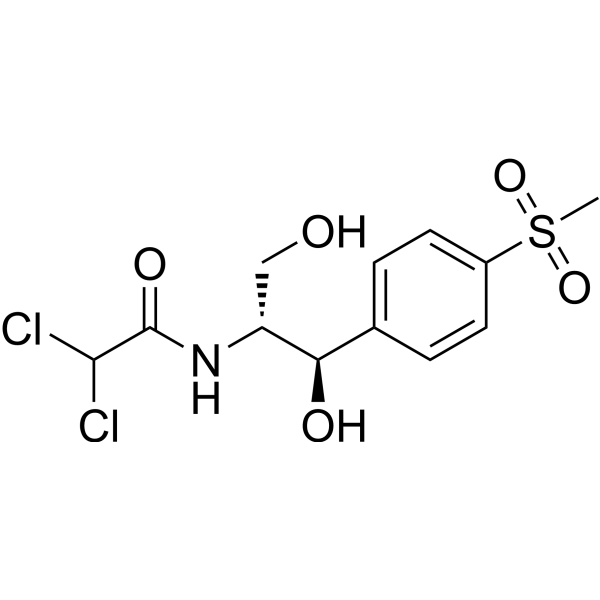
Thiamphenicol (Standard) is the analytical standard of Thiamphenicol. This product is intended for research and analytical applications. Thiamphenicol (Thiophenicol), a methyl-sulfonyl derivative of Chloramphenicol, is a broad-spectrum antimicrobial antibiotic. Thiamphenicol acts by binding to the 50S ribosomal subunit, leading to inhibition of protein synthesis and bacteriostatic effect (against Gram-negative, Gram-positive aerobic and anaerobic bacteria).
For research use only. We do not sell to patients.
- Purity : 99.77%
- CAS No.: 15318-45-3
- Formula: C12H15Cl2NO5S
- Molecular Weight:356.22
-
Storage:
Please store the product under the recommended conditions in the Certificate of Analysis.

To place orders, for customer services and technical support, please contact: MedChemExpress USA
Tel: 609-228-6898 E-mail: [email protected] [email protected]


-
 Product Information
-
Chemical Information
- Purity & Documentation
-
 Help & FAQs




Product Information
Information
Application
The compound is the grade of analytical standard, which is the reference standard supplied assay. It is commonly used in qualitative, quantitative and methodological research experiments in HPLC, GC and MS.


Chemical Information
-
CAS No. 15318-45-3
-
Appearance Solid
-
Molecular Weight 356.22
-
Formula C12H15Cl2NO5S
-
Color White to off-white
-
SMILES
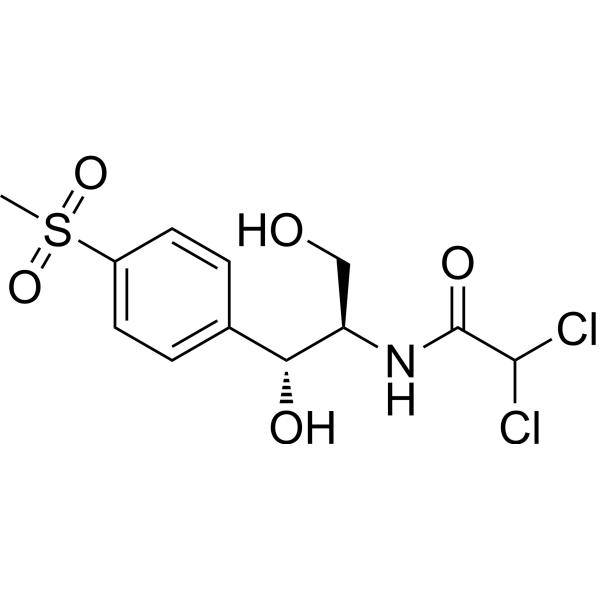
O=C(N[C@H](CO)[C@H](O)C1=CC=C(S(=O)(C)=O)C=C1)C(Cl)Cl
-
Synonyms
Thiophenicol (Standard); Dextrosulphenidol (Standard)
-
Shipping
Room temperature in continental US; may vary elsewhere.
-
Storage
Please store the product under the recommended conditions in the Certificate of Analysis.


Purity & Documentation
-
SDS (393 KB)
- English - EN (393 KB)
- Français - FR (393 KB)
- Deutsch - DE (393 KB)
- Norwegian - NO (393 KB)
- Español - ES (393 KB)
- Swedish - SV (393 KB)
- Italian - IT (393 KB)
- Korean - KR (393 KB)
- Portuguese - PT (393 KB)
-
Handling Instructions (2659 KB)
References
[1]. A Marchese, et al. In vitro activity of thiamphenicol against multiresistant Streptococcus pneumoniae, Haemophilus influenzae and Staphylococcus aureus in Italy. J Chemother. 2002 Dec;14(6):554-61. [Content Brief]
[2]. Marta Tikhomirov, et al. Pharmacokinetics of florfenicol and thiamphenicol in ducks. J Vet Pharmacol Ther. 2019 Jan;42(1):116-120. [Content Brief]

Calculators
Concentration (start) × Volume (start) = Concentration (final) × Volume (final)


Thiamphenicol (Standard) Related Classifications
HY-B0479R Related Classifications
 Powered by Bioz