



TL13-12

Based on 1 Customer Validation
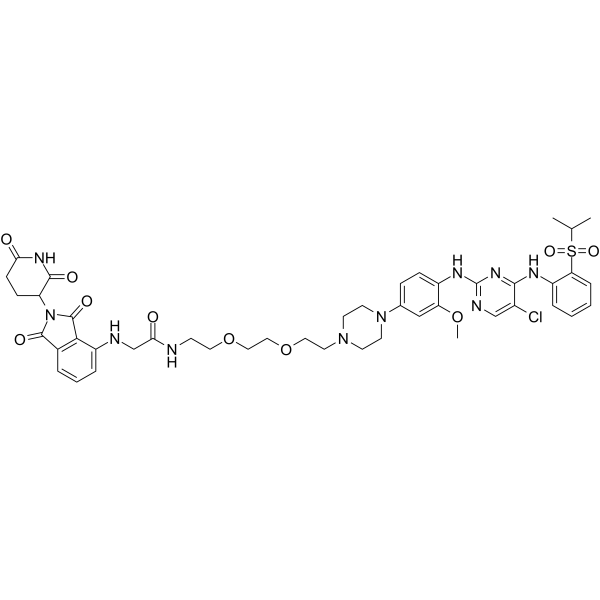
TL13-12 is a CRBN-recruiting ALK PROTAC degrader, with a DC50 of 10 nM in H3122 cells. TL13-12 induces dimerization of CRBN and truncated ALK, which brings the DNA-binding domain and transactivation domain into close proximity, thereby activating the expression of downstream reporter genes, while exhibiting extremely low leaky expression under non-inducing conditions. TL13-12 serves as a tool molecule for the orthogonal PROTAC-CID system, and is applied in research on non-small cell lung cancer, anaplastic large cell lymphoma, and neuroblastoma.
(Pink: Anaplastic lymphoma kinase (ALK) ligand (HY-184540); Blue: Cereblon ligand (HY-131717); Black: linker (HY-130485)).
For research use only. We do not sell to patients.
- Purity : 98.16%
- CAS No.: 2229037-04-9
- Formula: C45H53ClN10O10S
- Molecular Weight:961.48
-
Storage:Powder -20°C, 3 years , 4°C, 2 years ; In solvent -80°C, 6 months , -20°C, 1 month

To place orders, for customer services and technical support, please contact: MedChemExpress USA
Tel: 609-228-6898 E-mail: [email protected] [email protected]


-
 Biological Activity
-
Chemical Information
-
Solvent & Solubility
- Protocols
- Purity & Documentation
- References
-
 Help & FAQs


All PROTACs Isoforms
More

Biological Activity
Description
IC50 & Target
|
ALK 10 nM (DC50, H3122 cells) |
ALK 180 nM (DC50, Karpas 299 cells) |
Cereblon 1.2 μM (IC50) |
Cellular Effect
|
Cell Line

|
Type | Value | Description | References |
|---|---|---|---|---|
| NCI-H3122 | DC50 |
10 nM
|
Induction of ALK degradation in human ALK-positive non-small-cell lung cancer H3122 cells assessed by Western blot after 16 h incubation.
Induction of ALK degradation in human ALK-positive non-small-cell lung cancer H3122 cells assessed by Western blot after 16 h incubation.
|
36626587 |
| KARPAS-299 | DC50 |
180 nM
|
Induction of ALK degradation in human anaplastic large-cell lymphoma Karpas 299 cells assessed by Western blot after 16 h incubation.
Induction of ALK degradation in human anaplastic large-cell lymphoma Karpas 299 cells assessed by Western blot after 16 h incubation.
|
36626587 |
| Kelly | DC50 |
50 nM
|
Induction of ALK degradation in human ABCB1-low neuroblastoma Kelly cells assessed by Western blot after 16 h incubation.
Induction of ALK degradation in human ABCB1-low neuroblastoma Kelly cells assessed by Western blot after 16 h incubation.
|
36626587 |
In Vitro
TL13-12 (2 days) induces activation of the EYFP reporter gene in HEK293T cells via a PROTAC-CID system that enables dimerization of CRBN and truncated ALK, with almost no basal leaky expression[2].
TL13-12 (2 days) selectively induces firefly luciferase reporter gene activation in HEK293T cells expressing the cognate GAL4-tALK and CRBN-VPR protein pair, which demonstrates the orthogonal function of the PROTAC-CID system[2].
TL13-12 (0.1 pM-10 µM) inhibits ALK kinase activity, with potency comparable to that of its parent inhibitor NVP-TAE 684 (TAE684) (HY-10192)[1].
TL13-12 (4 h) induces significant degradation of PTK2, FER, RPS6KA1, and Aurora A in Kelly neuroblastoma cells, while no significant degradation of ALK is detected at this time point[1].
TL13-12 (compound 9) (72 h) inhibits the proliferation of H3122, Karpas 299 and SU-DHL-1 cells, with potency comparable to its parent inhibitor TAE684[1].
TL13-12 (0.01-1 μM; 16 h) induces proteasome-mediated degradation of ALK, with a DC50 of 10 nM in H3122 cells and a DC50 of 180 nM in Karpas 299 cells. In both cell lines, its degradative effect peaks at 16 h, and it exhibits higher selectivity for ALK than for Aurora A compared to compound 11[1].
TL13-12 (50-250 nM; 16 h) exhibits comparable inhibitory effects on ALK downstream signaling to TAE684 in H3122 cells, with the inhibitory activity persisting for 48 h, while its inhibitory effect in Karpas 299 cells is relatively weak[1].
TL13-12 (72 h) inhibits the proliferation of ABCB1-low-expressing Kelly and LAN5 neuroblastoma cells, but its potency decreases in ABCB1-high-expressing SH-SY5Y and CHLA20 cells; its activity is restored when combined with 125 nM Tariquidar (HY-10550)[1].
TL13-12 (10-160 nM; 2-16 h) induces ALK degradation in Kelly neuroblastoma cells with a DC50 of 50 nM; degradation is detected at 8 h in Kelly cells, while degradation is detected at 4 h in CHLA20 cells (co-treated with 125 nM P-glycoprotein inhibitor Tariquidar); moreover, its selectivity for ALK is higher than that of compound 11 in both cell lines[1].
TL13-12 (50-250 nM; 16 h) exhibits comparable potency to NVP-TAE 684 (TAE684) (HY-10192) in inhibiting ALK downstream signaling in Kelly neuroblastoma cells, with the inhibitory effect persisting for more than 48 h, and shows stronger inhibition of ALK downstream signaling than TAE684 in CHLA20 cells (co-treated with 125 nM Tariquidar), with the inhibitory effect maintained for over 48 h[1].
MedChemExpress (MCE) has not independently confirmed the accuracy of these methods. They are for reference only. Further protocols information, click here.
-
Cell Line:ALK-positive non-small-cell lung cancer cell line H3122, anaplastic large-cell lymphoma cell line Karpas 299
-
Concentration:0.01, 0.05, 0.1, 0.5, 1 μM (16 h); 250 nM (2, 4, 8, 16 h)
-
Incubation Time:16 h (dose titrations); 2, 4, 8, 16 h (250 nM)
-
Result:Induced ALK degradation with a DC50 of 10 nM in H3122 cells and 180 nM in Karpas 299 cells after 16 h treatment.
Partial ALK degradation was observed at 4 h in H3122 cells and 8 h in Karpas 299 cells, with maximum degradation achieved at 16 h in both cell lines.
Exhibited higher selectivity for ALK degradation over Aurora A degradation compared to compound 11.
-
Cell Line:ALK-positive non-small-cell lung cancer cell line H3122, anaplastic large-cell lymphoma cell line Karpas 299
-
Concentration:50, 250 nM (16 h); 0.25 μM (6, 12, 24, 48 h)
-
Incubation Time:16 h (50, 250 nM); 6, 12, 24, 48 h (0.25 μM)
-
Result:Inhibited ALK phosphorylation to a similar extent as parental inhibitor TAE684 in H3122 cells after 16 h, and sustained inhibition of ALK and STAT3 phosphorylation over 48 h comparable to TAE684.
Inhibited ALK phosphorylation to a lesser extent than TAE684 in Karpas 299 cells after 16 h.
-
Cell Line:neuroblastoma cell lines Kelly (ABCB1-low), CHLA20 (ABCB1-high, co-treated with 125 nM P-glycoprotein inhibitor tariquidar)
-
Concentration:10, 20, 40, 80, 160 nM (16 h); 100 nM (2, 4, 8, 16 h)
-
Incubation Time:16 h (dose titrations); 2, 4, 8, 16 h (100 nM)
-
Result:Induced ALK degradation with a DC50 of 50 nM in Kelly cells after 16 h treatment.
ALK degradation was observed at 8 h in Kelly cells and 4 h in CHLA20 cells.
Exhibited higher selectivity for ALK degradation over Aurora A degradation compared to compound 11 in both cell lines.
-
Cell Line:neuroblastoma cell lines Kelly (ABCB1-low), CHLA20 (ABCB1-high, co-treated with 125 nM tariquidar)
-
Concentration:50, 250 nM (16 h); 0.25 μM (6, 12, 24, 48 h)
-
Incubation Time:16 h; 6, 12, 24, 48 h (0.25 μM)
-
Result:Inhibited ALK phosphorylation to an extent equipotent to parental inhibitor TAE684 in Kelly cells after 16 h, and sustained inhibition of ALK and STAT3 phosphorylation over 48 h.
Inhibited ALK phosphorylation more potently than its parental inhibitor TAE684 in CHLA20 cells (co-treated with tariquidar) after 16 h, with sustained inhibition of ALK and STAT3 phosphorylation over 48 h.


Chemical Information
-
CAS No. 2229037-04-9
-
Appearance Solid
-
Molecular Weight 961.48
-
Formula C45H53ClN10O10S
-
Color Yellow to brown
-
SMILES
O=C(NCCOCCOCCN1CCN(C2=CC=C(NC3=NC=C(Cl)C(NC4=CC=CC=C4S(=O)(C(C)C)=O)=N3)C(OC)=C2)CC1)CNC5=CC=CC(C(N6C(CC7)C(NC7=O)=O)=O)=C5C6=O
-
Shipping
Room temperature in continental US; may vary elsewhere.
-
Storage
Powder -20°C 3 years 4°C 2 years In solvent -80°C 6 months -20°C 1 month


Solvent & Solubility
In Vitro:
DMSO : ≥ 100 mg/mL (104.01 mM; Hygroscopic DMSO has a significant impact on the solubility of product, please use newly opened DMSO)
* "≥" means soluble, but saturation unknown.
Please refer to the solubility information to select the appropriate solvent. Once prepared, please aliquot and store the solution to prevent product inactivation from repeated freeze-thaw cycles.
Storage method and period of stock solution: -80°C, 6 months; -20°C, 1 month. When stored at -80°C, please use it within 6 months. When stored at -20°C, please use it within 1 month.
Please refer to the solubility information to select the appropriate solvent. Once prepared, please aliquot and store the solution to prevent product inactivation from repeated freeze-thaw cycles.
Storage method and period of stock solution: -80°C, 6 months; -20°C, 1 month. When stored at -80°C, please use it within 6 months. When stored at -20°C, please use it within 1 month.
Concentration (start) × Volume (start) = Concentration (final) × Volume (final)

Protocols
-
RNA extraction experimental
By lysing cells, releasing RNA, and removing impurities such as proteins and DNA, high-purity RNA products are finally obtained. The commonly used traditional method is the guanidine isothiocyanate/phenol/chloroform method (Trizol), which is suitable for a variety of animal materials including animal tissues, microorganisms, cultured cells, etc., and most plant materials.


Purity & Documentation
-
Data Sheet (282 KB)
-
SDS (251 KB)
- English - EN (251 KB)
- Français - FR (251 KB)
- Deutsch - DE (251 KB)
- Norwegian - NO (251 KB)
- Español - ES (251 KB)
- Swedish - SV (251 KB)
- Italian - IT (251 KB)
- Korean - KR (251 KB)
- Portuguese - PT (251 KB)
-
Handling Instructions (2659 KB)
References


Complete Stock Solution Preparation Table
Please refer to the solubility information to select the appropriate solvent. Once prepared, please aliquot and store the solution to prevent product inactivation from repeated freeze-thaw cycles.
Storage method and period of stock solution: -80°C, 6 months; -20°C, 1 month. When stored at -80°C, please use it within 6 months. When stored at -20°C, please use it within 1 month.
| Optional Solvent | Concentration Solvent Mass | 1 mg | 5 mg | 10 mg | 25 mg |
|---|---|---|---|---|---|
| DMSO | 1 mM | 1.0401 mL | 5.2003 mL | 10.4006 mL | 26.0016 mL |
| 5 mM | 0.2080 mL | 1.0401 mL | 2.0801 mL | 5.2003 mL | |
| 10 mM | 0.1040 mL | 0.5200 mL | 1.0401 mL | 2.6002 mL | |
| 15 mM | 0.0693 mL | 0.3467 mL | 0.6934 mL | 1.7334 mL | |
| 20 mM | 0.0520 mL | 0.2600 mL | 0.5200 mL | 1.3001 mL | |
| 25 mM | 0.0416 mL | 0.2080 mL | 0.4160 mL | 1.0401 mL | |
| 30 mM | 0.0347 mL | 0.1733 mL | 0.3467 mL | 0.8667 mL | |
| 40 mM | 0.0260 mL | 0.1300 mL | 0.2600 mL | 0.6500 mL | |
| 50 mM | 0.0208 mL | 0.1040 mL | 0.2080 mL | 0.5200 mL | |
| 60 mM | 0.0173 mL | 0.0867 mL | 0.1733 mL | 0.4334 mL | |
| 80 mM | 0.0130 mL | 0.0650 mL | 0.1300 mL | 0.3250 mL | |
| 100 mM | 0.0104 mL | 0.0520 mL | 0.1040 mL | 0.2600 mL |


TL13-12 Related Classifications
HY-122582 Related Classifications
 Powered by Bioz