



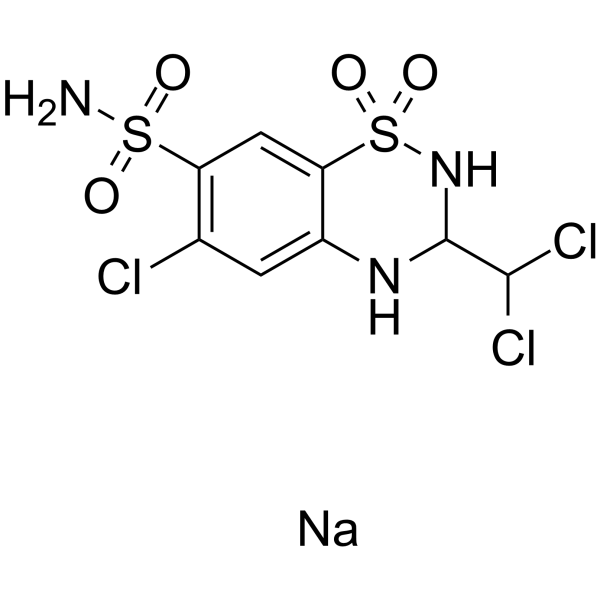
Trichlormethiazide sodium
Based on 2 publication(s) in Google Scholar
Trichlormethiazide sodium is an orally active thiazide diuretic, with antihypertensive effect. Trichlormethiazide sodium increases urine volume (UV), Na and K excretion and tends to improve the depressed creatinine clearance (CCRE) in acute renal failure rats model.
For research use only. We do not sell to patients.
- CAS No.: 91996-54-2
- Formula: C8H8Cl3N3NaO4S2
- Molecular Weight:403.65
-
Storage:
Please store the product under the recommended conditions in the Certificate of Analysis.

To place orders, for customer services and technical support, please contact: MedChemExpress USA
Tel: 609-228-6898 E-mail: [email protected] [email protected]


-
 Biological Activity
-
Chemical Information
- Protocols
- Purity & Documentation
- References
-
 Help & FAQs


Publications Citing Use of MedChemExpress (MCE) Trichlormethiazide sodium
More

Biological Activity
Description
In Vivo
Trichlormethiazide (10 mg/kg, i.v.; daily for 5 days) sodium significantly reduces mean arterial pressure (MAP) within 24 h in high salt intake (HS) rats receiving angiotensin II, but does not affect MAP in any other group[2].
MedChemExpress (MCE) has not independently confirmed the accuracy of these methods. They are for reference only.
-
Animal Model:Male Wistar rats, weighing 170-300 g[1]
-
Dosage:1 mg/kg
-
Administration:Oral administration, once
-
Result:Significantly increased potassium excretion in normal rats. Significantly increased urinary volume, sodium and potassium excretion in cisplatin-induced ARF (acute renal failures) rats.
-
Animal Model:Male Sprague-Dawley rats (350-450 g)[2]
-
Dosage:10 mg/kg
-
Administration:Intravenous injection, daily, for 15 days
-
Result:Produced a significant fall in MAP in rats on combined angiotensin II and high salt intake.


Chemical Information
-
CAS No. 91996-54-2
-
Molecular Weight 403.65
-
Formula C8H8Cl3N3NaO4S2
-
SMILES
O=S(C1=C(Cl)C=C(C2=C1)NC(C(Cl)Cl)NS2(=O)=O)(N)=O.[Na]
-
Shipping
Room temperature in continental US; may vary elsewhere.
-
Storage
Please store the product under the recommended conditions in the Certificate of Analysis.


Publications (2)
-
Journal Impact Factor
-
Most Recent
-
ACS Environ Au
Machine Learning-Assisted Recognition of Environmental Sulfur-Containing Chemicals in Nontargeted Mass Spectrometry Analysis of Inadequate Mass Resolution. [Abstract]2025 Aug 5;5(6):573-582. PMID: 41277996 -
Anal Chem
Exposome-Scale Investigation of Cl-/Br-Containing Chemicals Using High-Resolution Mass Spectrometry, Multistage Machine Learning, and Cloud Computing. [Abstract]2025 Jun 3;97(21):11099-11109. PMID: 40401576

Protocols
-
Nephrotoxicity Study
This protocol assesses nephrotoxicity by combining functional kidney injury readouts, urinary/tissue injury biomarkers, and renal histopathology. Serum creatinine and BUN reflect impaired kidney function, while KIM-1, NGAL, clusterin, osteopontin, IL-18, cystatin C, nephrin, Oat5, urinary protein, glucose, and alkaline phosphatase have been used to detect tubular injury in cisplatin-, gentamicin-, and acetaminophen-induced nephrotoxicity models.
-
Protocol for Pharmacokinetic Study
Pharmacokinetic studies quantify how an organism handles a drug over time through absorption, distribution, metabolism, and excretion, and the core experimental readout is the concentration-time profile of parent drug and, when relevant, metabolites in biological matrices such as plasma, whole blood, urine, bile, or tissue. Pharmacokinetic analysis links dose, route, exposure, clearance, half-life, distribution, bioavailability, and systemic exposure to drug efficacy and toxicity hypotheses rather than measuring a signaling pathway directly. The literature links pharmacokinetics to drug-development phenotypes by showing that drug metabolism and pharmacokinetics influence compound progression, exposure-response interpretation, safety margins, dosing strategy, and failure risk during discovery and development. DMPK science contributes to compound optimization by integrating physicochemical properties, in vitro metabolism, transporter behavior, in vivo exposure, and pharmacodynamic contex


Purity & Documentation
References
[1]. K Yao, et al. Diuretic effects of KW-3902, a novel adenosine A1-receptor antagonist, in various models of acute renal failure in rats. Jpn J Pharmacol. 1994 Apr;64(4):281-8. [Content Brief]
[2]. J R Ballew, et al. Characterization of the antihypertensive effect of a thiazide diuretic in angiotensin II-induced hypertension. J Hypertens. 2001 Sep;19(9):1601-6. [Content Brief]

Calculators
Concentration (start) × Volume (start) = Concentration (final) × Volume (final)


Trichlormethiazide sodium Related Classifications
HY-B0235A Related Classifications
 Powered by Bioz