



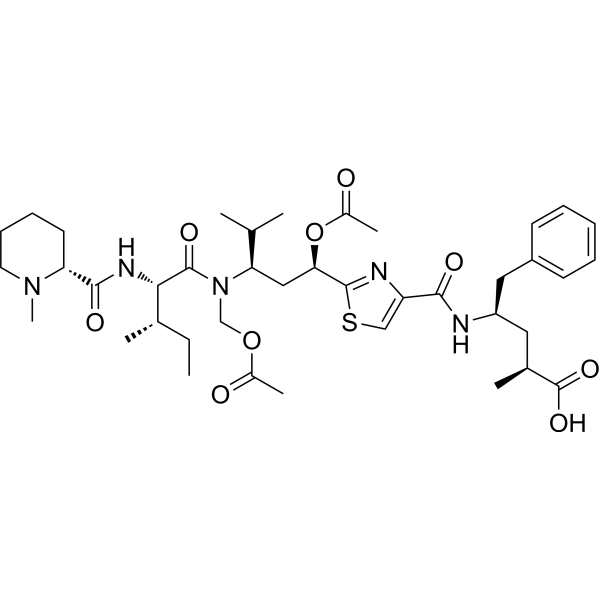
Tubulysin H
Tubulysin H is a highly cytotoxic anti-microtubule toxin (anti-microtubule toxins) that is synthesized as an ADC cytotoxin (ADC Cytotoxin). Tubulysin H can be isolated from the myxobacteria Archangium geophyra and Angiococcus disciformis. Tubulysin H displays extremely potent cytotoxic activity in mammalian cells, including multidrug-resistant cell lines, with IC50 values in the low nanomolar range. Tubulysin H inhibits microtubule/tubulin polymerization and leads to cell cycle arrest and apoptosis.
Para uso exclusivo en investigación. No vendemos a pacientes.
- No. CAS: 799822-09-6
- Fòrmula: C40H59N5O9S
- Peso molecular:785.99
-
Almacenamiento:
Please store the product under the recommended conditions in the Certificate of Analysis.

To place orders, for customer services and technical support, please contact: MedChemExpress USA
Tel: 609-228-6898 E-mail: [email protected] [email protected]


-
 Actividad biológica
-
Chemical Information
- Protocolo
- Pureza y Documentación
- Referencias
-
 Help & FAQs


Ver todos los productos específicos de isoformas ADC Payloads
More

Actividad biológica
Descripciòn


Chemical Information
-
No. CAS 799822-09-6
-
Peso molecular 785.99
-
Fòrmula C40H59N5O9S
-
SMILES
O=C(N[C@@H]([C@@H](C)CC)C(N(COC(C)=O)[C@@H](C(C)C)C[C@@H](OC(C)=O)C1=NC(C(N[C@@H](CC2=CC=CC=C2)C[C@H](C)C(O)=O)=O)=CS1)=O)[C@@H]3N(C)CCCC3
-
Structure Classification
-
Initial Source
Archangium gephyra and Angiococcus disciformis
-
Envío
Room temperature in continental US; may vary elsewhere.
-
Almacenamiento
Please store the product under the recommended conditions in the Certificate of Analysis.


Pureza y Documentación
Referencias
[1]. Steinmetz H, et al. Isolation, crystal and solution structure determination, and biosynthesis of tubulysins--powerful inhibitors of tubulin polymerization from myxobacteria. Angew Chem Int Ed Engl. 2004 Sep 20;43(37):4888-92. [Content Brief]
[2]. Kubicek K, et al. The tubulin-bound structure of the antimitotic drug tubulysin. Angew Chem Int Ed Engl. 2010 Jun 28;49(28):4809-12. [Content Brief]
[3]. Vlahov IR, et al. Acid mediated formation of an N-acyliminium ion from tubulysins: a new methodology for the synthesis of natural tubulysins and their analogs. Bioorg Med Chem Lett. 2011 Nov 15;21(22):6778-81. [Content Brief]

Calculators
Concentration (start) × Volume (start) = Concentration (final) × Volume (final)


Tubulysin H Related Classifications
HY-N7051 Related Classifications
 Powered by Bioz