



UTP trisodium salt, 100 mM Solution, PCR Grade

Based on 1 Customer Validation
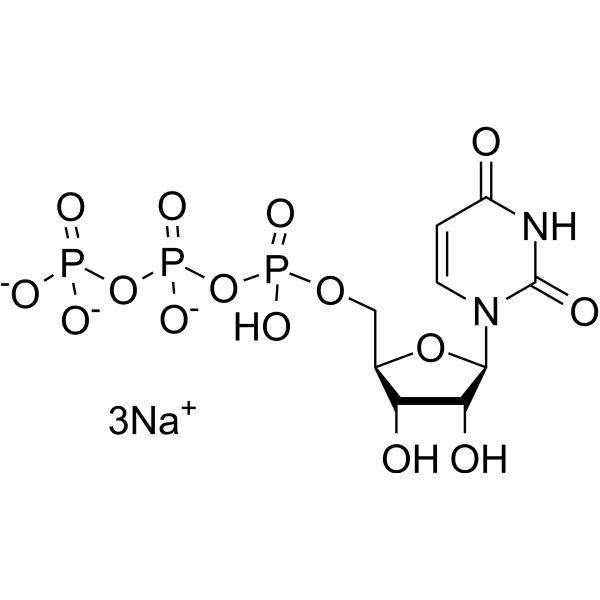
UTP (Uridine 5'-triphosphate) trisodium salt, 100 mM Solution, PCR Grade is a solution prepared from uridine triphosphate at a concentration of 100 mM, free of DNase, RNase and phosphatase contamination, suitable for molecular biology research. Uridine triphosphate (HY-107372) is a pyrimidine nucleoside triphosphate that is used as a substrate to synthesize RNA or as an energy source in metabolic reactions. Uridine triphosphate activates membrane-bound P2Y2 receptors.
For research use only. We do not sell to patients.
- CAS No.: 19817-92-6
- Formula: C9H12N2Na3O15P3
- Molecular Weight:550.09
-
Storage:
Solution, -20°C, 2 years


To place orders, for customer services and technical support, please contact: MedChemExpress USA
Tel: 609-228-6898 E-mail: [email protected] [email protected]


-
 Biological Activity
-
Chemical Information
- Purity & Documentation
- References
-
 Help & FAQs


-

HY-B2176I
ATP disodium salt, 100 mM Solution, PCR Grade -

HY-113225H
GTP trisodium salt, 100 mM Solution, PCR Grade -

HY-125818I
CTP disodium salt, 100 mM Solution, PCR Grade -
HY-W013093
Uridine triphosphate trisodium salt -
HY-B2176
ATP -
HY-W010918
Adenosine 5'-diphosphate -

HY-W013093R
Uridine triphosphate trisodium salt (Standard) -
HY-B0345A
ATP disodium salt -
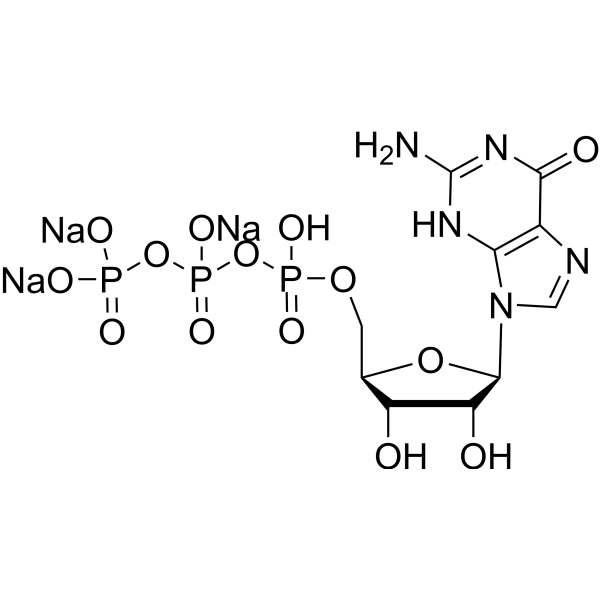
HY-12695
Guanosine triphosphate trisodium -

HY-B2176R
ATP (Standard) -

HY-W010918R
Adenosine 5'-diphosphate (Standard) -
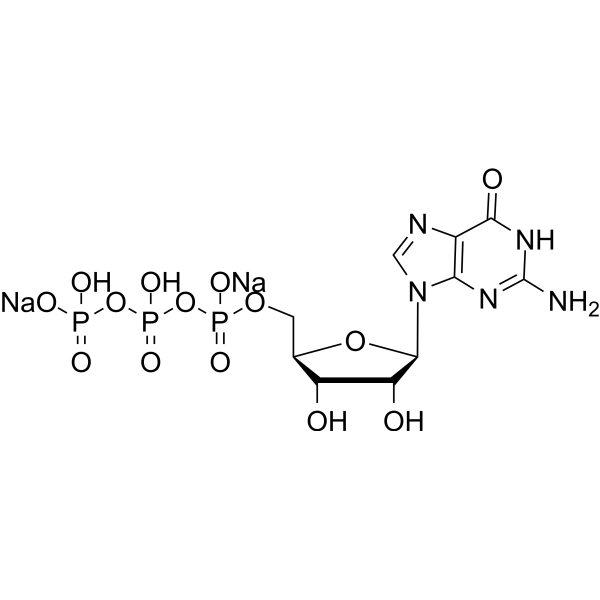
HY-W010737
Guanosine triphosphate disodium
All Endogenous Metabolite Isoforms
MoreAll DNA/RNA Synthesis Isoforms
MoreAll P2Y Receptor Isoforms
More

Biological Activity
Description
Cellular Effect
|
Cell Line

|
Type | Value | Description | References |
|---|---|---|---|---|
| A549 | EC50 |
0.45 μM
Compound: UTP
|
Activity against human P2Y2-GFP expressed in A549 cells by intracellular calcium increase
Activity against human P2Y2-GFP expressed in A549 cells by intracellular calcium increase
|
[PMID: 16539385] |
| HEK293 | EC50 |
0.13 μM
Compound: UTP
|
Activity against rat P2Y2-GFP transfected in HEK293 cells by intracellular calcium increase
Activity against rat P2Y2-GFP transfected in HEK293 cells by intracellular calcium increase
|
[PMID: 16539385] |
| NG108-15 | EC50 |
1.26 μM
Compound: UTP
|
Agonist activity at mouse P2Y2 receptor expressed in NG108-15 hybrid cells assessed as increase in intracellular calcium release by fluorescence assay
Agonist activity at mouse P2Y2 receptor expressed in NG108-15 hybrid cells assessed as increase in intracellular calcium release by fluorescence assay
|
[PMID: 19523835] |
| NG108-15 | IC50 |
1.51 μM
Compound: UTP
|
Antagonist activity at mouse P2Y2 receptor expressed in NG108-15 hybrid cells assessed as inhibition of 1 uM UTP-induced intracellular calcium release preincubated 30 mins before UTP challenge by fluorescence assay
Antagonist activity at mouse P2Y2 receptor expressed in NG108-15 hybrid cells assessed as inhibition of 1 uM UTP-induced intracellular calcium release preincubated 30 mins before UTP challenge by fluorescence assay
|
[PMID: 19523835] |
In Vitro
UTP enhances the migration and wound repair of RT4-D6P2T cells by activating the P2Y2 receptor and increasing the activation and expression of extracellular MMP-2[2].
UTP induces MAPK phosphorylation in a biphasic manner. It causes early transient phosphorylation within 5 minutes after treatment, and late persistent phosphorylation occurs 6 hours later, lasting for up to 24 hours[2].
MedChemExpress (MCE) has not independently confirmed the accuracy of these methods. They are for reference only.
-
Cell Line:RT4-D6P2T cells
-
Concentration:250 μM
-
Incubation Time:5 min, 45 min, 2 h, 6 h, 12 h, 24 h, 48 h
-
Result:Induces biphasic MAPK phosphorylation.
In Vivo
MedChemExpress (MCE) has not independently confirmed the accuracy of these methods. They are for reference only.
-
Animal Model:Male Wistar rats (250-300 g; 2-3 months) with myocardial infarction (MI)[3]
-
Dosage:0.44 µg/kg 30 min before MI, and 4.4 µg/kg i.v. 24 h prior to MI.
-
Administration:i.v.; once
-
Result:Reduced infarct size and improves rat heart function after myocardial infarct.


Chemical Information
-
CAS No. 19817-92-6
-
Appearance Liquid
-
Molecular Weight 550.09
-
Formula C9H12N2Na3O15P3
-
Color Colorless to light yellow
-
SMILES
O=C(N1[C@H]2[C@H](O)[C@H](O)[C@@H](COP(O)(OP(OP(O[Na])(O[Na])=O)(O[Na])=O)=O)O2)NC(C=C1)=O
-
Synonyms
Uridine 5'-triphosphate trisodium salt, 100 mM Solution, PCR Grade
-
Shipping
Room temperature in continental US; may vary elsewhere.
-
Storage
Solution, -20°C, 2 years


Purity & Documentation
-
Data Sheet (275 KB)
-
SDS (252 KB)
- English - EN (252 KB)
- Français - FR (252 KB)
- Deutsch - DE (252 KB)
- Norwegian - NO (252 KB)
- Español - ES (252 KB)
- Swedish - SV (252 KB)
- Italian - IT (252 KB)
- Korean - KR (252 KB)
- Portuguese - PT (252 KB)
-
Handling Instructions (2659 KB)
References
[1]. Choi JH, et al. Uridine triphosphate increases proliferation of human cancerous pancreatic duct epithelial cells by activating P2Y2 receptor. Pancreas. 2013 May;42(4):680-6. [Content Brief]
[2]. Lamarca A, et al. Uridine 5'-triphosphate promotes in vitro Schwannoma cell migration through matrix metalloproteinase-2 activation. PLoS One. 2014 Jun 6;9(6):e98998. [Content Brief]
[3]. Yitzhaki S, et al. Uridine-5'-triphosphate (UTP) reduces infarct size and improves rat heart function aftermyocardial infarct. Biochem Pharmacol. 2006 Oct 16;72(8):949-55. [Content Brief]

Calculators
Concentration (start) × Volume (start) = Concentration (final) × Volume (final)


UTP trisodium salt, 100 mM Solution, PCR Grade Related Classifications
HY-107372H Related Classifications
 Powered by Bioz