



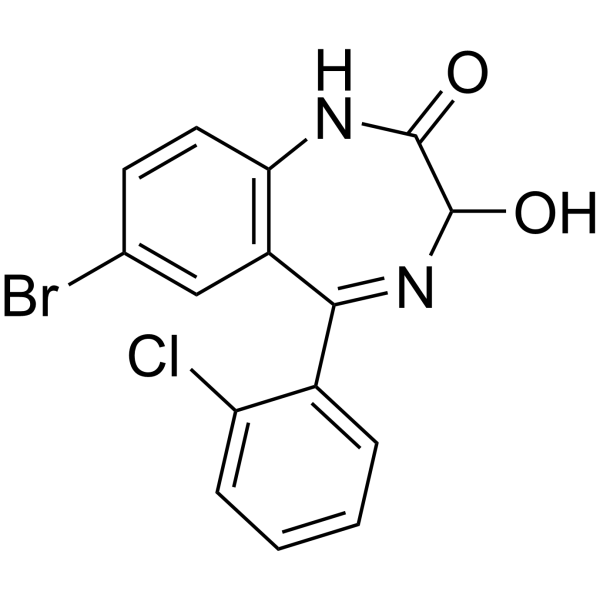
3-Hydroxyphenazepam

Based on 1 Customer Validation
3-Hydroxyphenazepam is a blood-brain barrier-permeable GABAA receptor positive allosteric modulator (PAM) with EC50 values of 2, 3, 17, > 300, and 10 nM for the hα1β3γ2, hα2β3γ2, hα3β3γ2, hα4β3γ2, and hα5β3γ2 subtypes, respectively. 3-Hydroxyphenazepam is the active metabolite of Cinazepam (HY-138014) and exhibits sedative-hypnotic, anticonvulsant, antihypoxic, and muscle-relaxant activities. 3-Hydroxyphenazepam binds with high affinity to GABAA receptors (Ki = 1.8 nM), thereby inhibiting transporter-mediated GABA uptake at presynaptic nerve terminals, causing synaptic membrane depolarization and reducing synaptic vesicle acidification. 3-Hydroxyphenazepam can be used for research on central nervous system disorders such as anxiety, epilepsy, and neuropathic pain.
For research use only. We do not sell to patients.
- CAS No.: 70030-11-4
- Formula: C15H10BrClN2O2
- Molecular Weight:365.61
-
Storage:Powder -20°C, 3 years ; In solvent -80°C, 6 months , -20°C, 1 month

To place orders, for customer services and technical support, please contact: MedChemExpress USA
Tel: 609-228-6898 E-mail: [email protected] [email protected]


-
 Biological Activity
-
Chemical Information
- Protocols
- Purity & Documentation
- References
-
 Help & FAQs




Biological Activity
Description
IC50 & Target
[1]|
GABAA 1.8 nM (Ki) |
GABAA (hα1β3γ2) 2 nM (EC50) |
GABAA (hα2β3γ2) 3 nM (EC50) |
GABAA (hα3β3γ2) 17 nM (EC50) |
GABAA (hα4β3γ2) > 300 nM (EC50) |
GABAA (hα5β3γ2) 10 nM (EC50) |
In Vitro
3-Hydroxyphenazepam (100 μM) increases Acridine orange (HY-101879) fluorescence in rat cortical synaptosomes, indicating reduced synaptic vesicle acidification[1].
3-Hydroxyphenazepam (100-200 μM; 10 min) reduces transporter-mediated [3H]GABA uptake in rat cortical synaptosomes[1].
3-Hydroxyphenazepam (100-200 μM; 10 min) does not change ambient [3H]GABA levels in rat cortical synaptosomes[1].
3-Hydroxyphenazepam (100 μM; 10 min) does not alter KCl-induced Ca2+-independent transporter-mediated [3H]GABA release in rat cortical synaptosomes[1].
3-Hydroxyphenazepam (100 μM; 10 min) does not induce tonic [3H]GABA release from rat cortical synaptosomes in the presence of NO-711 (HY-114040)[1].
3-Hydroxyphenazepam (100 μM; 10 min) reduces KCl-evoked exocytotic [3H]GABA release from rat cortical synaptosomes in the presence of NO-711[1].
3-Hydroxyphenazepam binds to rat brain synaptic benzodiazepine receptors with a Ki of 1.8 nM[2].
3-hydroxypropoxazepam (0.0001-3 μM) acts as a positive allosteric modulator in HEK293 cells expressing specific GABAA receptor subtypes (hα1β3γ2, hα2β3γ2, hα3β3γ2, hα4β3γ2, hα5β3γ2), significantly enhancing GABA-evoked currents, with potency in the nanomolar range (EC50 of 2-17 nM) and maximal efficacy ranging from 240% to 400% (but with very weak effects on the α4 subtype)[3].
MedChemExpress (MCE) has not independently confirmed the accuracy of these methods. They are for reference only.
In Vivo
MedChemExpress (MCE) has not independently confirmed the accuracy of these methods. They are for reference only.


Chemical Information
-
CAS No. 70030-11-4
-
Appearance Solid
-
Molecular Weight 365.61
-
Formula C15H10BrClN2O2
-
Color White to off-white
-
SMILES
BrC1=CC(C(C2=CC=CC=C2Cl)=NC3O)=C(C=C1)NC3=O
-
Shipping
Room temperature in continental US; may vary elsewhere.
-
Storage
Powder -20°C 3 years In solvent -80°C 6 months -20°C 1 month


Purity & Documentation


References
Hot Topics
-
All
-
Topics
-
Most Recent
-
Oldest
-
Topics Synaptic Plasticity & Brain Health
Synaptic plasticity is the activity-, experience-, development-, and injury-dependent modification of synaptic strength, number, and structure, and it remains a central mechanism for learning, memory, sensory adaptation, and brain health.
2026-06-18

Calculators
Concentration (start) × Volume (start) = Concentration (final) × Volume (final)


3-Hydroxyphenazepam Related Classifications
HY-124030 Related Classifications
 Powered by Bioz
Keywords
- 3-Hydroxyphenazepam
- 70030-11-4
- Drug Metabolite
- GABA Receptor
- Gamma-aminobutyric acid Receptor
- γ-Aminobutyric acid Receptor
- GABA uptake inhibitor
- GABAA receptor
- benzodiazepine allosteric site
- exocytotic GABA release
- seizures
- synaptic vesicle acidification
- synaptosomal plasma membrane depolarization
- α1-containing GABAA receptors
- α2-containing GABAA receptors
- α3-containing GABAA receptors
- Inhibitor
- inhibitor
- inhibit