



D-Arabitol

Based on 1 Customer Validation
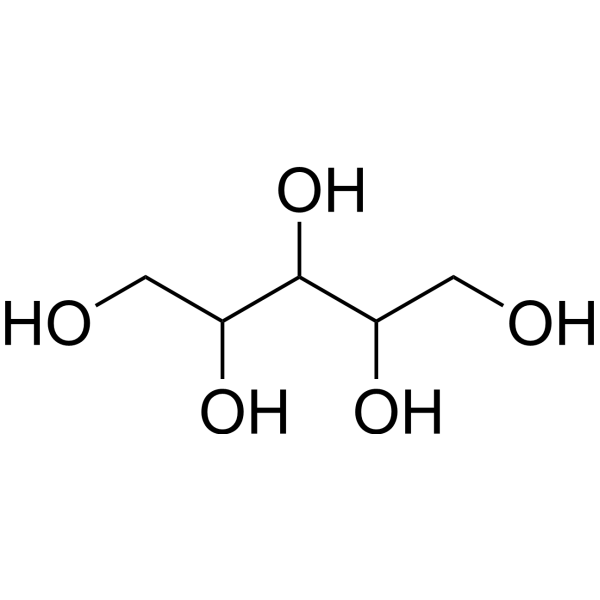
D-Arabitol is an orally active D-enantiomer of arabitol. D-Arabitol modulates the composition of gut microbiota, increases short-chain fatty acids, and promotes AMPK-PGC-1α-related browning of white adipose tissue. D-Arabitol improves weight gain, fat accumulation, insulin resistance, lipid deposition and inflammatory responses. D-Arabitol serves as the sole carbon/energy source for Bacillus methanolicus MGA3, a strain that can co-utilize it with mannitol. D-Arabitol is applicable to obesity-related research.
For research use only. We do not sell to patients.
- Purity : 99.92%
- CAS No.: 488-82-4
- Formula: C5H12O5
- Molecular Weight:152.15
-
Storage:Powder -20°C, 3 years , 4°C, 2 years ; In solvent -80°C, 6 months , -20°C, 1 month

To place orders, for customer services and technical support, please contact: MedChemExpress USA
Tel: 609-228-6898 E-mail: [email protected] [email protected]


-
 Biological Activity
-
Chemical Information
-
Solvent & Solubility
- Protocols
- Purity & Documentation
- References
-
 Help & FAQs


-

HY-N3686R
D-Arabitol (Standard)Analytical Standard -
HY-N0378
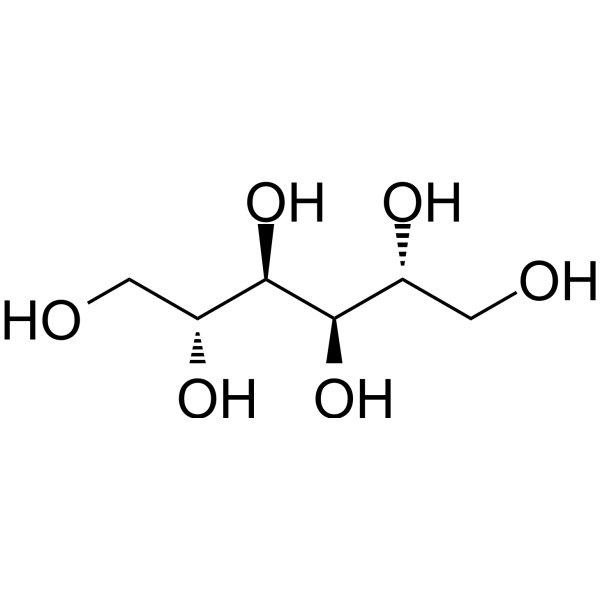
D-MannitolResistant Sugar/Osmotic Diuretics -
HY-N0210
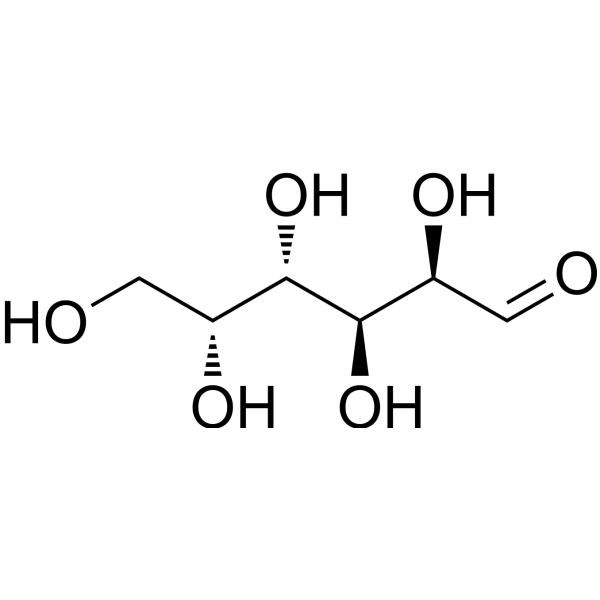
D-GalactoseEndogenous Metabolite -
HY-N7092
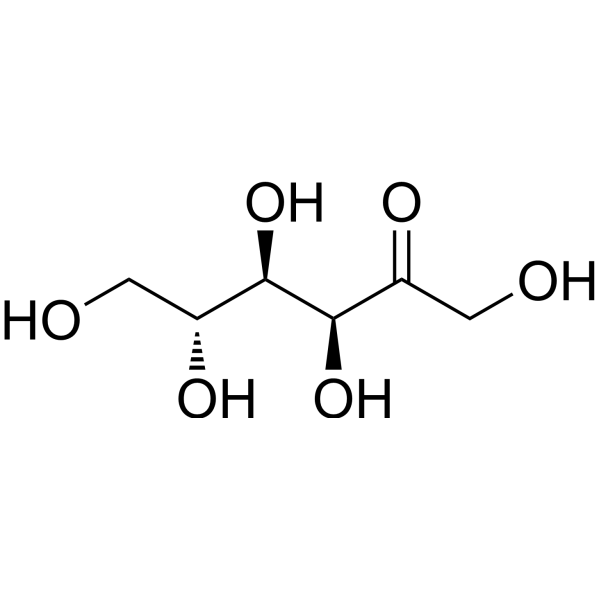
D-FructoseEndogenous Metabolite -
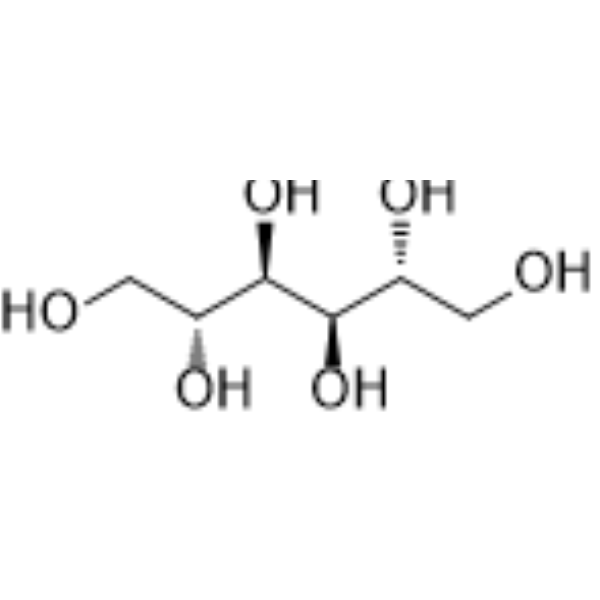
HY-N0378R
D-Mannitol (Standard)Resistant Sugar/Osmotic Diuretics -
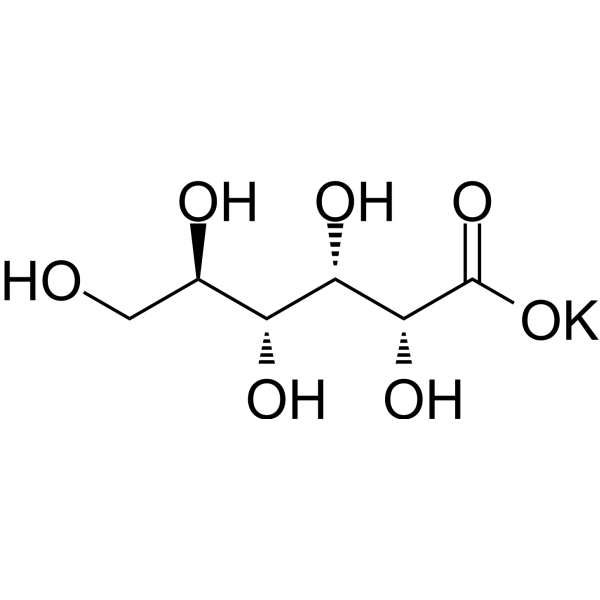
HY-Y0569C
D-Gluconic acid potassiumAntifungal Agent -

HY-N7092R
D-Fructose (Standard)Endogenous Metabolite -

HY-N0210R
D-Galactose (Standard)Endogenous Metabolite -

HY-Y0569CR
D-Gluconic acid potassium (Standard)Antifungal Agent -

HY-N0378AGL
D-Mannitol, M200 (GMP Like)Resistant Sugar -

HY-N0378BGL
D-Mannitol, M100 (GMP Like)Resistant Sugar
All AMPK Isoforms
More

Biological Activity
Description
IC50 & Target
|
Microbial Metabolite |
Human Endogenous Metabolite |
In Vitro
D-arabitol (10-60 mM; duration of growth phase) supports growth of Bacillus methanolicus MGA3 as a sole carbon source with a growth rate of 0.20 h−1 at 15 mM, and is co-consumed with mannitol in equimolar mixtures[2].
D-arabitol (15 mM; growth to mid-exponential phase, OD600 = 1.0) induces significant upregulation of the atlABCD gene cluster in Bacillus methanolicus MGA3, with atlD transcript levels also elevated in co-consumption conditions with mannitol[2].
D-arabitol (30 mM; duration of growth phase) allows heterologous expression of Bacillus methanolicus MGA3 atlD alone, or the full atlABCD gene cluster, to restore growth of arabitol-negative Corynebacterium glutamicum ΔmtlD[2].
D-arabitol (15 mM; growth to mid-exponential phase, OD600 = 1.0) induces elevated arabitol phosphate dehydrogenase activity (0.05 U/mg) in crude cell extracts of Bacillus methanolicus MGA3, with high affinity for xylulose 5-phosphate (Km = 0.03 mM)[2].
MedChemExpress (MCE) has not independently confirmed the accuracy of these methods. They are for reference only. Further protocols information, click here.
-
Cell Line:Bacillus methanolicus MGA3
-
Concentration:15 mM (RNA-seq, sole carbon source); 15 mM (RNA-seq, mannitol control); 15 mM (qRT-PCR, D-arabitol plus 15 mM mannitol)
-
Incubation Time:growth to mid-exponential phase (OD600 = 1.0)
-
Result:Induced significant upregulation of the atlA (log2 fold change = 3.06), atlB (log2 fold change = 3.41), atlC (log2 fold change = 2.73), and atlD (log2 fold change = 2.90) gene cluster when used as a 15 mM sole carbon source compared to 15 mM mannitol.
Showed elevated atlD transcript levels in cells grown on 15 mM D-arabitol plus 15 mM mannitol compared to mannitol alone, as confirmed by qRT-PCR.
In Vivo
MedChemExpress (MCE) has not independently confirmed the accuracy of these methods. They are for reference only.
-
Animal Model:Sprague-Dawley (SD) (male, 180 g)[1]
-
Dosage:4% (dietary supplementation); 8% (dietary supplementation)
-
Administration:dietary supplementation; daily; 10 weeks
-
Result:Significantly reduced HFD-induced body weight gain, liver weight, epididymal fat weight, and Lee's index, with 8% D-Arabitol showing a greater reduction than 4%.
Reduced HFD-induced fasting glucose by 28.17% (8% dose).
Significantly decreased the HOMA-IR index and increased the QUICK index and serum adiponectin levels (both doses).
Dose-dependently reduced serum total cholesterol (TC), triacylglycerols (TG), low-density lipoprotein cholesterol (LDL-C), and hepatic TC and TG, while increasing serum high-density lipoprotein cholesterol (HDL-C) and reducing serum leptin, with 8% D-Arabitol showing more significant lipid-lowering effects than 4%.
Significantly reduced HFD-increased serum aspartate aminotransferase (AST) and alanine aminotransferase (ALT) levels, and reduced hepatic lipid droplet accumulation (8% dose).
Dose-dependently reduced serum levels of proinflammatory cytokines C-reactive protein (CRP), interleukin-6 (IL-6), and tumor necrosis factor-α (TNF-α), and decreased relative mRNA expression of proinflammatory cytokines IL-6, TNF-α, interleukin-1β (IL-1β), and monocyte chemoattractant protein-1 (MCP-1) in epididymal adipose tissue, while increasing anti-inflammatory cytokine interleukin-10 (IL-10) mRNA expression (both doses).
Significantly increased fecal concentrations of propionic acid, butyric acid, isovaleric acid, and total short-chain fatty acids (SCFAs) compared to the HFD group (8% dose).
Upregulated relative mRNA expression of white adipose tissue (WAT) browning-related genes PPAR-γ, Cidea, Prdm16, PGC-1α, and UCP-1 in epididymal adipose tissue, and increased protein expression of AMPK, p-AMPK, and PPAR-γ (8% dose).


Chemical Information
-
CAS No. 488-82-4
-
Appearance Solid
-
Molecular Weight 152.15
-
Formula C5H12O5
-
Color White to off-white
-
SMILES
OCC(O)C(O)C(O)CO
-
Structure Classification
-
Initial Source
-
Shipping
Room temperature in continental US; may vary elsewhere.
-
Storage
Powder -20°C 3 years 4°C 2 years In solvent -80°C 6 months -20°C 1 month


Solvent & Solubility
In Vitro:
DMSO : 66.67 mg/mL (438.19 mM; Need ultrasonic; Hygroscopic DMSO has a significant impact on the solubility of product, please use newly opened DMSO)
Please refer to the solubility information to select the appropriate solvent. Once prepared, please aliquot and store the solution to prevent product inactivation from repeated freeze-thaw cycles.
Storage method and period of stock solution: -80°C, 6 months; -20°C, 1 month. When stored at -80°C, please use it within 6 months. When stored at -20°C, please use it within 1 month.
Please refer to the solubility information to select the appropriate solvent. Once prepared, please aliquot and store the solution to prevent product inactivation from repeated freeze-thaw cycles.
Storage method and period of stock solution: -80°C, 6 months; -20°C, 1 month. When stored at -80°C, please use it within 6 months. When stored at -20°C, please use it within 1 month.
Concentration (start) × Volume (start) = Concentration (final) × Volume (final)
In Vivo:
Select the appropriate dissolution method based on your experimental animal and administration route.
- For the following dissolution methods, please ensure to first prepare a clear stock solution using an In Vitro approach and then sequentially add co-solvents:
- To ensure reliable experimental results, the clarified stock solution can be appropriately stored based on storage conditions. As for the working solution for In Vivo experiments, it is recommended to prepare freshly and use it on the same day.
- The percentages shown for the solvents indicate their volumetric ratio in the final prepared solution. If precipitation or phase separation occurs during preparation, heat and/or sonication can be used to aid dissolution.
Add each solvent one by one: 10% DMSO 40% PEG300 5% Tween-80 45% Saline
Solubility: ≥ 2.5 mg/mL (16.43 mM); Clear solution
This protocol yields a clear solution of ≥ 2.5 mg/mL (saturation unknown).
Taking 1 mL working solution as an example, add 100 μL DMSO stock solution (25.0 mg/mL) to 400 μL PEG300, and mix evenly; then add 50 μL Tween-80 and mix evenly; then add 450 μL Saline to adjust the volume to 1 mL.
Preparation of Saline: Dissolve 0.9 g sodium chloride in ddH₂O and dilute to 100 mL to obtain a clear Saline solution.
Add each solvent one by one: 10% DMSO 90% (20% SBE-β-CD in Saline)
Solubility: ≥ 2.5 mg/mL (16.43 mM); Clear solution
This protocol yields a clear solution of ≥ 2.5 mg/mL (saturation unknown).
Taking 1 mL working solution as an example, add 100 μL DMSO stock solution (25.0 mg/mL) to 900 μL 20% SBE-β-CD in Saline, and mix evenly.
Preparation of 20% SBE-β-CD in Saline (4°C, storage for one week): 2 g SBE-β-CD powder is dissolved in 10 mL Saline, completely dissolve until clear.
In Vivo Dissolution Calculator
Please enter the basic information of animal experiments:
-
-
-
-
Recommended: Prepare an additional quantity of animals to account for potential losses during experiments.
Please enter your animal formula composition:
-
%DMSO +
Recommended: Keep the proportion of DMSO in working solution below 2% if your animal is weak.
-
%+
-
+%Tween-80 + +
-
%Saline +
The co-solvents required include: DMSO, . All of co-solvents are available by MedChemExpress (MCE). , Tween 80. All of co-solvents are available by MedChemExpress (MCE).
Working solution concentration: 0.22 mg/mL
Method for preparing stock solution: mg drug dissolved in μL DMSO. Stock solution concentration: mg/mL.
1. Take μL DMSO stock solution;
2. Add μL .
μL , mix evenly;
3. Then add μL Tween 80, mix evenly;
4. Then add μL
Please ensure that the stock solution in the first step is dissolved to a clear state, and add co-solvents in sequence. You can use ultrasonic heating (ultrasonic cleaner, recommended frequency 20-40 kHz), vortexing, etc. to assist dissolution.

Protocols
-
Large-size fat particle sorting
Large-size fat particle sorting is widely used to isolate cells up to 200 μm in diameter. Single-cell flow sorting will allow greater insight into adipocyte heterogeneity by identifying gene expression, protein composition, and metabolic signatures at the single-cell level.
-
Research Protocol for Endocrine Diseases
Endocrine diseases often arise from disrupted hormone production, hormone signaling, or target-tissue responsiveness; for diabetes-focused endocrine disease models, insulin signaling regulates glucose uptake, hepatic glucose output, lipid metabolism, and β-cell compensation. Type 2 diabetes develops through interacting defects in insulin resistance, β-cell dysfunction, adipose inflammation, hepatic glucose overproduction, altered incretin signaling, and ectopic lipid metabolism. A major unresolved question is whether endocrine dysfunction is driven primarily by target-tissue insulin resistance, intrinsic β-cell failure, immune/inflammatory stress, or combined multi-organ failure that differs by disease stage.
-
Research Protocol for Microbiome Analysis
Microbiome analysis characterizes microbial communities in biological or environmental samples by measuring community composition, diversity, taxonomic structure, functional potential, and associations with host or environmental phenotypes. 16S rRNA gene amplicon sequencing is commonly used for bacterial and archaeal taxonomic profiling, while shotgun metagenomics provides higher taxonomic resolution and direct functional information, including microbial genes, pathways, viruses, fungi, and antimicrobial-resistance genes when sequencing depth and host-DNA contamination are adequately controlled. Microbiome results are strongly affected by sample collection, storage, DNA extraction, contamination, sequencing method, reference database, and bioinformatic pipeline; therefore, standardized protocols, negative controls, mock communities, and transparent analysis workflows are required. Unresolved issues include low-biomass contamination, compositional-data bias, inconsistent species-level c
-
Research Protocol for Metabolic Diseases
AMP-activated protein kinase, AMPK, is a conserved cellular energy sensor that responds to reduced cellular energy status and coordinates metabolism by increasing ATP-generating catabolic pathways while suppressing ATP-consuming anabolic processes. In metabolic disease research, the AMPK pathway is experimentally relevant because it regulates hepatic lipid synthesis, fatty acid oxidation, glucose production, skeletal-muscle glucose disposal, mTORC1-linked biosynthesis, autophagy, mitochondrial homeostasis, and whole-body energy balance. The central pathway logic is that energy stress, metformin, exercise-like stimulation, or direct AMPK activators increase AMPKα Thr172 phosphorylation and downstream substrate phosphorylation, including ACC and RAPTOR. Phosphorylation of ACC suppresses lipogenesis and supports fatty acid oxidation, whereas phosphorylation of RAPTOR suppresses mTORC1 signaling and links cellular energy status to growth and protein synthesis control. The pathway is linked


Purity & Documentation
-
Data Sheet (284 KB)
-
SDS (393 KB)
- English - EN (393 KB)
- Français - FR (393 KB)
- Deutsch - DE (393 KB)
- Norwegian - NO (393 KB)
- Español - ES (393 KB)
- Swedish - SV (393 KB)
- Italian - IT (393 KB)
- Korean - KR (393 KB)
- Portuguese - PT (393 KB)
-
Handling Instructions (2659 KB)
References
[1]. Li X, et al. d-Arabitol Ameliorates Obesity and Metabolic Disorders via the Gut Microbiota-SCFAs-WAT Browning Axis. J Agric Food Chem. 2023;71(1):522-534. [Content Brief]
[2].
López MG, et al. Characterization of D-Arabitol as Newly Discovered Carbon Source of Bacillus methanolicus. Front Microbiol. 2019 Jul 31;10:1725.
[Content Brief]


Complete Stock Solution Preparation Table
Please refer to the solubility information to select the appropriate solvent. Once prepared, please aliquot and store the solution to prevent product inactivation from repeated freeze-thaw cycles.
Storage method and period of stock solution: -80°C, 6 months; -20°C, 1 month. When stored at -80°C, please use it within 6 months. When stored at -20°C, please use it within 1 month.
| Optional Solvent | Concentration Solvent Mass | 1 mg | 5 mg | 10 mg | 25 mg |
|---|---|---|---|---|---|
| DMSO | 1 mM | 6.5725 mL | 32.8623 mL | 65.7246 mL | 164.3115 mL |
| 5 mM | 1.3145 mL | 6.5725 mL | 13.1449 mL | 32.8623 mL | |
| 10 mM | 0.6572 mL | 3.2862 mL | 6.5725 mL | 16.4312 mL | |
| 15 mM | 0.4382 mL | 2.1908 mL | 4.3816 mL | 10.9541 mL | |
| 20 mM | 0.3286 mL | 1.6431 mL | 3.2862 mL | 8.2156 mL | |
| 25 mM | 0.2629 mL | 1.3145 mL | 2.6290 mL | 6.5725 mL | |
| 30 mM | 0.2191 mL | 1.0954 mL | 2.1908 mL | 5.4771 mL | |
| 40 mM | 0.1643 mL | 0.8216 mL | 1.6431 mL | 4.1078 mL | |
| 50 mM | 0.1314 mL | 0.6572 mL | 1.3145 mL | 3.2862 mL | |
| 60 mM | 0.1095 mL | 0.5477 mL | 1.0954 mL | 2.7385 mL | |
| 80 mM | 0.0822 mL | 0.4108 mL | 0.8216 mL | 2.0539 mL | |
| 100 mM | 0.0657 mL | 0.3286 mL | 0.6572 mL | 1.6431 mL |


D-Arabitol Related Classifications
HY-N3686 Related Classifications
 Powered by Bioz