



COH29
Based on 5 publication(s) in Google Scholar
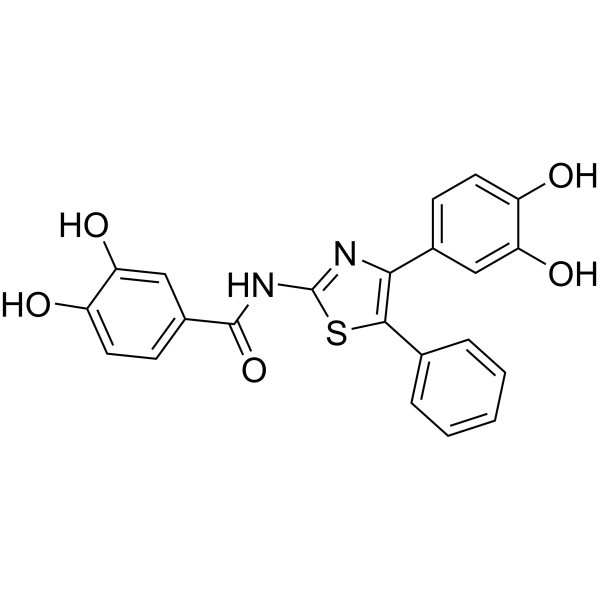
COH29 (RNR Inhibitor COH29) is a potent ribonucleotide reductase (RNR) inhibitor with anticancer activity. COH29 inhibits α and β subunit of RNR with IC50s of 16 μM.
Nos produits utilisent uniquement pour la recherche. Nous ne vendons pas aux patients.
- Pureté : 98.76%
- CAS No.: 1190932-38-7
- Formule: C22H16N2O5S
- Masse moléculaire:420.44
-
Stockage:Powder -20°C, 3 years , 4°C, 2 years ; In solvent -80°C, 6 months , -20°C, 1 month

To place orders, for customer services and technical support, please contact: MedChemExpress USA
Tel: 609-228-6898 E-mail: [email protected] [email protected]


-
 Activité biologique
-
Chemical Information
-
Solvant et solubilité
- Pureté et documentation
- Références
-
 Help & FAQs


Publications Citing Use of MedChemExpress (MCE) COH29
MoreVoir tous les produits spécifiques à Isoform DNA/RNA Synthesis
More

Activité biologique
Description
IC50 & Target
IC50: 8 μM (RNR, KB cell), 31.57±3.35 μM (RNR, OV90 cell)[2]
In Vitro
COH29 (RNR Inhibitor COH29) overcome hydroxyurea and gemcitabine resistance in cancer cells. It effectively inhibits proliferation of most cell lines in the NCI 60 human cancer panel, most notably ovarian cancer and leukemia, but exerts little effect on normal fibroblasts or endothelial cells. Site-directed mutagenesis, NMR and surface plasmon resonance biosensor studies confirm COH29 binding to the proposed ligand-binding pocket and offer evidence for assembly blockade of the RRM1-RRM2 quaternary structure[1].
MedChemExpress (MCE) has not independently confirmed the accuracy of these methods. They are for reference only. .
In Vivo
MedChemExpress (MCE) has not independently confirmed the accuracy of these methods. They are for reference only.
Essai clinique
| NCT Number | Sponsor | Condition | Start Date |
Phase

|
|---|---|---|---|---|
| NCT01329991 | Plexxikon| | 2011-05 | PHASE1 |


Chemical Information
-
CAS No. 1190932-38-7
-
Appearance Solid
-
Masse moléculaire 420.44
-
Formule C22H16N2O5S
-
Color Light yellow to yellow
-
SMILES
O=C(NC1=NC(C2=CC=C(O)C(O)=C2)=C(C3=CC=CC=C3)S1)C4=CC=C(O)C(O)=C4
-
Synonyms
RNR Inhibitor COH29
-
Livraison
Room temperature in continental US; may vary elsewhere.
-
Stockage
Powder -20°C 3 years 4°C 2 years In solvent -80°C 6 months -20°C 1 month


Publications (5)
-
Journal Impact Factor
-
Most Recent
-
J Exp Clin Cancer Res
Targeting of RRM2 suppresses DNA damage response and activates apoptosis in atypical teratoid rhabdoid tumor. [Abstract]2023 Dec 20;42(1):346. PMID: 38124207 -
mBio
Blockade of de novo dNTP biosynthesis pathway delays HIV-1 early life cycle kinetics and dynamics. [Abstract]2025 Aug 13;16(8):e0104725. PMID: 40586616 -
Bioorg Chem
Identification of FTY720 and COH29 as novel topoisomerase I catalytic inhibitors by experimental and computational studies. [Abstract]2024 Jun:147:107412. PMID: 38696845 -
Sci Rep
De novo deoxyribonucleotide biosynthesis regulates cell growth and tumor progression in small-cell lung carcinoma. [Abstract]2021 Jun 29;11(1):13474. PMID: 34188151 -
Cancers (Basel)
Novel Insights into the Molecular Regulation of Ribonucleotide Reductase in Adrenocortical Carcinoma Treatment. [Abstract]2021 Aug 20;13(16):4200. PMID: 34439352


Solvant et solubilité
In Vitro:
DMSO : 50 mg/mL (118.92 mM; Need ultrasonic; Hygroscopic DMSO has a significant impact on the solubility of product, please use newly opened DMSO)
Please refer to the solubility information to select the appropriate solvent. Once prepared, please aliquot and store the solution to prevent product inactivation from repeated freeze-thaw cycles.
Storage method and period of stock solution: -80°C, 6 months; -20°C, 1 month. When stored at -80°C, please use it within 6 months. When stored at -20°C, please use it within 1 month.
Please refer to the solubility information to select the appropriate solvent. Once prepared, please aliquot and store the solution to prevent product inactivation from repeated freeze-thaw cycles.
Storage method and period of stock solution: -80°C, 6 months; -20°C, 1 month. When stored at -80°C, please use it within 6 months. When stored at -20°C, please use it within 1 month.
Concentration (start) × Volume (start) = Concentration (final) × Volume (final)
In Vivo:
Select the appropriate dissolution method based on your experimental animal and administration route.
- For the following dissolution methods, please ensure to first prepare a clear stock solution using an In Vitro approach and then sequentially add co-solvents:
- To ensure reliable experimental results, the clarified stock solution can be appropriately stored based on storage conditions. As for the working solution for In Vivo experiments, it is recommended to prepare freshly and use it on the same day.
- The percentages shown for the solvents indicate their volumetric ratio in the final prepared solution. If precipitation or phase separation occurs during preparation, heat and/or sonication can be used to aid dissolution.
Add each solvent one by one: 10% DMSO 40% PEG300 5% Tween-80 45% Saline
Solubility: ≥ 2.5 mg/mL (5.95 mM); Clear solution
This protocol yields a clear solution of ≥ 2.5 mg/mL (saturation unknown).
Taking 1 mL working solution as an example, add 100 μL DMSO stock solution (25.0 mg/mL) to 400 μL PEG300, and mix evenly; then add 50 μL Tween-80 and mix evenly; then add 450 μL Saline to adjust the volume to 1 mL.
Preparation of Saline: Dissolve 0.9 g sodium chloride in ddH₂O and dilute to 100 mL to obtain a clear Saline solution.
Add each solvent one by one: 10% DMSO 90% (20% SBE-β-CD in Saline)
Solubility: ≥ 2.5 mg/mL (5.95 mM); Clear solution
This protocol yields a clear solution of ≥ 2.5 mg/mL (saturation unknown).
Taking 1 mL working solution as an example, add 100 μL DMSO stock solution (25.0 mg/mL) to 900 μL 20% SBE-β-CD in Saline, and mix evenly.
Preparation of 20% SBE-β-CD in Saline (4°C, storage for one week): 2 g SBE-β-CD powder is dissolved in 10 mL Saline, completely dissolve until clear.
For the following dissolution methods, please prepare the working solution directly:
It is recommended to prepare fresh solutions and use them promptly within a short period of time.
The percentages shown for the solvents indicate their volumetric ratio in the final prepared solution. If precipitation or phase separation occurs during preparation, heat and/or sonication can be used to aid dissolution.
Add each solvent one by one: 30% Solutol HS-15 in Saline
Solubility: 5 mg/mL (11.89 mM); Suspended solution; Need ultrasonic
In Vivo Dissolution Calculator
Please enter the basic information of animal experiments:
-
-
-
-
Recommended: Prepare an additional quantity of animals to account for potential losses during experiments.
Please enter your animal formula composition:
-
%DMSO +
Recommended: Keep the proportion of DMSO in working solution below 2% if your animal is weak.
-
%+
-
+%Tween-80 + +
-
%Saline +
The co-solvents required include: DMSO, . All of co-solvents are available by MedChemExpress (MCE). , Tween 80. All of co-solvents are available by MedChemExpress (MCE).
Working solution concentration: 0.22 mg/mL
Method for preparing stock solution: mg drug dissolved in μL DMSO. Stock solution concentration: mg/mL.
1. Take μL DMSO stock solution;
2. Add μL .
μL , mix evenly;
3. Then add μL Tween 80, mix evenly;
4. Then add μL
Please ensure that the stock solution in the first step is dissolved to a clear state, and add co-solvents in sequence. You can use ultrasonic heating (ultrasonic cleaner, recommended frequency 20-40 kHz), vortexing, etc. to assist dissolution.


Pureté et documentation
-
Fiche technique (281 KB)
-
SDS (393 KB)
- English - EN (393 KB)
- Français - FR (393 KB)
- Deutsch - DE (393 KB)
- Norwegian - NO (393 KB)
- Español - ES (393 KB)
- Swedish - SV (393 KB)
- Italian - IT (393 KB)
- Korean - KR (393 KB)
- Portuguese - PT (393 KB)
-
Instruction de manipulation (2659 KB)
Références
[1]. Zhou B, et al. A small-molecule blocking ribonucleotide reductase holoenzyme formation inhibits cancer cell growth and overcomes drug resistance.Cancer Res. 2013 Nov 1;73(21):6484-93. [Content Brief]
[2]. Chen MC, et al. The Novel Ribonucleotide Reductase Inhibitor COH29 Inhibits DNA Repair In Vitro. Mol Pharmacol. 2015 Jun;87(6):996-1005. [Content Brief]


Complete Stock Solution Preparation Table
Please refer to the solubility information to select the appropriate solvent. Once prepared, please aliquot and store the solution to prevent product inactivation from repeated freeze-thaw cycles.
Storage method and period of stock solution: -80°C, 6 months; -20°C, 1 month. When stored at -80°C, please use it within 6 months. When stored at -20°C, please use it within 1 month.
| Optional Solvent | Concentration Solvent Mass | 1 mg | 5 mg | 10 mg | 25 mg |
|---|---|---|---|---|---|
| DMSO | 1 mM | 2.3785 mL | 11.8923 mL | 23.7846 mL | 59.4615 mL |
| 5 mM | 0.4757 mL | 2.3785 mL | 4.7569 mL | 11.8923 mL | |
| 10 mM | 0.2378 mL | 1.1892 mL | 2.3785 mL | 5.9462 mL | |
| 15 mM | 0.1586 mL | 0.7928 mL | 1.5856 mL | 3.9641 mL | |
| 20 mM | 0.1189 mL | 0.5946 mL | 1.1892 mL | 2.9731 mL | |
| 25 mM | 0.0951 mL | 0.4757 mL | 0.9514 mL | 2.3785 mL | |
| 30 mM | 0.0793 mL | 0.3964 mL | 0.7928 mL | 1.9821 mL | |
| 40 mM | 0.0595 mL | 0.2973 mL | 0.5946 mL | 1.4865 mL | |
| 50 mM | 0.0476 mL | 0.2378 mL | 0.4757 mL | 1.1892 mL | |
| 60 mM | 0.0396 mL | 0.1982 mL | 0.3964 mL | 0.9910 mL | |
| 80 mM | 0.0297 mL | 0.1487 mL | 0.2973 mL | 0.7433 mL | |
| 100 mM | 0.0238 mL | 0.1189 mL | 0.2378 mL | 0.5946 mL |


COH29 Related Classifications
HY-19931 Related Classifications
 Powered by Bioz