



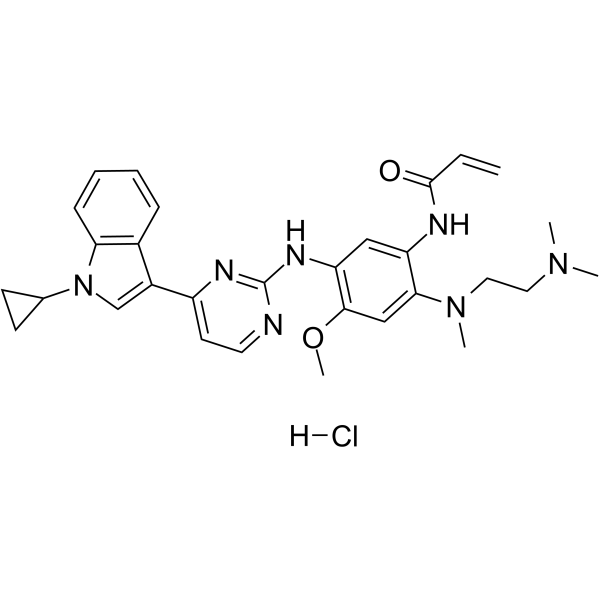
Almonertinib hydrochloride
Based on 10 publication(s) in Google Scholar
Almonertinib (HS-10296) hydrochloride is an orally available, irreversible, third-generation EGFR tyrosine kinase inhibitor with high selectivity for EGFR-sensitizing and T790M resistance mutations. Almonertinib hydrochloride shows great inhibitory activity against T790M, T790M/L858R and T790M/Del19 (IC50: 0.37, 0.29 and 0.21 nM, respectively), and is less effective against wild type (3.39 nM). Almonertinib hydrochloride is used for the research of the non-small cell lung cancer.
For research use only. We do not sell to patients.
- Purity : 98.92%
- CAS No.: 2134096-03-8
- Formula: C30H36ClN7O2
- Molecular Weight:562.11
-
Storage:
4°C, sealed storage, away from moisture
* In solvent : -80°C, 6 months; -20°C, 1 month (sealed storage, away from moisture)

To place orders, for customer services and technical support, please contact: MedChemExpress USA
Tel: 609-228-6898 E-mail: [email protected] [email protected]


-
 Biological Activity
-
Chemical Information
-
Solvent & Solubility
- Protocols
- Purity & Documentation
- References
-
 Help & FAQs


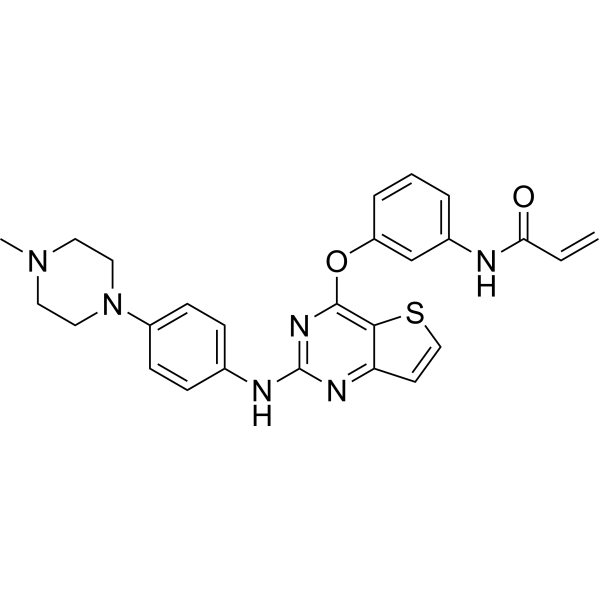
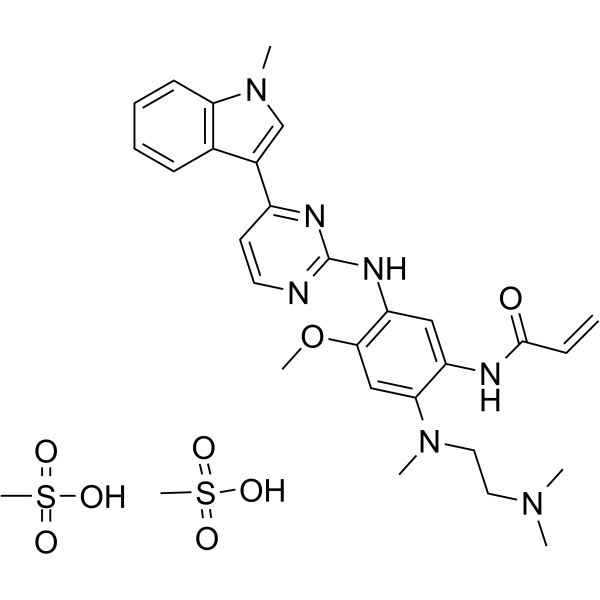
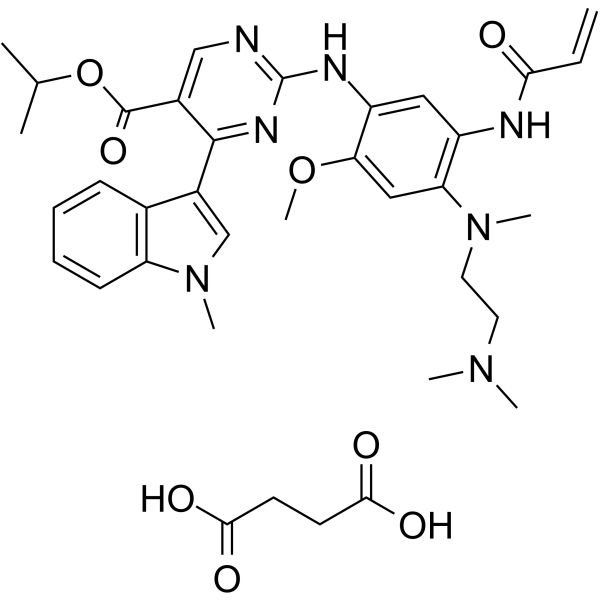
Publications Citing Use of MedChemExpress (MCE) Almonertinib hydrochloride
More- Cell Rep Med. 2023 Feb 21;4(2):100911. [Abstract]
- Eur J Pharmacol. 2026 Jan 12:1011:178448. [Abstract]
- Cell Oncol (Dordr). 2026 Jul 4.
- Front Pharmacol. 2021 May 14:12:671328. [Abstract]
- Transl Lung Cancer Res. 2025 Jun 30;14(6):2159-2179. [Abstract]
- Breast Cancer Res Treat. 2025 Jun;211(2):467-478. [Abstract]
- Biochem Biophys Res Commun. 2026 Feb 12:800:153165.
- Biol Methods Protoc. 2025 Feb 13;10(1):bpaf012. [Abstract]
- bioRxiv. 2026 Mar 12.
- Patent. US20220177473A1.
 Customer Validation & Images

-
Cell Proliferation/Viability Assay

-
Flow Cytometry

-
WB

-
IF

-
Cell Imaging/Staining

All EGFR Isoforms
More

Biological Activity
Description
IC50 & Target
[1]|
EGFRT790M 0.37 nM (IC50) |
EGFRL858R/T790M 0.29 mM (IC50) |
EGFRdel19 T790M 0.214 nM (IC50) |
In Vitro
Almonertinib (HS-10296) is an orally available inhibitor of the epidermal growth factor receptor (EGFR) mutant form T790M, with potential antineoplastic activity, which canbe used to treat NSCLC[2]. Additionaly, Almonertinib (HS-10296) could also inhibit other EGFR sensitive mutations, including G719X, del19, L858R and L861Q[3].
MedChemExpress (MCE) has not independently confirmed the accuracy of these methods. They are for reference only. Further protocols information, click here.


Chemical Information
-
CAS No. 2134096-03-8
-
Appearance Solid
-
Molecular Weight 562.11
-
Formula C30H36ClN7O2
-
Color Off-white to yellow
-
SMILES
COC(C=C(N(C)CCN(C)C)C(NC(C=C)=O)=C1)=C1NC2=NC(C3=CN(C4CC4)C5=C3C=CC=C5)=CC=N2.[H]Cl
-
Synonyms
HS-10296 hydrochloride
-
Shipping
Room temperature in continental US; may vary elsewhere.
-
Storage
4°C, sealed storage, away from moisture
* In solvent : -80°C, 6 months; -20°C, 1 month (sealed storage, away from moisture)


Publications (10)
-
Journal Impact Factor
-
Most Recent
-
Cell Rep Med
Using patient-derived organoids to predict locally advanced or metastatic lung cancer tumor response: A real-world study. [Abstract]2023 Feb 21;4(2):100911. PMID: 36657446 -
Eur J Pharmacol
ROS-mediated senescence and autophagy inhibition drive 5-FU/Aumolertinib synergy in colorectal cancer. [Abstract]2026 Jan 12:1011:178448. PMID: 41352706 -
-
Front Pharmacol
Restricting Glutamine Uptake Enhances NSCLC Sensitivity to Third-Generation EGFR-TKI Almonertinib. [Abstract]2021 May 14:12:671328. PMID: 34054543
Almonertinib hydrochloride purchased from MedChemExpress. Usage Cited in: Front Pharmacol. 2021 May 14:12:671328. [Abstract]
CCK8 assay was used to detect different concentrations of Almonertinib (HS-10296) (2, 4, 8, and 16 µM) on H1975 and A549 cells for 24, 48, and 72 h.
Almonertinib hydrochloride purchased from MedChemExpress. Usage Cited in: Front Pharmacol. 2021 May 14:12:671328. [Abstract]
Flow cytometry was used to detect the apoptosis rate of different concentrations of Almonertinib (HS-10296) (4, 8,12 μM) on H1975 and A549 cells after 24 h.
Almonertinib hydrochloride purchased from MedChemExpress. Usage Cited in: Front Pharmacol. 2021 May 14:12:671328. [Abstract]
Western blotting (WB) was used to examine the expression of SLC1A5 protein in H1975 cells stimulated by Almonertinib (4, 8, 12 μM) at different times.
Almonertinib hydrochloride purchased from MedChemExpress. Usage Cited in: Front Pharmacol. 2021 May 14:12:671328. [Abstract]
Immunofluorescence was used to detect the expression of SLC1A5 protein in H1975 cells stimulated by Almonertinib (4, 8, 12 μM) at different times.
Almonertinib hydrochloride purchased from MedChemExpress. Usage Cited in: Front Pharmacol. 2021 May 14:12:671328. [Abstract]
Effects of Almonertinib (4, 8,12 μM) and V9302 alone or in combination on the colony forming ability.
-
Transl Lung Cancer Res
Development of a 3D-3 co-culture microbead consisting of cancer-associated fibroblasts and human umbilical vein endothelial cells for the anti-tumor drug assessment of lung cancer. [Abstract]2025 Jun 30;14(6):2159-2179. PMID: 40673102 -
Breast Cancer Res Treat
2025 Jun;211(2):467-478. PMID: 40055251 -
-
Biol Methods Protoc
Optimizing drug sensitivity assays in patient-derived tumor organoids: a comparison of IC50 estimation methods and experimental parameters. [Abstract]2025 Feb 13;10(1):bpaf012. PMID: 40060949 -
-


Solvent & Solubility
In Vitro:
H2O : 12.5 mg/mL (22.24 mM; ultrasonic and warming and heat to 60°C)
DMSO : 5 mg/mL (8.90 mM; Need ultrasonic; Hygroscopic DMSO has a significant impact on the solubility of product, please use newly opened DMSO)
Please refer to the solubility information to select the appropriate solvent. Once prepared, please aliquot and store the solution to prevent product inactivation from repeated freeze-thaw cycles.
Storage method and period of stock solution: -80°C, 6 months; -20°C, 1 month (sealed storage, away from moisture). When stored at -80°C, please use it within 6 months. When stored at -20°C, please use it within 1 month.
* Note: If you choose water as the stock solution, please dilute it to the working solution, then filter and sterilize it with a 0.22 μm filter before use.
Please refer to the solubility information to select the appropriate solvent. Once prepared, please aliquot and store the solution to prevent product inactivation from repeated freeze-thaw cycles.
Storage method and period of stock solution: -80°C, 6 months; -20°C, 1 month (sealed storage, away from moisture). When stored at -80°C, please use it within 6 months. When stored at -20°C, please use it within 1 month.
* Note: If you choose water as the stock solution, please dilute it to the working solution, then filter and sterilize it with a 0.22 μm filter before use.
Concentration (start) × Volume (start) = Concentration (final) × Volume (final)
In Vivo:
Select the appropriate dissolution method based on your experimental animal and administration route.
- For the following dissolution methods, please ensure to first prepare a clear stock solution using an In Vitro approach and then sequentially add co-solvents:
- To ensure reliable experimental results, the clarified stock solution can be appropriately stored based on storage conditions. As for the working solution for In Vivo experiments, it is recommended to prepare freshly and use it on the same day.
- The percentages shown for the solvents indicate their volumetric ratio in the final prepared solution. If precipitation or phase separation occurs during preparation, heat and/or sonication can be used to aid dissolution.
Add each solvent one by one: 10% DMSO 40% PEG300 5% Tween-80 45% Saline
Solubility: ≥ 2.08 mg/mL (3.70 mM); Clear solution
This protocol yields a clear solution of ≥ 2.08 mg/mL (saturation unknown).
Taking 1 mL working solution as an example, add 100 μL DMSO stock solution (20.8 mg/mL) to 400 μL PEG300, and mix evenly; then add 50 μL Tween-80 and mix evenly; then add 450 μL Saline to adjust the volume to 1 mL.
Preparation of Saline: Dissolve 0.9 g sodium chloride in ddH₂O and dilute to 100 mL to obtain a clear Saline solution.
Add each solvent one by one: 10% DMSO 90% (20% SBE-β-CD in Saline)
Solubility: ≥ 2.08 mg/mL (3.70 mM); Clear solution
This protocol yields a clear solution of ≥ 2.08 mg/mL (saturation unknown).
Taking 1 mL working solution as an example, add 100 μL DMSO stock solution (20.8 mg/mL) to 900 μL 20% SBE-β-CD in Saline, and mix evenly.
Preparation of 20% SBE-β-CD in Saline (4°C, storage for one week): 2 g SBE-β-CD powder is dissolved in 10 mL Saline, completely dissolve until clear.
In Vivo Dissolution Calculator
Please enter the basic information of animal experiments:
-
-
-
-
Recommended: Prepare an additional quantity of animals to account for potential losses during experiments.
Please enter your animal formula composition:
-
%DMSO +
Recommended: Keep the proportion of DMSO in working solution below 2% if your animal is weak.
-
%+
-
+%Tween-80 + +
-
%Saline +
The co-solvents required include: DMSO, . All of co-solvents are available by MedChemExpress (MCE). , Tween 80. All of co-solvents are available by MedChemExpress (MCE).
Working solution concentration: 0.22 mg/mL
Method for preparing stock solution: mg drug dissolved in μL DMSO. Stock solution concentration: mg/mL. * In solvent : -80°C, 6 months; -20°C, 1 month (sealed storage, away from moisture)
1. Take μL DMSO stock solution;
2. Add μL .
μL , mix evenly;
3. Then add μL Tween 80, mix evenly;
4. Then add μL
Please ensure that the stock solution in the first step is dissolved to a clear state, and add co-solvents in sequence. You can use ultrasonic heating (ultrasonic cleaner, recommended frequency 20-40 kHz), vortexing, etc. to assist dissolution.

Protocols
-
Cell Cytotoxicity Assay
Cytotoxicity assays are usually based on the assessment of cell membrane damage, which can also be indirectly detected by measuring cell viability. Detection methods include MTT assay, CKK-8 assay, LDH assay and ATP assay, etc.


Purity & Documentation
-
Data Sheet (276 KB)
-
SDS (393 KB)
- English - EN (393 KB)
- Français - FR (393 KB)
- Deutsch - DE (393 KB)
- Norwegian - NO (393 KB)
- Español - ES (393 KB)
- Swedish - SV (393 KB)
- Italian - IT (393 KB)
- Korean - KR (393 KB)
- Portuguese - PT (393 KB)
-
Handling Instructions (2659 KB)
References
[1]. Sullivan I, et al. Next-Generation EGFR Tyrosine Kinase Inhibitors for Treating EGFR-Mutant Lung Cancer beyond First Line. Front Med (Lausanne). 2017 Jan 18;3:76. [Content Brief]
[2]. Wu SG, et al. Management of acquired resistance to EGFR TKI-targeted therapy in advanced non-small cell lung cancer. Mol Cancer. 2018 Feb 19;17(1):38. [Content Brief]
[3]. Yang JC, et al. Safety, Efficacy, and Pharmacokinetics of Almonertinib (HS-10296) in Pretreated Patients With EGFR-Mutated Advanced NSCLC: A Multicenter, Open-label, Phase 1 Trial [published online ahead of print, 2020 Sep 9]. J Thorac Oncol. 2020;S1556-0 [Content Brief]


Complete Stock Solution Preparation Table
Please refer to the solubility information to select the appropriate solvent. Once prepared, please aliquot and store the solution to prevent product inactivation from repeated freeze-thaw cycles.
Storage method and period of stock solution: -80°C, 6 months; -20°C, 1 month (sealed storage, away from moisture). When stored at -80°C, please use it within 6 months. When stored at -20°C, please use it within 1 month.
| Optional Solvent | Concentration Solvent Mass | 1 mg | 5 mg | 10 mg | 25 mg |
|---|---|---|---|---|---|
| DMSO / H2O | 1 mM | 1.7790 mL | 8.8951 mL | 17.7901 mL | 44.4753 mL |
| 5 mM | 0.3558 mL | 1.7790 mL | 3.5580 mL | 8.8951 mL | |
| H2O | 10 mM | 0.1779 mL | 0.8895 mL | 1.7790 mL | 4.4475 mL |
| 15 mM | 0.1186 mL | 0.5930 mL | 1.1860 mL | 2.9650 mL | |
| 20 mM | 0.0890 mL | 0.4448 mL | 0.8895 mL | 2.2238 mL |
* Note: If you choose water as the stock solution, please dilute it to the working solution, then filter and sterilize it with a 0.22 μm filter before use.


Almonertinib hydrochloride Related Classifications
HY-112823B Related Classifications
 Powered by Bioz