



Pasiniazid

Based on 1 Customer Validation
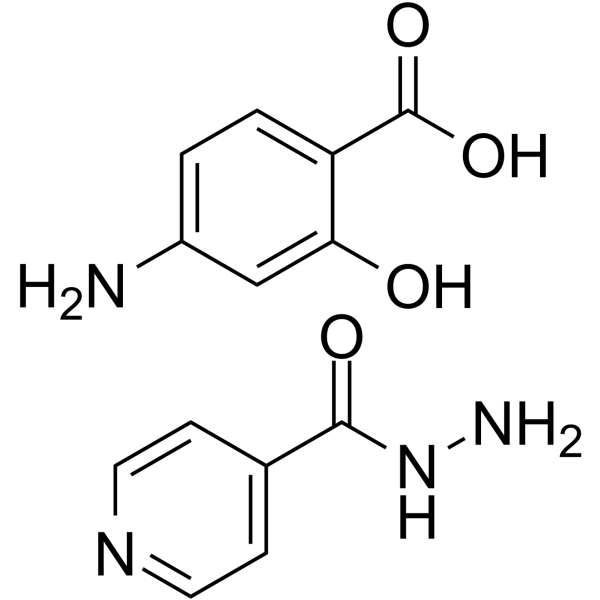
Pasiniazid is a chemical complex formed by Isoniazid (HY-B0329) and Para-aminosalicylic acid in a 1:1 molar ratio. Pasiniazid is an antibacterial agent. Pasiniazid is rapidly decomposed into isoniazid and para-aminosalicylic acid in the gastrointestinal tract. Isoniazid exerts a bactericidal effect, while para-aminosalicylic acid delays the acetylation process of isoniazid. Pasiniazid has antibacterial activity against Mycobacterium tuberculosis. Pasiniazid can be used in tuberculosis research.
Nur für Forschungszwecke. Wir verkaufen nicht an Patienten.
- Reinheit : 98.0%
- CAS. Nr.: 2066-89-9
- Formel: C13H14N4O4
- Molecular Weight:290.27
-
Speicherung:Powder -20°C, 3 years , 4°C, 2 years ; In solvent -80°C, 2 years , -20°C, 1 year

To place orders, for customer services and technical support, please contact: MedChemExpress USA
Tel: 609-228-6898 E-mail: [email protected] [email protected]


-
 Biologische Aktivität
-
Chemical Information
-
Lösungsmittel & Löslichkeit
- Protokoll
- Reinheit & Dokumentation
- Verweise
-
 Help & FAQs




Biologische Aktivität
Beschreibung
In Vitro
Pasiniazid (0.125-256 μg/mL) shows that 85 out of 109 INH-resistant Mycobacterium tuberculosis isolates are susceptible to it[1].
MedChemExpress (MCE) has not independently confirmed the accuracy of these methods. They are for reference only.


Chemical Information
-
CAS. Nr. 2066-89-9
-
Appearance Solid
-
Molecular Weight 290.27
-
Formel C13H14N4O4
-
Color Light yellow to khaki
-
SMILES
O=C(C1=CC=NC=C1)NN.O=C(O)C2=CC=C(N)C=C2O
-
Synonyms
Paraniazide; Pasiniazide; Isonicotinic acid hydrazide p-aminosalicylate
-
Versand
Room temperature in continental US; may vary elsewhere.
-
Speicherung
Powder -20°C 3 years 4°C 2 years In solvent -80°C 2 years -20°C 1 year


Lösungsmittel & Löslichkeit
In Vitro:
DMSO : 100 mg/mL (344.51 mM; Need ultrasonic; Hygroscopic DMSO has a significant impact on the solubility of product, please use newly opened DMSO)
Please refer to the solubility information to select the appropriate solvent. Once prepared, please aliquot and store the solution to prevent product inactivation from repeated freeze-thaw cycles.
Storage method and period of stock solution: -80°C, 2 years; -20°C, 1 year. When stored at -80°C, please use it within 2 years. When stored at -20°C, please use it within 1 year.
Please refer to the solubility information to select the appropriate solvent. Once prepared, please aliquot and store the solution to prevent product inactivation from repeated freeze-thaw cycles.
Storage method and period of stock solution: -80°C, 2 years; -20°C, 1 year. When stored at -80°C, please use it within 2 years. When stored at -20°C, please use it within 1 year.
Konzentration (Stammlösung) × Volumen (Stammlösung) = Konzentration (Ziellösung) × Volumen (Ziellösung)


Reinheit & Dokumentation
-
Data Sheet (275 KB)
-
SDS (393 KB)
- English - EN (393 KB)
- Français - FR (393 KB)
- Deutsch - DE (393 KB)
- Norwegian - NO (393 KB)
- Español - ES (393 KB)
- Swedish - SV (393 KB)
- Italian - IT (393 KB)
- Korean - KR (393 KB)
- Portuguese - PT (393 KB)
-
Handling Instructions (2659 KB)
Verweise


Complete Stock Solution Preparation Table
Please refer to the solubility information to select the appropriate solvent. Once prepared, please aliquot and store the solution to prevent product inactivation from repeated freeze-thaw cycles.
Storage method and period of stock solution: -80°C, 2 years; -20°C, 1 year. When stored at -80°C, please use it within 2 years. When stored at -20°C, please use it within 1 year.
| Optional Solvent | Concentration Solvent Mass | 1 mg | 5 mg | 10 mg | 25 mg |
|---|---|---|---|---|---|
| DMSO | 1 mM | 3.4451 mL | 17.2253 mL | 34.4507 mL | 86.1267 mL |
| 5 mM | 0.6890 mL | 3.4451 mL | 6.8901 mL | 17.2253 mL | |
| 10 mM | 0.3445 mL | 1.7225 mL | 3.4451 mL | 8.6127 mL | |
| 15 mM | 0.2297 mL | 1.1484 mL | 2.2967 mL | 5.7418 mL | |
| 20 mM | 0.1723 mL | 0.8613 mL | 1.7225 mL | 4.3063 mL | |
| 25 mM | 0.1378 mL | 0.6890 mL | 1.3780 mL | 3.4451 mL | |
| 30 mM | 0.1148 mL | 0.5742 mL | 1.1484 mL | 2.8709 mL | |
| 40 mM | 0.0861 mL | 0.4306 mL | 0.8613 mL | 2.1532 mL | |
| 50 mM | 0.0689 mL | 0.3445 mL | 0.6890 mL | 1.7225 mL | |
| 60 mM | 0.0574 mL | 0.2871 mL | 0.5742 mL | 1.4354 mL | |
| 80 mM | 0.0431 mL | 0.2153 mL | 0.4306 mL | 1.0766 mL | |
| 100 mM | 0.0345 mL | 0.1723 mL | 0.3445 mL | 0.8613 mL |


Pasiniazid Related Classifications
HY-B1048 Related Classifications
 Powered by Bioz