



Autophagy
Autophagy is a conserved cellular degradation and recycling process in the lysosome. In mammalian cells, there are three primary types of autophagy: microautophagy, macroautophagy, and chaperone-mediated autophagy (CMA). Microphagy captures cargoes by means of invaginations or protrusions of the lysosomal membrane directly, CMA uses chaperones to identify cargo proteins and then unfolds and transfers them into the lysosomal, while macroautophagy sequesters cargo by autophagosomes-de novo synthesized of double-membrane vesicles-and subsequently transport it to the lysosome.
Macroautophagy is the best studied and it occurs at a low level constitutively and can also be further induced under stress conditions, such as nutrient or energy starvation with a salient feature of autophagy protein degradation. Stress-induced macrophagy plays an important role in protein catabolism with another key protein degradation pathway, the ubiquitin–proteasome system (UPS).
As the study progressed, autophagy gains its importance under basal, nutrient-rich conditions, and is now recognized as a critical housekeeping pathway in catabolism of diverse cellular constituents, such as protein aggregates (aggrephagy), lipid droplets (lipophagy), iron complex (Ferritinophagy) and carbohydrate. Except for macromolecules, autophagy can also target several organelles and structures, such as mitochondria (mitophagy), peroxisome (pexophagy), endoplasmic reticulum (reticulophagy or ER-phagy), ribosome (ribophagy), spermatozoon-inherited organelles following fertilization (allophagy), secretory granules within pancreatic cells (zymophagy) and intracellular pathogens (xenophagy).
Autophagy and its dysfunction are associated with a variety of human pathologies, including ageing, cancer, neurodegenerative disease, heart disease and metabolic diseases, such as diabetes. Plenty of drugs and natural products are involved in autophagy modulation through multiple signaling pathways. Small molecules that can regulate autophagy seem to have great potential to intervene such diseases in animal models or clinical courses.
All Product Categories
-
Autophagy Inhibitors
(489)
View all products
-
Autophagy Agonists
(6)
View all products
-
Autophagy Activators
(124)
View all products
-
Autophagy Modulators
(59)
View all products
-
Autophagy Chemicals
(2)
View all products
-
Autophagy Inducers
(2214)
View all products
-
Autophagy Controls
(5)
View all products
-
Autophagy Ligand
(1)
View all products
-
Autophagy Related Products (3434)
Related Products (3434)

-
Antibodies (31)
-
Autophagy Signaling Pathway
-
Pazopanib-d3 hydrochloride
 0 ImagesCat. No.: HY-W705479CAS No.: 2469755-67-5Synonyms: GW786034-d3 hydrochloridePazopanib-d3 (hydrochloride) (GW786034-d3 (hydrochloride)) is deuterium labeled Pazopanib (Hydrochloride). Pazopanib Hydrochloride (GW786034 Hydrochloride) is a novel multi-target inhibitor of VEGFR1, VEGFR2, VEGFR3, PDGFRβ, c-Kit, FGFR1, and c-Fms with an IC50 of 10, 30, 47, 84, 74, 140 and 146 nM, respectively.
-
SNX-2112 (Standard)
 0 ImagesCat. No.: HY-10214RCAS No.: 908112-43-6Synonyms: PF-04928473 (Standard)SNX-2112 (Standard) is the analytical standard of SNX-2112 (HY-10214). This product is intended for research and analytical applications. SNX-2112 (PF 04928473) is an orally active Hsp90 inhibitor, with a Kd of 16 nM for Hsp90 and IC50s of 30 nM, 30 nM for Hsp90 α and Hsp90 β, also induces Her-2 degradation, and inhibits Grp94 and Trap-1, with IC50s of 10 nM, 4.275 μM and 0.862 μM, respectively. SNX-2112 (PF 04928473) binds Hsp90 isoforms Hsp90α, Hsp90β and Hsp90b1/Grp94 with Kds of 4 nM, 6 nM and 484 nM, respectively.
-
BIIB021 (Standard)
 0 ImagesCat. No.: HY-10212RCAS No.: 848695-25-0Synonyms: CNF2024 (Standard)BIIB021 (Standard) is the analytical standard of BIIB021. This product is intended for research and analytical applications. BIIB021 (CNF2024) is an orally active, fully synthetic inhibitor of HSP90 with a Ki and an EC50 of 1.7 nM and 38 nM, respectively.
-
Piperlongumine (Standard)
 0 ImagesSynonyms: Piplartine (Standard)Piperlongumine is a alkaloid, possesses ant-inflammatory, antibacterial, antiangiogenic, antioxidant, antitumor, and antidiabetic activities. Piperlongumine induces ROS, and induces apoptosis in cancer cell lines. Piperlongumine shows anti-cardiac fibrosis activity, suppresses myofibroblast transformation via suppression of the ERK1/2 signaling pathway. Piperlongumin could be used in the study of migrasome.
-
Momelotinib (Standard)
 0 ImagesSynonyms: CYT387 (Standard)Momelotinib (Standard) is the analytical standard of Momelotinib. This product is intended for research and analytical applications. Momelotinib (CYT387) is an ATP-competitive inhibitor of JAK1/JAK2 with IC50a of 11 nM and 18 nM,respectively. CYT387 shows much less activity against JAK3.
-
3'-Hydroxypterostilbene (Standard)
 0 ImagesCat. No.: HY-N6002RCAS No.: 475231-21-13'-Hydroxypterostilbene (Standard) is the analytical standard of 3'-Hydroxypterostilbene (HY-N6002). This product is intended for research and analytical applications. 3'-Hydroxypterostilbene is a Pterostilbene (HY-N0828) analogue. 3'-Hydroxypterostilbene inhibits the growth of COLO 205, HCT-116 and HT-29 cells with IC50s of 9.0, 40.2 and 70.9 μM, respectively. 3'-Hydroxypterostilbene significantly down-regulates PI3K/Akt and MAPKs signaling pathways and effectively inhibits the growth of human colon cancer cells by inducing apoptosis and autophagy. 3'-Hydroxypterostilbene can be used for the research of cancer.

-
Silmitasertib sodium salt (Standard)
 0 ImagesSynonyms: CX-4945 sodium salt (Standard)Silmitasertib (sodium salt) (Standard) is the analytical standard of Silmitasertib (sodium salt). This product is intended for research and analytical applications. Silmitasertib sodium salt is an orally bioavailable, highly selective and potent CK2 inhibitor, with IC50 values of 1 nM against CK2α and CK2α'.

-
Ambroxol (Standard)
 0 ImagesSynonyms: NA-872 (Standard)Ambroxol (Standard) is the analytical standard of Ambroxol. This product is intended for research and analytical applications. Ambroxol (NA-872), an active metabolite of the proagent Bromhexine, has potent expectorant effects. Ambroxol is a glucocerebrosidase (GCase) chaperone and increases glucocerebrosidase activity. Ambroxol induces lung autophagy and has the potential for Parkinson disease and neuronopathic Gaucher disease research.
-
Astragaloside II (Standard)
 0 ImagesCat. No.: HY-N0433RCAS No.: 84676-89-1Synonyms: Astrasieversianin VIII (Standard)Astragaloside II (Standard) is the analytical standard of Astragaloside II (HY-N0433). This product is intended for research and analytical applications. Astragaloside II is an orally active Cycloartane-type triterpene glycoside. Astragaloside II can be extracted from Astragalus membranaceus. Astragaloside II inhibits Autophagy, decreases pro-inflammatory cytokines (IL-6, IL-1β), HIF-α, p-p65, p-IκB and increases SOD. Astragaloside II regulates immunity and reduces inflammatory responses. Astragaloside II can be used in the research of diseases such as liver cancer, osteoporosis, immunosuppressive diseases, and ulcerative colitis.
-
Antileishmanial agent-43
 0 ImagesCat. No.: HY-183621Antileishmanial agent-43 is a 3,4,5‑trisubstituted isoxazole with selective antileishmanial activity. Antileishmanial agent-43 shows IC50 values of 12.7 μM against Leishmania amazonensis promastigotes and 0.96 μM against intracellular amastigotes. Antileishmanial agent-43 induces ROS elevation, oxidative stress and mitochondrial dysfunction, resulting in lipid peroxidation, mitochondrial depolarization and ATP imbalance. Antileishmanial agent-43 causes cell shrinkage, phosphatidylserine externalization, plasma membrane permeabilization, and promotes autophagy. Antileishmanial agent-43 can be used for the research of leishmaniasis.
-
β-Lapachone (Standard)
 0 ImagesSynonyms: ARQ-501 (Standard); NSC-26326 (Standard)β-Lapachone (Standard) is the analytical standard of β-Lapachone. This product is intended for research and analytical applications. β-Lapachone (ARQ-501;NSC-26326) is a naturally occurring O-naphthoquinone, acts as a topoisomerase I inhibitor, and induces apoptosis by inhibiting cell cycle progression.
-
Autophinib (Standard)
 0 ImagesAutophinib (Standard) is the analytical standard of Autophinib (HY-101920). This product is intended for research and analytical applications. Autophinib is a potent, selective autophagy inhibitor with IC50s of 90 nM and 40 nM for starvation- and Rapamycin-induced autophagy, respectively. Autophinib is also an ATP competitive Vacuolar Protein Sorting 34 (VPS34) inhibitor with an IC50 of 19 nM. Autophinib inhibits autophagy induced by starvation or Rapamycin by targeting VPS34.
-
Trimetazidine (Standard)
 0 ImagesTrimetazidine (Standard) is the analytical standard of Trimetazidine. This product is intended for research and analytical applications. Trimetazidine is a selective long chain 3-ketoyl coenzyme A thiolase inhibitor with an IC50 of 75 nM, which can inhibit β-oxidation of free fatty acid (FFA). Trimetazidine is an effective antianginal agent and a cytoprotective agent, has anti-oxidant, anti-inflammatory, antinociceptive and gastroprotective properties. Trimetazidine triggers autophagy. Trimetazidine is also a 3-hydroxyacyl-CoA dehydrogenase (HADHA) inhibitor.
-
Atiprimod hydrochloride
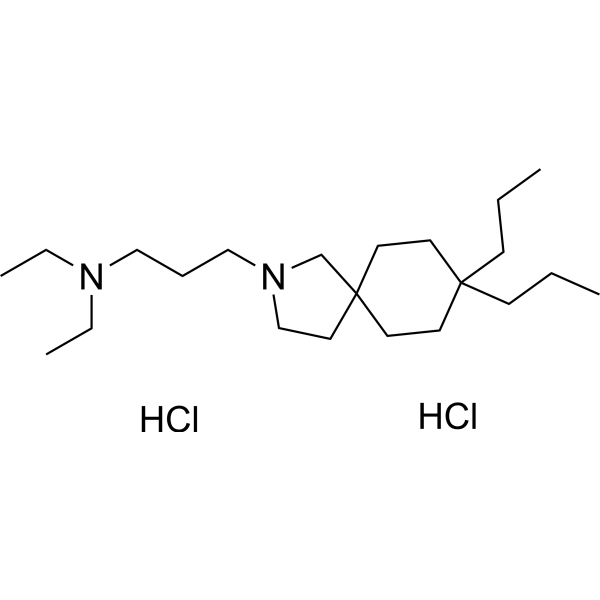 0 ImagesCat. No.: HY-110102CAS No.: 130065-61-1Synonyms: Azaspirane hydrochloride; SKF 106615-12 hydrochloride; SKF 106615Atiprimod (Azaspirane) hydrochloride is a STAT3 inhibitor with antitumor, anti-inflammatory, and anti-angiogenic activities. Atiprimod blocks the signaling pathways of IL-6 and VEGF by inhibiting the phosphorylation of signal transducer and activator of STAT3. Atiprimod blocks the JAK-STAT signaling pathway by inhibiting the phosphorylation of JAK2 and JAK3. Atiprimod also inhibits cell proliferation, induces cell cycle arrest, and induces autophagy and apoptosis. Atiprimod triggers persistent ER stress-mediated apoptosis in breast cancer cells by activating the PERK/eIF2α/ATF4/CHOP axis and inhibiting the nuclear translocation of STAT3/NF-κB. Atiprimod shows great anti-tumor activities in tumor xenograft mouse models. Atiprimod can be used for the study of pituitary adenoma, breast cancer, multiple myeloma and acute myeloid leukemia (AML).
-
SR-18292-d9
 0 ImagesCat. No.: HY-101491S
-
Daunorubicin-13C,d3
 0 ImagesCat. No.: HY-W654130Synonyms: Daunomycin-13C,d3; RP 13057-13C,d3; Rubidomycin-13C,d3Daunorubicin-13C,d3 is 13C and deuterium labeled Daunorubicin. Daunorubicin (Daunomycin) is a topoisomerase II inhibitor with potent anti-tumor activity. Daunorubicin inhibits DNA and RNA synthesis. Daunorubicin is a cytotoxin that inhibits cancer cell viability and induces apoptosis and necrosis. Daunorubicin is also an anthracycline antibiotic. Daunorubicin can be used in the research of infection and variety of cancers, including leukemia, non-Hodgkin lymphomas, Ewing's sarcoma, Wilms' tumor.
-
STO-609 (Standard)
 0 ImagesCat. No.: HY-19805RCAS No.: 52029-86-4STO-609 (Standard) is the analytical standard of STO-609 (HY-19805). This product is intended for research and analytical applications. STO-609 is a selective and cell-permeable inhibitor of the Ca2+/calmodulin-dependent protein Kinase Kinase (CaM-KK), with Ki values of 80 and 15 ng/mL for recombinant CaM-KKα and CaM-KKβ, respectively. STO-609 inhibits AMP-activated protein Kinase Kinase (AMPKK) activity in HeLa cell lysates with an IC50 ~0.02 g/ml.
-
Glyphosate isopropylammonium
 0 ImagesCat. No.: HY-B0863BCAS No.: 38641-94-0Glyphosate isopropylammonium, a non-selective systemic biocide with broad-spectrum activity, is an herbicidal derivative of the amino acid glycine. Glyphosate isopropylammonium inhibits the enzymatic activity of the 5-endopyruvylshikimate 3-phosphate synthase (EPSPS) in the shikimic acid pathway, preventing the synthesis of the aromatic amino acids tyrosine, phenylalanine, and tryptophan. Glyphosate isopropylammonium induces oxidative stress, neuroinflammation, and mitochondrial dysfunction, processes that lead to neuronal death by autophagia, necrosis, or apoptosis, as well as the appearance of behavioral and motor disorders.




