



Proteasome
Proteasomes are very large protein complexes inside all eukaryotes and archaea, and in some bacteria. In eukaryotes, they are located in the nucleus and the cytoplasm. The main function of the proteasome is to degrade unneeded or damaged proteins by proteolysis, a chemical reaction that breaks peptide bonds. Enzymes that carry out such reactions are called proteases. Proteasomes are part of a major mechanism by which cells regulate the concentration of particular proteins and degrade misfolded proteins. The degradation process yields peptides of about seven to eight amino acids long, which can then be further degraded into amino acids and used in synthesizing new proteins. Proteins are tagged for degradation with a small protein called ubiquitin. The tagging reaction is catalyzed by enzymes called ubiquitin ligases. Once a protein is tagged with a single ubiquitin molecule, this is a signal to other ligases to attach additional ubiquitin molecules. The result is a polyubiquitin chain that is bound by the proteasome, allowing it to degrade the tagged protein.
All Product Categories
-
Proteasome Inhibitors
(224)
View all products
-
Proteasome Activators
(10)
View all products
-
Proteasome Modulator
(1)
View all products
-
Proteasome Degraders
(3)
View all products
-
Proteasome Controls
(3)
View all products
-
Proteasome Substrates
(6)
View all products
-
Proteasome Ligands
(7)
View all products
-
Proteasome Related Products (292)
Related Products (292)

-
Antibodies (22)
-
INVA8001
 0 ImagesCat. No.: HY-180131CAS No.: 1312993-34-2Synonyms: ASB17061INVA8001 (ASB17061) is a highly selective and orally active chymase inhibitor with IC50 values for human chymase and mouse mast cell proteinase 4 (mMCP-4) of 0.02 and 0.03 μM, respectively. INVA8001 exhibits IC50 values for bovine α-chymotrypsin and human cathesin G of 3.4 and 32.1 μM, respectively, and it shows over 1000-fold selectivity for other related serine proteases. INVA8001 inhibits mast cells in a mouse primary sclerosing cholangitis (PSC) model, improves bile duct pathology, and alleviates bile stasis, demonstrating anti-inflammatory and anti-fibrotic effects.
-
Isomoreollic acid
 0 ImagesCat. No.: HY-N7890CAS No.: 1240792-57-7Isomoreollic acid is a cage xanthonoid. Isomoreollic acid exhibits cytotoxicity against colon cancer cells, with an IC50 > 10 μM for proteasome inhibition. Isomoreollic acid is present in the stem bark of Garcinia lateriflora. Isomoreollic acid can be used in colon cancer research.
-
DB-310
 0 ImagesCat. No.: HY-182325CAS No.: 2338531-17-0DB-310 is a selective immunoproteasome LMP2 inhibitor with an IC50 value of 80.62 nM. DB-310 inhibits the production of IL-1α in microglia. DB-310 improves cognitive function in the Tg2576 transgenic mouse model of Alzheimer's disease. DB-310 can be used for research related to Alzheimer's disease.
-
BSc2118
 0 ImagesCat. No.: HY-123255CAS No.: 863924-64-5BSc2118 is a 20S proteasome inhibitor with an IC50 of approximately 50 nM. BSc2118 induces G2/M phase cell cycle arrest and apoptosis in myeloma cells, inhibits cytoprotective autophagy, and suppresses tumor angiogenesis. BSc2118 reduces MMP9 activity, promotes angioneurogenesis, and alleviates recombinant tissue-type plasminogen activator-induced cerebral toxicity. BSc2118 is applicable to studies related to cerebral ischemia and multiple myeloma.
-
LMP7/LMP2-IN-1
 0 ImagesCat. No.: HY-162754CAS No.: 3053755-09-9LMP7/LMP2-IN-1 (Compound 19) is the orally active inhibitor for immunoproteasome subunits LMP7 and LMP2 with IC50 of 257 and 10 nM. LMP7/LMP2-IN-1 reduces the generation of antibody, downregulates the cells in spleen germinal center B and in plasma in NP-OVA-immunized mice, and can be used in research about autoimmune diseases.
-
Immunoproteasome-IN-2
 0 ImagesCat. No.: HY-179394Immunoproteasome-IN-2 is selective immunoproteasome inhibitor with IC50 = 232.3 nM for LMP7, IC50 = 9384.9 nM for β5. Immunoproteasome-IN-2 exhibits ancillary inhibitory activity against LMP2 and MECL-1 subunits. Immunoproteasome-IN-2 demonstrates anti-inflammatory efficacy in a mouse model of arthritis and shows a favorable safety profile in toxicological studies with reduced hepatotoxicity and hematotoxicity. Immunoproteasome-IN-2 has LMP7/β5 selectivity directly correlated with lower systemic toxicity. Immunoproteasome-IN-2 can be employed for research in arthritis.
-
N-Acetyl-L-leucyl-L-leucyl-L-methional
 0 ImagesCat. No.: HY-103321CAS No.: 145757-50-2N-Acetyl-L-leucyl-L-leucyl-L-methional is a Calpain II inhibitor with an IC50 of 0.24 μM against porcine Calpain II. N-Acetyl-L-leucyl-L-leucyl-L-methional forms a stable tetrahedral adduct with the thiol group at the active site of Calpain II, thereby inhibiting proteolytic activity. N-Acetyl-L-leucyl-L-leucyl-L-methionally inhibits cathepsins in a non-selective manner. N-Acetyl-L-leucyl-L-leucyl-L-methional reduces SARS-CoV-2 infection levels in human coronary artery endothelial cells in vitro. N-Acetyl-L-leucyl-L-leucyl-L-methional can be used in research related to cataracts and coronavirus infections.

-
Phepropeptin B
 0 ImagesCat. No.: HY-N14928CAS No.: 396729-24-1Phepropeptin B, a microbial secondary metabolite, is a proteasome inhibitor with an IC50 of 11 μg/mL.
-
M3258 (Standard)
 0 ImagesCat. No.: HY-111790RCAS No.: 2285330-15-4M3258 (Standard) is the analytical standard of M3258 (HY-111790). This product is intended for research and analytical applications. M3258 is an orally bioavailable, potent, reversible and highly selective immunoproteasome subunit LMP7 (β5i) inhibitor. M3258 exerts high biochemical (IC50=3.6 nM) and cellular (IC50=3.4 nM) potency against the LMP7 subunit. M3258 shows strong antitumor efficacy in multiple myeloma xenograft models. M3258 leads to a significant and prolonged suppression of tumor LMP7 activity and ubiquitinated protein turnover and the induction of apoptosis in multiple myeloma cells.
-
(Rac)-PD 151746
 0 ImagesCat. No.: HY-W409181CAS No.: 179461-52-0(Rac)-PD 151746 is the optically inactive racemate of PD 151746 (HY-19749). PD 151746 is a neuroprotective calpain inhibitor with Ki values of 0.26 μM (u-calpain) and 5.33 μM (m-calpain), respectively.
-
β5i-IN-1
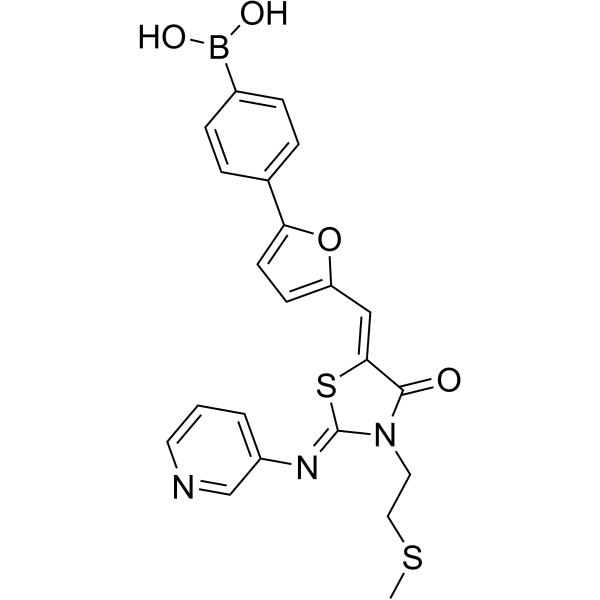 0 ImagesCat. No.: HY-156297CAS No.: 3055187-85-1
-
Aclacinomycin A (Standard)
 0 ImagesCat. No.: HY-N2306RCAS No.: 57576-44-0Synonyms: Aclarubicin (Standard)Aclacinomycin A (Standard) is the analytical standard of Aclacinomycin A. This product is intended for research and analytical applications. Aclacinomycin A (Aclarubicin) is an orally active and potent anthracycline antitumor antibiotic. Aclacinomycin A is an inhibitor of topoisomerase I and II. Aclacinomycin A inhibits synthesis of nucleic acid, especially RNA. Aclacinomycin A might inhibit the 26S protease complex as well as the ubiquitin-ATP-dependent proteolysis.
-
Cerpegin
 0 ImagesCat. No.: HY-N15130CAS No.: 129748-28-3Cerpegin, a pyridinone-fused c-lactone, is an inhibitor of 20S proteasome. Cerpegin can be used as a tranquillizer, anti-inflammatory, analgesic and antiulcer.
-
Carmaphycin-17
 0 ImagesCat. No.: HY-171956CAS No.: 2143080-91-3Carmaphycin-17 (CP-17) is a selective 20S proteasome inhibitor with an EC50 of 217 ?nM. Carmaphycin-17 has potent antimicrobial activity against Trichomonas vaginalis. Carmaphycin-17 overcomes Metronidazole (HY-B0318) resistance and significantly reduces parasite burden upon topical treatment without any apparent adverse effects in vaginal trichomonad infection mice model. Carmaphycin-17 can be used for sexually transmitted disease like trichomoniasis research.
-
TDI6245
 0 ImagesCat. No.: HY-187442TDI6245 is a Aurora kinase A (AURKA) inhibitor with an IC50 value of 21.64 nM against AURKA. TDI6245 also inhibits the β5 subunit of the 20S proteasome from Plasmodium falciparum (Pf 20S), with IC50 values of 0.11 μM, 31.1 μM and 6.8 μM against Pf 20S β5, human constitutive proteasome β5c and human immunoproteasome β5i subunits, respectively. TDI6245 binds to the AURKA pocket and the substrate cleft of Pf 20S β5 via antiparallel β-sheets and hydrogen bonds. TDI6245 inhibits the growth of Plasmodium falciparum. TDI6245 can be used in research related to triple-negative breast cancer and malaria.
-
Phepropeptin D
 0 ImagesCat. No.: HY-N14940CAS No.: 396729-26-3Phepropeptin D, a microbial secondary metabolite, is a proteasome inhibitor with an IC50 of 7.8 μg/mL.
-
Bepridil hydrochloride (Standard)
 0 ImagesSynonyms: CERM 1978 (Standard); Org 5730 hydrochloride (Standard)Bepridil hydrochloride (Standard) (CERM 1978 (Standard);Org 5730 hydrochloride (Standard)) is the analytical standard of Bepridil hydrochloride (HY-103315). This product is intended for research and analytical applications. Bepridil hydrochloride is an orally active non-selective calcium channel antagonist with multi-ion channel blocking activity. Bepridil hydrochloride modulates Calmodulin, the 20S proteasome, T-type/L-type calcium channels, cardiac sodium channels, multiple potassium channels, γ-secretase, β-secretase, and mitoKATP/sarcKATP channels. Bepridil hydrochloride acts as a hydroxyl radical scavenger, regulates mitochondrial and intracellular calcium handling, and exerts antiarrhythmic, antianginal, and cardioprotective effects. Bepridil hydrochloride alters amyloid precursor protein processing, reduces β-amyloid and thalamic calcium levels, restores seladin-1/DHCR24 expression, and improves sensorimotor recovery after cerebral ischemia. Bepridil hydrochloride also exhibits potent inhibitory effects on SARS-CoV-2 replication. Bepridil hydrochloride is used in studies related to stable angina, arrhythmias, cerebral ischemia, Alzheimer's disease, and SARS-CoV-2 infection.
-
Aloin (mixture of A&B) (Standard)
 0 ImagesAloin (mixture of A&B) (Standard) is the analytical standard of Aloin (mixture of A&B) (HY-N6013). This product is intended for research and analytical applications. Aloin (mixture of A&B) is an orally active anthraquinone derivative isolated from Aloe vera. Aloin (mixture of A&B) mitigates airway impairment and exerts neuroprotective, anti-inflammatory, antioxidant, antibacterial, antifungal, antiviral and antitumor effects. Aloin (mixture of A&B) inhibits Clostridium histolyticum collagenase, granulocyte matrix metalloproteinases and human 20S proteasome. Aloin (mixture of A&B) upregulates the Nrf2/HO-1 pathway, suppresses the TGF-β/Smad2/3 pathway. Aloin (mixture of A&B) reduces IL-4/IL-5/IL-13 levels, and reverses oxidative stress markers (MDA, SOD, GSH). Aloin (mixture of A&B) can be used for research on chronic ulcers, burns, wounds, inflammatory and degenerative disorders, asthma and neuroblastoma.
-
Ixazomib (Standard)
 0 ImagesSynonyms: MLN2238 (Standard)Ixazomib (Standard) is the analytical standard of Ixazomib. This product is intended for research and analytical applications. Ixazomib (MLN2238) is a selective, potent, and reversible proteasome inhibitor, which inhibits the chymotrypsin-like proteolytic (β5) site of the 20S proteasome with an IC50 of 3.4 nM (Ki of 0.93 nM).




