



VD/VDR
Vitamin D; Vitamin D receptor
Vitamin D is a secosteroidalprohormone, it can be synthesized at sufficient levels in skin, given adequate skin exposure to UV B radiation from sunlight. Vitamin D modulates its biological effects by directly regulating target gene expression through the Vitamin D receptor (VDR), a ligand-regulated transcription factor and a member of the nuclear receptor superfamily. Whether synthesized in the skin or ingested, vitamin D requires two hydroxylation steps to become the biologically active hormone, 1,25-dyhydroxyvitamin D3 [1,25(OH)2D3], a form that signals through the VDR. The hormone-bound VDR modulates target gene transcription in response to vitamin D. VDR acts as a master transcriptional regulator of autophagy. Activation of the VDR by vitamin D induces autophagy and an autophagic transcriptional signature in breast cancer (BC) cells.
There are 2 forms of vitamin D. Vitamin D2 (ergocalciferol) comes from irradiation of the yeast and plant sterol ergosterol, and vitamin D3 (cholecalciferol) is found in oily fish and cod liver oil and is made in the skin. Vitamin D represents vitamin D2 and vitamin D3.
Topical agents containing active vitamin D3 (calcitriol, 1α, 25- dihydroxyvitaminD3, VD3) analogues such as Tacalcitol, Calcipotriol and Maxacalcitol are widely used for psoriasis therapy.
All Product Categories
-
VD/VDR Inhibitors
(5)
View all products
-
VD/VDR Agonists
(22)
View all products
-
VD/VDR Antagonists
(15)
View all products
-
VD/VDR Activators
(59)
View all products
-
VD/VDR Modulators
(8)
View all products
-
VD/VDR Chemicals
(3)
View all products
-
VD/VDR Controls
(2)
View all products
-
VD/VDR Ligands
(7)
View all products
-
VD/VDR Related Products (164)
Related Products (164)

-
Antibodies (3)
-
19-nor-1α,25-Dihydroxyvitamin D3
 0 ImagesCat. No.: HY-15364CAS No.: 130447-37-919-nor-1α,25-Dihydroxyvitamin D3 is a vitamin D receptor (VDR) agonist with an EC50 of 4.8 nM. 19-nor-1α,25-Dihydroxyvitamin D3 binds to VDR and promotes gene transcription. 19-nor-1α,25-Dihydroxyvitamin D3 can be used in the research of diseases related to the vitamin D signaling pathway.
-
Difethialone-d4
 0 ImagesCat. No.: HY-113958SCAS No.: 2714420-97-8Synonyms: Baraki-d4; LM 2219-d4Difethialone-d4 (Baraki-d4; LM 2219-d4) is the deuterium labeled Difethialone (HY-113958). Difethialone (LM-2219) is an anticoagulant rodenticide. Difethialone shows high rodenticide activity in warfarin-sensitive and resistant strains of rats and mice. Difethialone interferes with the circulation of vitamin K in the liver, preventing the synthesis of coagulation factors, resulting in the inability of the blood to coagulate properly, ultimately causing internal bleeding and death. Difethialone can be used in studies of ecological impacts.
-
Tioclomarol
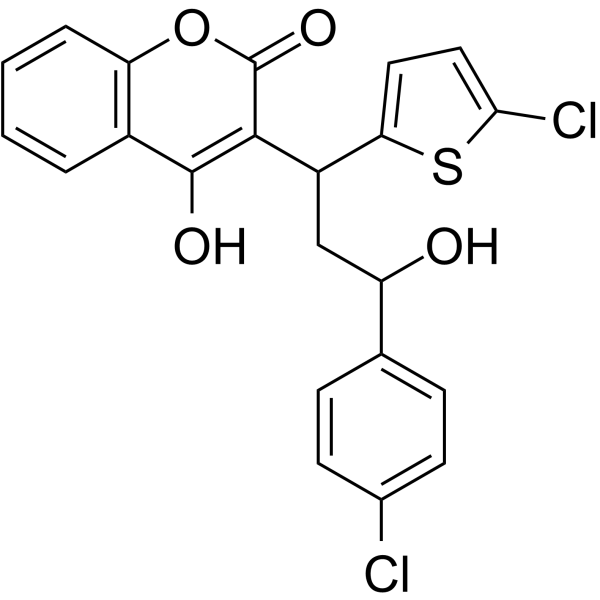 0 ImagesCat. No.: HY-106561CAS No.: 22619-35-8Tioclomarol, a coumarin anticoagulant, is a vitamin K antagonist.
-
Ercalcidiol-d9
 0 ImagesCat. No.: HY-32349S2CAS No.: 1202355-80-3Synonyms: 25-Hydroxy Vitamin D2-d9Ercalcidiol-d9 (25-Hydroxy Vitamin D2-d9) is the deuterium labeled Ercalcidiol (HY-32349). Ercalcidiol is a metabolite of vitamin D2, is regarded as an indicator of vitamin D nutritional status.
-
Pyrocholecalciferol
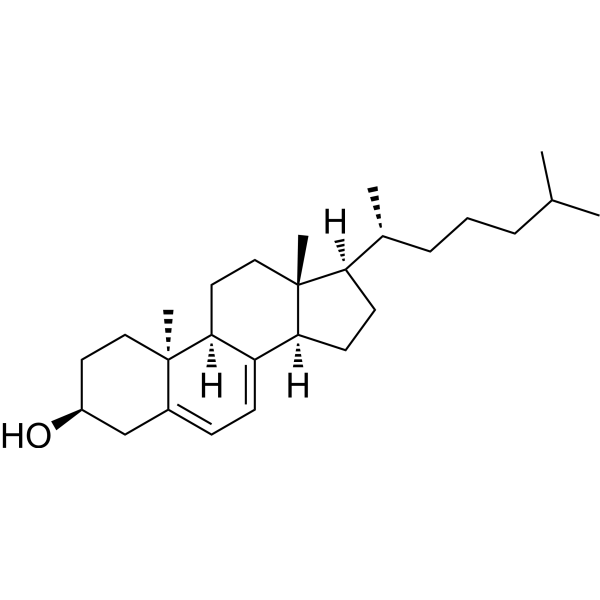 0 ImagesCat. No.: HY-142129CAS No.: 10346-43-7Pyrocholecalciferol, a vitamin D analogue, produced by photochemical transformation of 7-dehydrocholesterol (7-DHC).
-
Calcifediol-d9
 0 ImagesCat. No.: HY-32351S3CAS No.: 1539301-45-5Synonyms: 25-hydroxy Vitamin D3-d9Calcifediol-d9 (25-hydroxy Vitamin D3-d9) is the deuterium labeled Calcifediol (HY-32351). Calcifediol (25-hydroxy Vitamin D3) is an effective VDR ligand and VD supplement. Calcifediol is a prohormone of the vitamin D endocrine system (VDES) and is hydroxylated in the liver to produce the active form, calcitriol. Calcifediol can rapidly increase serum VD levels.
-
Coumachlor-d4
 0 ImagesCat. No.: HY-W745719CAS No.: 2714472-72-5Coumachlor-d4 is the deuterium labeled Coumachlor (HY-W013200). Coumachlor is an orally active antieoagulant agent. Coumachlor is a vitamin K antagonist.

-
Difethialone
 0 ImagesSynonyms: LM-2219Difethialone (LM-2219) is an anticoagulant rodenticide. Difethialone shows high rodenticide activity in warfarin-sensitive and resistant strains of rats and mice. Difethialone interferes with the circulation of vitamin K in the liver, preventing the synthesis of coagulation factors, resulting in the inability of the blood to coagulate properly, ultimately causing internal bleeding and death. Difethialone can be used in studies of ecological impacts.
-
LG190178
 0 ImagesCat. No.: HY-117182CAS No.: 233268-81-0LG190178 is a non-steroidal vitamin D receptor (VDR) ligand that can induce the formation of heterodimer complexes between VDR and retinoid X receptor (RXR), stabilizing the agonistic conformation of the VDR ligand-binding domain and promoting its interaction with co-activators. LG190178 has functions in regulating calcium homeostasis, bone mineralization, as well as cell proliferation, differentiation, and apoptosis, making it useful for research in psoriasis, osteoporosis, and cancer.
-
AC-340
 0 ImagesCat. No.: HY-178336CAS No.: 3109965-54-7AC-340 is a potent hybrid VDR agonist/HDAC inhibitor. AC-340 superinduces VDR target genes (e.g., CYP24A1) and inhibits HDAC6 (IC50 = 0.37 μM) with ~10-fold selectivity over HDAC2. AC-340 induces VDR hyperagonism by causing widespread protein hyperacetylation (e.g., tubulin and H3K9/K27), which leads to elevated H3K27 acetylation on VDR target genes. AC-340 can be used for melanoma cancer research.
-
VDR ligand-1
 0 ImagesCat. No.: HY-179431VDR ligand-1 (compound 13a) is a nonsecosteroidal VDR agonist with an EC50 value of 16 nM. VDR ligand-1 can be used for osteoporosis, psoriasis, and cancer research.
-
Lunacalcipol
 0 ImagesCat. No.: HY-14863CAS No.: 250384-82-8Synonyms: CTA-018Lunacalcipol (CTA-018), as a vitamin D analogue, has a dual role in the pathogenesis of Chronic Kidney Disease (CKD), as an agonist of vitamin D receptor and an antagonist of cytochrome P450 enzyme 24-hydroxylase. Lunacalcipol binds to VDR and regulates transcriptional activity of VDR by influencing ligand binding affinity, ligand-dependent coactivator recruitment or inhibitory factor dissociation, efficiency of ligand entry into target cells, tissue specificity and different metabolism of ligand. Lunacalcipol can be used in the study of CKD, especially Secondary Hyperparathyroidism (sHPT).
-
Doxercalciferol (Standard)
 0 ImagesCat. No.: HY-32348RCAS No.: 54573-75-0Synonyms: 1.alpha.-Hydroxyvitamin D2 (Standard)Doxercalciferol (Standard) is the analytical standard of Doxercalciferol. This product is intended for research and analytical applications. Doxercalciferol is a Vitamin D2 analog, acts as an activator of Vitamin D receptor, and prevent renal disease.
-
Ercalcidiol-13C3
 0 ImagesCat. No.: HY-32349S3CAS No.: 1325307-59-2Synonyms: 25-Hydroxy Vitamin D2-13C3Ercalcidiol-13C3 (25-Hydroxy Vitamin D2-13C3) is the 13C-labeled Ercalcidiol (HY-32349). Ercalcidiol is a metabolite of vitamin D2, is regarded as an indicator of vitamin D nutritional status.
-
24R-Calcipotriol-d4
 0 ImagesCat. No.: HY-166525SSynonyms: PRI 2202-d4; Impurity D of Calcipotriol-d424R-Calcipotriol-d4 (PRI 2202-d4; Impurity D of Calcipotriol-d4) is the deuterium labeled 24R-Calcipotriol. 24R-Calcipotriol is an impurity of Calcipotriol. Calcipotriol is a ligand of VDR-like receptors.
-
Phenprocoumon-d5
 0 ImagesCat. No.: HY-A0145SCAS No.: 121513-38-0Phenprocoumon-d5 is the deuterium labeled Phenprocoumon (HY-A0145). Phenprocoumon is a coumarin derivative that acts as a long acting oral anticoagulant and an antagonist of vitamin K.
-
5,6-trans-Vitamin D2 (Standard)
 0 ImagesSynonyms: 5,6-trans-Ergocalciferol (Standard); 5,6-trans-Calciferol (Standard); 5,6-trans-Ercalciol (Standard)5,6-trans-Vitamin D2 (Standard) is the analytical standard of 5,6-trans-Vitamin D2. This product is intended for research and analytical applications. 5,6-trans-Vitamin D2 is the isomer of Vitamin D2[1].
-
Calcipotriol Impurity C (Standard)
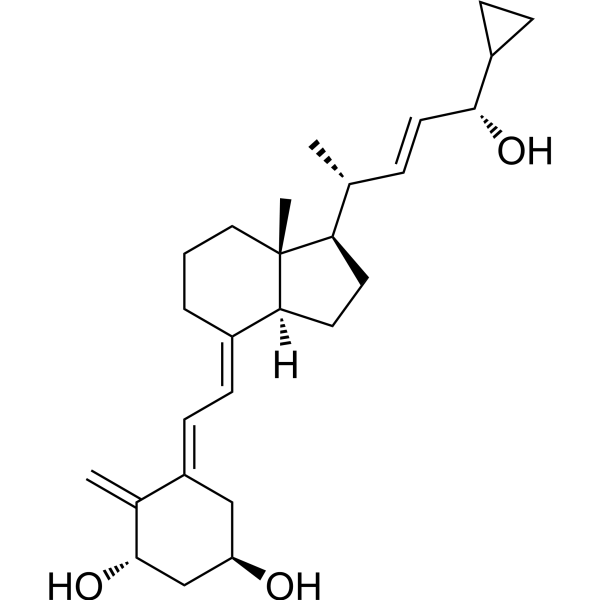 0 ImagesCat. No.: HY-75035RCAS No.: 113082-99-8Calcipotriol Impurity C (Standard) is the analytical standard of Calcipotriol Impurity C. This product is intended for research and analytical applications. Calcipotriol Impurity C is an impurity of Calcipotriol (HY-10001). Calcipotriol is a synthetic vitamin D3 analogue with high affinity for the vitamin D receptor.
-
Difethialone-d4-1
 0 ImagesCat. No.: HY-113958S1Synonyms: LM-2219-d4-1Difethialone-d4-1 (LM-2219-d4-1) is the deuterium labeled Difethialone (HY-113958). Difethialone (LM-2219) is an anticoagulant rodenticide. Difethialone shows high rodenticide activity in warfarin-sensitive and resistant strains of rats and mice. Difethialone interferes with the circulation of vitamin K in the liver, preventing the synthesis of coagulation factors, resulting in the inability of the blood to coagulate properly, ultimately causing internal bleeding and death. Difethialone can be used in studies of ecological impacts.




