



Molecular Glues
Protein degradation agents based on the ubiquitin-proteasome pathway include a part of molecular glues. Molecular glues are a class of small molecule compounds that can induce or stabilize the interaction between proteins. If one of the protein is ubiquitin ligase, molecular glue can cause another protein to undergo ubiquitin modification and degradation through the proteasome pathway, which is similar to PROTAC. However, these molecules are classified as ligand for E3 ligase as functional molecules in subsequent classification. Older drugs, thalidomide, lenalidomide, and pomalidomide, together with CC-90009 and CC-92480 reported later all belong to this category.
All Product Categories
-
Molecular Glues Related Products (372)
Related Products (372)

-
Related Compound Screening Libraries (1)
-
MGD-22
 0 ImagesCat. No.: HY-175502CAS No.: 2991818-12-1MGD-22, a molecular glue, is an orally active IKZF1/2/3 degrader with DC50 values of 8.33 nM, 9.91 nM, and 5.74 nM, respectively. MGD-22 exhibits extremely potent anti-proliferative activity against diverse hematological cancer cells. MGD-22 induces apoptosis in cancer cells. MGD-22 demonstrates potent anti-tumor efficacy in mice bearing NCI-H929 xenografts or WSU-DLCL-2 xenografts. MGD-22 can be used for the study of hematological cancers, including multiple myeloma (MM), acute myeloid leukemia (AML), and diffuse large B-cell lymphoma (DLBCL).
-
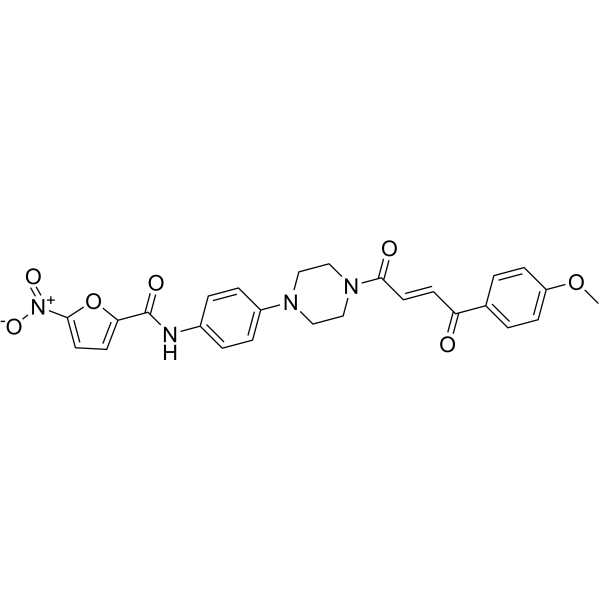
PROTAC FLT-3 degrader 5
 0 ImagesCat. No.: HY-175040PROTAC FLT-3 degrader 5 is an orally active FLT3 PROTAC degrader with a DC50 of 1.2 nM. PROTAC FLT-3 degrader 5 also acts as a molecular glue to degrade GSPT1 and IKZF1/3, with DC50 values of 8.54 nM, 0.02 nM and 0.79 nM, respectively. PROTAC FLT-3 degrader 5 mediates the degradation of FLT3, GSPT1 and IKZF1/3 through interaction with the cereblon E3 ubiquitin ligase complex. PROTAC FLT-3 degrader 5 can be used in the research of acute myeloid leukemia.
-
Z6466608628 hydrochloride
 0 ImagesCat. No.: HY-175599APurity: 99.25%Z6466608628 hydrochloride is a selective PPIL4 molecular glue degrader with human PPIL4 EC50 values of 0.34 µM. Z6466608628 hydrochloride functionally recruits PPIL4 to CRBN, induces CRL4CRBN-mediated ubiquitylation and degradation of PPIL4. Z6466608628 hydrochloride can be used for the research of intracranial aneurysms[1].

-
CDK2 degrader 10
 0 ImagesCat. No.: HY-184657CDK2 degrader 10 is an orally active, cereblon-based molecular glue degrader targeting CDK2, with a DC50 of 120 nM. CDK2 degrader 10 forms a ternary complex with cereblon and CDK2 via a non-canonical recruitment mode, thereby driving CDK2 degradation through the ubiquitin-proteasome system. CDK2 degrader 10 inhibits retinoblastoma protein phosphorylation, induces G1/S cell cycle arrest, and suppresses CDK2-dependent cell proliferation. CDK2 degrader 10 can be used in studies related to CDK2-dependent cancers.
-
rac-Lenalidomide-13C5
 0 ImagesCat. No.: HY-W777286CAS No.: 1219332-91-8Synonyms: CC-5013-13C5rac-Lenalidomide-13C5 (CC-5013-13C5) is the 13C5-labeled Lenalidomide (HY-A0003). Lenalidomide (CC-5013) is an orally active immunomodulatory agent that binds CRBN as a molecular glue to alter substrate specificity, inducing ubiquitination and proteasome-dependent degradation of IKZF1, IKZF3 and CK1α. Lenalidomide induces apoptosis by degrading IKZF1/3, and activates p53 by degrading CK1α. Lenalidomide promotes IL-2 release and effector functions of CD8+ T/NK cells, while inhibiting TNF-α secretion and M1-type pyroptosis. Lenalidomide can be used in research related to hematological malignancies, acute liver failure and acute kidney injury.
-
PRLX-93936 analog 1
 0 ImagesCat. No.: HY-W1125585PRLX-93936 analog 1 is a TRIM21-targeting cytotoxin. PRLX-93936 analog 1 binds to the TRIM21 PRYSPRY domain, inducing TRIM21-mediated ubiquitination and degradation of nucleoporin proteins. PRLX-93936 analog 1 impairs nuclear trafficking, triggering cell death. PRLX-93936 analog 1 exhibits TRIM21-dependent cytotoxicity, suppressible by TRIM21 ligand HGC1g. PRLX-93936 analog 1 can be used for the research of acute myeloid leukemia.


-
BNNC
 0 ImagesCat. No.: HY-184452BNNC is a Photomolecular glue. BNNC selectively releases (R)-CR8 (HY-18340) (a Cyclin K molecular glue) and BSS-Et in hypoxic tumor microenvironments, thereby triggering Cyclin K degradation dependent on the ubiquitin-proteasome pathway. BNNC generates ROS and singlet oxygen in hypoxic tumor cells under light irradiation. BNNC enhances DNA damage and Apoptosis through the combined effects of Cyclin K degradation and phototherapy. BNNC enhances the tumor selectivity of molecular glue via specific activation in hypoxic tumor microenvironments. BNNC can be used in breast cancer-related research.
-
NEK7 degrader-4
 0 ImagesCat. No.: HY-177433CAS No.: 3069891-88-6NEK7 degrader-4 is a NEK7 molecular glue degrader with a DC50 of 9 nM. NEK7 degrader-4 can be used for autoinflammatory and autoimmune disorders like multiple sclerosis, neurodegeneraive diseases like Alzheimer's disease and cardiovascular and melabolic disorders like pericarditis and Type 2 diabetes research.

-
MG degrader 3
 0 ImagesCat. No.: HY-177728CAS No.: 2413733-73-8MG degrader 3 is a molecular glue degrader that induces the degradation of multiple proteins including GSPT1, ZFP91 and CK1α via the ubiquitin-proteasome system, regulates protein stability and cellular signaling networks, and exhibits anti-proliferative activity against multiple myeloma cells. MG degrader 3 can be applied in the research of multiple myeloma.
-
Z-NCTS
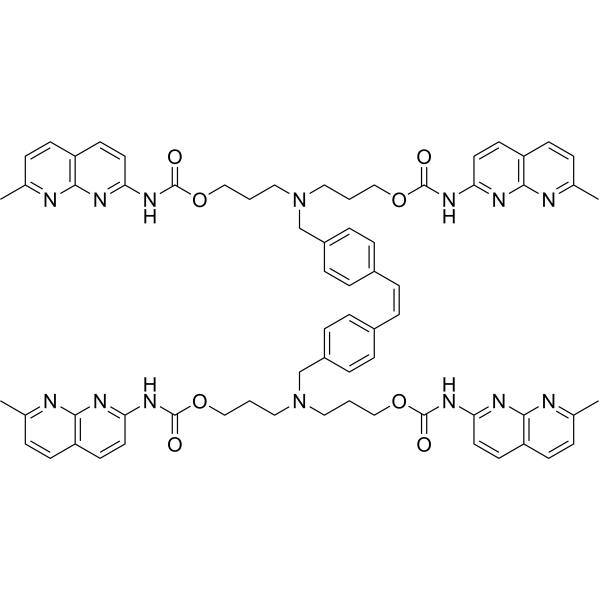 0 ImagesCat. No.: HY-153805CAS No.: 1373391-77-5Z-NCTS is a small molecule that binds to mismatched RNA, recognizes the 5'-r (XGG)-3'/5'-r (XGG)-3' sequence, and acts as an RNA molecular glue. Z-NCTS induces the formation of tertiary structures in ribozymes and activates their RNA cleavage activity. As an RNA molecular glue, Z-NCTS enables small molecule-based strategies for regulating RNA structure and function. Z-NCTS binds to d (CGG)/d (CGG) double-stranded DNA, recognizes four guanine bases via hydrogen bonding, and stabilizes the double-stranded DNA. Z-NCTS binds to r (GGG)/r (GGG) double-stranded RNA and enhances the thermodynamic stability of the RNA duplex. Z-NCTS acts as a translation inhibitor by inducing the formation of stable hairpin structures in the 5'-UTR region of engineered mRNA, thereby blocking ribosomal access to the binding site.
-
IKZF1-degrader-2
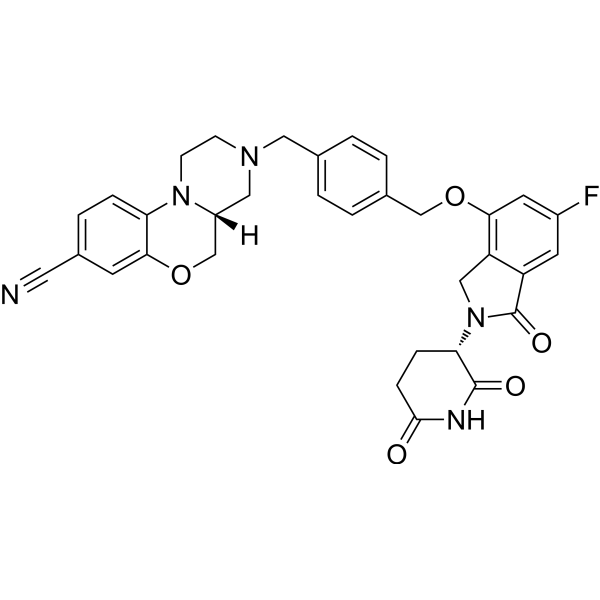 0 ImagesCat. No.: HY-160533CAS No.: 2915330-86-6IKZF1-degrader-2 (Compound 3) is an IKZF1 molecular glues degrader. IKZF1-degrader-2 has anticancer activity and low toxicity.
-
AHL-7160
 0 ImagesCat. No.: HY-180898AHL-7160 is a molecular glue degrader targeting DGKα, with an IC50 value of 12 nM against the human protein. AHL-7160 rapidly recruits DGKα to the plasma membrane, blocks DGKα-mediated phosphatidic acid production, and induces proteasome-dependent degradation of DGKα with full proteome selectivity. AHL-7160 enhances primary T cell-mediated glioblastoma cell killing. AHL-7160 can be used in related research on glioblastoma.
-
MG degrader 2
 0 ImagesCat. No.: HY-177725CAS No.: 2413733-33-0MG degrader 2 (Compound CM-2) is a CRBN-dependent molecular glue degrader. MG degrader 2 induces ZFP91, FIZ1 and PI4KB degradation. MG degrader 2 has anti-proliferative activity against MM.1S cells (IC50 = 162 nM). MG degrader 2 can be used for the research of cancer, such as multiple myeloma.
-
DDO-6513
 0 ImagesCat. No.: HY-W1150738CAS No.: 2809367-71-1DDO-6513 is a STING molecular glue inhibitor with an IC50 of 1.93 μM. DDO-6513 selectively targets human STING but not murine STING, and exhibits a Kd value of 151 nM for human STING. DDO-6513 induces aberrant head-to-head STING oligomerization and disrupts the formation of normal signal-competent linear STING polymers. DDO-6513 inhibits STING-dependent downstream activation of TBK1 and IRF3, and suppresses the expression of proinflammatory cytokines. DDO-6513 can be used for research on STING-related autoinflammatory diseases.
-
IKZF2-degrader 2
 0 ImagesCat. No.: HY-W1128213CAS No.: 2983841-00-3IKZF2-degrader 2 is a selective and orally active IKZF2 molecular glue degrader with DC50 values of 0.5 nM and 1.8 nM in HiBit and FACS. The IKZF2-degrader 2 mediates the ubiquitination and degradation of target proteins by recruiting the CRL4-CRBN E3 ubiquitin ligase. IKZF2-degrader 2 displays moderate degradation against SALL4 with a DC50 of 9 nM but does not induce any significant degradation towards IKZF1, IKZF3, CK1α and GSPT1. IKZF2-degrader 2 can be used for the study of cancer immunology.



