



Alkaline phosphatase, Bovine intestine
Based on 2 publication(s) in Google Scholar
Alkaline phosphatase, Bovine intestine (Apase) is an orally active membrane-bound glycoprotein that catalyzes the hydrolysis of phosphate monoesters at alkaline pH. Alkaline phosphatase, Bovine intestine reduces myeloperoxidase activity and bacterial translocation. Alkaline phosphatase, Bovine intestine improves survival rate of mice infected with E. coli. Alkaline phosphatase, Bovine intestine improves TNBS-induced colon inflammation.
For research use only. We do not sell to patients.
- CAS No.: 9001-78-9
-
Storage:
Please store the product under the recommended conditions in the Certificate of Analysis.

To place orders, for customer services and technical support, please contact: MedChemExpress USA
Tel: 609-228-6898 E-mail: [email protected] [email protected]


-
 Biological Activity
-
Chemical Information
-
Solvent & Solubility
- Protocols
- Purity & Documentation
- References
-
 Help & FAQs


-

HY-P2818E
Alkaline Phosphatase, Calf intestinalAlkaline Phosphatase from Calf Intestinal -
HY-P2985
Alanine aminotransferase, Porcine heartAlanine Aminotransferase -

HY-P2818A
Alkaline phosphatase, Escherichia coliAlkaline phosphatase -

HY-P2818C
Alkaline phosphatase, microorganismAlkaline Phosphatase -

HY-W250978
OvalbuminsAllergen -

HY-P2818B
Alkaline phosphatase, Chicken IntestineAlkaline Phosphatase -

HY-P2997
γ-glutamyltransferase, Porcine kidneyBiochemical Reagent -
HY-15902
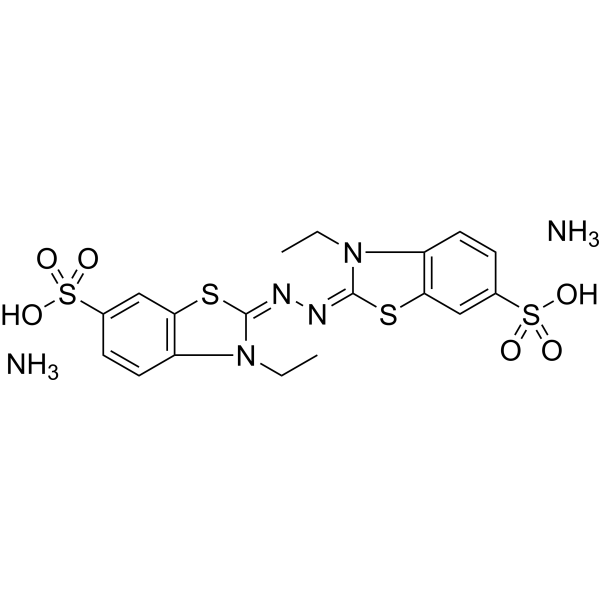
ABTS diammonium saltHRP Substrate -
HY-15928
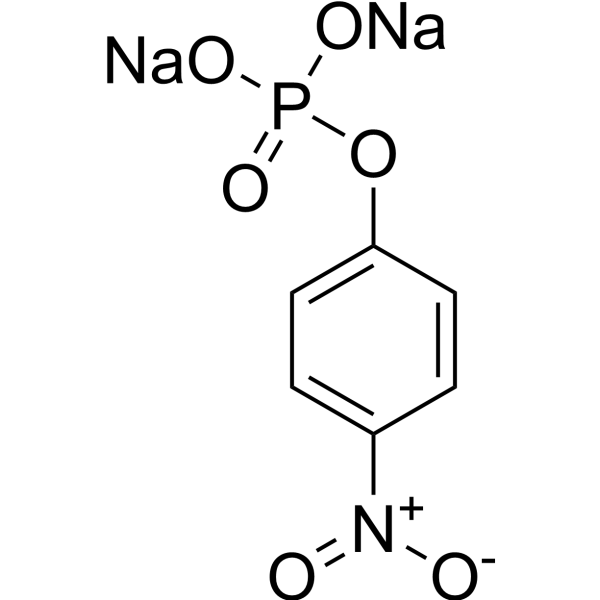
4-Nitrophenyl phosphate disodiumPhosphatases Substrate -

HY-P2818F
Alkaline phosphatase, Human (HEK293)Alkaline phosphatase -

HY-P1645
PapainPapain
Publications Citing Use of MedChemExpress (MCE) Alkaline phosphatase, Bovine intestine
More

Biological Activity
Description
In Vitro
Instructions
1. Dissolve the enzyme in 30 U/μL 10 mM Tris-HCl (pH8.0), 1 mM MgCl2, 50 mM KCl, 0.1 mM ZnCl2. Fresh preparation is recommended.
2. Add the following reagents to a 1.5 mL centrifuge tube to dephosphorylate DNA:
1) 1-20 pmol DNA fragment
2) 1-2 μL Alkaline Phosphatase
3) 5 μL 500 mM Tris-HCl pH 9.0, 10 mM MgCl2
4) Add sterile ddH2O to 50 μL
Note: Single-stranded DNA or DNA with 5' protruding ends is recommended to be incubated at low temperature, while blunt-ended DNA or DNA with 3' protruding ends is recommended to be incubated at higher temperature.
3. Mix well and incubate at 37°C or 50°C for 30 min. Alternatively, incubate at 37°C for 15 min, then incubate at 50°C for 15 min.
4. Extract twice with phenol/chloroform/isoamyl alcohol (25:24:1).
Note: Before phenol extraction, it is recommended to incubate it at 56°C for 30 min in a solution containing 5 mM EDTA, 0.5% SDS, and 50 μg/mL Proteinase K to completely inactivate alkaline phosphatase. Incubate at 75°C for 10 min before phenol extraction for better inactivation.
5. Extract with chloroform/isoamyl alcohol (24:1).
6. Add 2.5 μL 3 M NaCl (final concentration 150 mM), 125 μL (2.5 times volume) pre-cooled ethanol, mix well, and place at -20°C for 30-60 min to precipitate DNA.
4 Centrifuge, completely remove ethanol, and dissolve DNA in an appropriate amount of deionized water (<20 μL).
MedChemExpress (MCE) has not independently confirmed the accuracy of these methods. They are for reference only.
In Vivo
Alkaline phosphatase, Bovine intestine (0.15 IU/g; i.v.; once; either 5 min before or 15 min after cecal ligation and puncture) reduces cytokine concentrations in plasma and peritoneal lavage fluid, decreases transaminase activity in plasma and myeloperoxidase activity in the lung in a murine cecal ligation and puncture model of polymicrobial sepsis[2].
Alkaline phosphatase, Bovine intestine (5000 U; i.p.) significantly reduces postoperative peritoneal adhesion formation in mice[3].
Alkaline phosphatase, Bovine intestine (700 U/kg day; p.o. or intrarectal administration) ameliorates TNBS-elicited colonic inflammation and reduces bacterial translocation in rats[4].
MedChemExpress (MCE) has not independently confirmed the accuracy of these methods. They are for reference only.
-
Animal Model:Female Wistar rats (175-225 g) + TNBS-induced colitis model[4]
-
Dosage:700 U/kg day (oral group: delivered in 1% methylcellulose with 0.2 mM MgCl2; intrarectal group: delivered in 1% methylcellulose with 0.2 mM MgCl2)
-
Administration:Oral gavage (p.o.) or intrarectal administration
-
Result:Presented a reduction in colonic weight to length ratio and overall damage score (rectal administration group).
Normalized the expression of S100A8 mRNA, a marker of neutrophil infiltration (rectal administration group).
Showed a reduction of IL-1β and LCN2 colonic expression (rectal administration group).
Had a less marked effect on some endpoints compared to the rectal administration group (p.o. group).
Counteracted bacterial translocation effectively (p.o. group and rectal administration group).
EC Number
3.1.3.1
Enzyme Activity
≥10 U/mg soild
Unit Definition
One unit is defined as the amount of enzyme that will hydrolyze 1.0 μmol of P-Nitrophenyl Phosphate per min at pH 9.8 at 37°C.


Chemical Information
-
CAS No. 9001-78-9
-
Appearance Solid
-
Color White to off-white
-
SMILES
[Alkaline phosphatase, Bovine intestine]
-
Synonyms
Apase
-
Structure Classification
-
Initial Source
all tissues throughout the human body
-
Shipping
Room temperature in continental US; may vary elsewhere.
-
Storage
Please store the product under the recommended conditions in the Certificate of Analysis.


Publications (2)
-
Journal Impact Factor
-
Most Recent


Solvent & Solubility
In Vitro:
H2O : ≥ 50 mg/mL
* "≥" means soluble, but saturation unknown.
In Vivo:
For the following dissolution methods, please prepare the working solution directly:
It is recommended to prepare fresh solutions and use them promptly within a short period of time.
The percentages shown for the solvents indicate their volumetric ratio in the final prepared solution. If precipitation or phase separation occurs during preparation, heat and/or sonication can be used to aid dissolution.
Add each solvent one by one: PBS
Solubility: 50 mg/mL; Clear solution; Need ultrasonic


Purity & Documentation
-
Data Sheet (274 KB)
-
SDS (393 KB)
- English - EN (393 KB)
- Français - FR (393 KB)
- Deutsch - DE (393 KB)
- Norwegian - NO (393 KB)
- Español - ES (393 KB)
- Swedish - SV (393 KB)
- Italian - IT (393 KB)
- Korean - KR (393 KB)
- Portuguese - PT (393 KB)
-
Handling Instructions (2659 KB)
References
[1]. Beumer C, et al. Calf intestinal alkaline phosphatase, a novel therapeutic drug for lipopolysaccharide (LPS)-mediated diseases, attenuates LPS toxicity in mice and piglets. J Pharmacol Exp Ther. 2003 Nov;307(2):737-44. [Content Brief]
[2]. van Veen SQ, et al. Bovine intestinal alkaline phosphatase attenuates the inflammatory response in secondary peritonitis in mice. Infect Immun. 2005 Jul;73(7):4309-14. [Content Brief]
[3]. Hyoju SK, et al. Intestinal alkaline phosphatase decreases intraperitoneal adhesion formation. J Surg Res. 2017 Feb;208:84-92. [Content Brief]
[4]. Martínez-Moya P, et al. Exogenous alkaline phosphatase treatment complements endogenous enzyme protection in colonic inflammation and reduces bacterial translocation in rats. Pharmacol Res. 2012 Aug;66(2):144-53. [Content Brief]
[5]. Ujjawal Sharma, et al. Alkaline Phosphatase: An Overview. Indian J Clin Biochem. 2014 Jul; 29(3): 269-278. [Content Brief]
[6]. Chirambo GM, et al. The role of alkaline phosphatase in intracellular lipid accumulation in the human hepatocarcinoma cell line, HepG2. Exp Mol Pathol. 2017 Apr;102(2):224-229. [Content Brief]

Calculators
Concentration (start) × Volume (start) = Concentration (final) × Volume (final)


Alkaline phosphatase, Bovine intestine Related Classifications
HY-P2818 Related Classifications
 Powered by Bioz