



AN15368
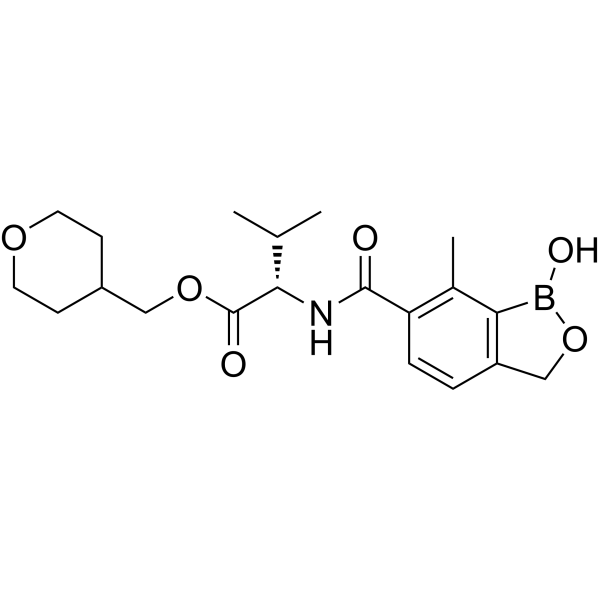
AN15368 is an orally active trypanocidal agent and a prodrug of AN14667. AN15368 selectively targets CPSF3-mediated mRNA maturation in intracellular amastigotes of Trypanosoma cruzi, reducing the mRNA levels of the parasite. As a prodrug, AN15368 can be cleaved into its active carboxylate form by CBP of Trypanosoma cruzi. AN15368 completely clears long-term naturally acquired Trypanosoma cruzi infections in non-human primates. AN15368 can be used in the research of Chagas disease.
For research use only. We do not sell to patients.
- CAS No.: 2152662-92-3
- Formula: C20H28BNO6
- Molecular Weight:389.25
-
Storage:
Please store the product under the recommended conditions in the Certificate of Analysis.

To place orders, for customer services and technical support, please contact: MedChemExpress USA
Tel: 609-228-6898 E-mail: [email protected] [email protected]


-
 Biological Activity
-
Chemical Information
- Protocols
- Purity & Documentation
- References
-
 Help & FAQs


All Parasite Isoforms
More

Biological Activity
Description
In Vitro
AN15368 (2-fold serial dilutions; 48-72 h) potently inhibits growth of wild-type intracellular T. cruzi amastigotes with an IC50 of 2.4 nM and wild-type extracellular T. cruzi amastigotes with an IC50 of 5 nM[1].
AN15368 (2-fold serial dilutions; 72 h) has reduced susceptibility in intracellular T. cruzi amastigotes overexpressing CPSF3, with an IC50 of 11.8 nM, confirming CPSF3 as a target of AN15368[1].
AN15368 (2-fold serial dilutions; 72 h) has drastically reduced susceptibility in intracellular T. cruzi amastigotes with the engineered Asn232His mutation in CPSF3, with an IC50 of 0.5 μM, confirming CPSF3 as a target of AN15368[1].
AN15368 (2-fold serial dilutions; 72 h) has drastically reduced susceptibility in intracellular T. cruzi amastigotes with disrupted TcCBP, with an IC50 of 2.5 μM, confirming AN15368 requires activation by parasite serine carboxypeptidase[1].
AN15368 (10 μM; 6 h) for epimastigotes, (50 nM) for amastigotes is converted to its active cleaved product AN14667 in wild-type T. cruzi epimastigotes and amastigotes, but not in TcCBP knockout parasites, confirming TcCBP mediates prodrug activation[1].
MedChemExpress (MCE) has not independently confirmed the accuracy of these methods. They are for reference only.
In Vivo
AN15368 (1-5 mg/kg; p.o.; daily; 21 days) reduces Trypanosoma cruzi parasite load in hairless mice, with the 2.5 and 5 mg/kg doses achieving near-complete parasite suppression[1].
MedChemExpress (MCE) has not independently confirmed the accuracy of these methods. They are for reference only.
-
Animal Model:C57BL/6J (6-9 weeks old, male and female, intraperitoneally infected with 104 Trypanosoma cruzi Brazil strain trypomastigotes)[1]
-
Dosage:2.5 and 10 mg/kg
-
Administration:p.o.; daily; 40 days
-
Result:Showed no parasite recovery by haemoculture and no parasite DNA detection in skeletal muscle via qPCR, with parasite equivalents per 50 ng DNA at or below the assay cut-off.
-
Animal Model:SKH-1 hairless backcrossed to C57BL/6J (6-9 weeks old, male and female, intraperitoneally infected with 5 × 10⁴ luciferase-expressing Trypanosoma cruzi Colombiana strain trypomastigotes)[1]
-
Dosage:1 mg/kg; 2.5 mg/kg; 5 mg/kg; 10 mg/kg
-
Administration:p.o.; daily; 21 days
-
Result:Reduced bioluminescence signals over time.
Reduced signals to near background levels (≤104 photons s-1 cm-2) by 30 dpi at 5 mg/kg dose.
Reduced signals to near background levels by 33 dpi at 2.5 mg/kg dose.
Resulted in a significant reduction in bioluminescence signals compared to untreated controls, with signals reaching ~106 photons s-1 cm-2 by 33 dpi at 1 mg/kg dose.


Chemical Information
-
CAS No. 2152662-92-3
-
Molecular Weight 389.25
-
Formula C20H28BNO6
-
SMILES
OB1OCC2=C1C(C)=C(C=C2)C(N[C@@H](C(C)C)C(OCC3CCOCC3)=O)=O
-
Shipping
Room temperature in continental US; may vary elsewhere.
-
Storage
Please store the product under the recommended conditions in the Certificate of Analysis.


Purity & Documentation
References

Calculators
Concentration (start) × Volume (start) = Concentration (final) × Volume (final)


AN15368 Related Classifications
HY-153238 Related Classifications
 Powered by Bioz