



Antiangiogenic agent 3
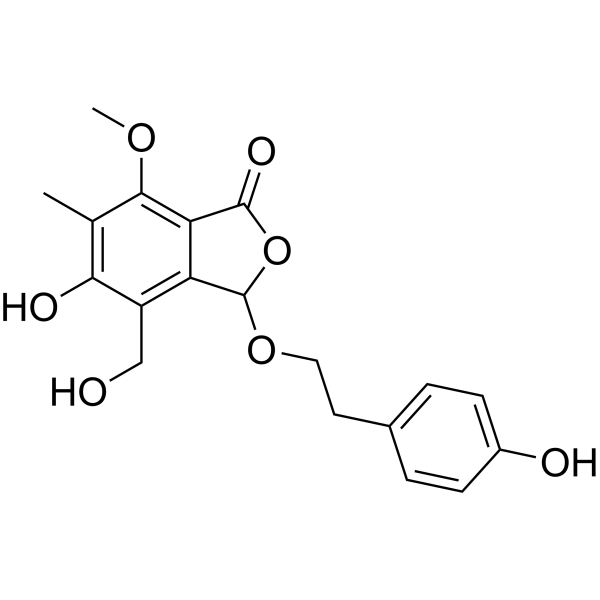
Antiangiogenic agent 3 (compound 3) is a potent antiangiogenic agent. Antiangiogenic agent 3 is an inhibitor of human umbilical vein endothelial cells (HUVEC). Antiangiogenic agent 3 inhibits HUVEC migration and chemotactic motilities. Antiangiogenic agent 3 also decreases the gene expression of Src, cdc42, and MAPK.
연구목적의 판매만을 진행합니다. 환자를 대상으로 한 판매는 하지 않습니다.
- 화학식: C19H20O7
- 분자량:360.36
-
보관:
Please store the product under the recommended conditions in the Certificate of Analysis.

To place orders, for customer services and technical support, please contact: MedChemExpress USA
Tel: 609-228-6898 E-mail: [email protected] [email protected]


-
 Biological Activity
-
Chemical Information
- Protocol
- 순도&문서
- References
-
 Help & FAQs




Biological Activity
제품 설명
In Vitro
Antiangiogenic agent 3 (6.25-200 μM; 48 h) decreases cell viability of human umbilical vein endothelial cells (HUVEC)[1].
Antiangiogenic agent 3 (5 μM, 10 μM; 24 h) inhibits HUVEC migration or chemotactic motilities induced by VEGF, with 30% and 33% inhibition rate at 5 μM and 10 μM, respectively[1].
Antiangiogenic agent 3 (10 μM; 24 h) down-regulates the gene expressions of Src, cdc42, and MAPK related to the migration of epithelial cells[1].
MedChemExpress (MCE) has not independently confirmed the accuracy of these methods. They are for reference only. Further protocols information, click here.
-
Cell Line:Human umbilical vein endothelial cells (HUVEC)
-
Concentration:10 μM
-
Incubation Time:24 hours
-
Result:Decreased the expressions of VEGF and some related to epithelial cell survival, such as Akt and mTOR.
Decreased the expressions of Src, cdc42, and MAPK.


Chemical Information
-
분자량 360.36
-
화학식 C19H20O7
-
SMILES
COC1=C2C(OC(C2=C(C(O)=C1C)CO)OCCC3=CC=C(C=C3)O)=O
-
선적
Room temperature in continental US; may vary elsewhere.
-
보관
Please store the product under the recommended conditions in the Certificate of Analysis.

Protocol
-
RT-PCR
Reverse transcription technology uses RNA as a template to synthesize DNA. RT-PCR is simple, specific and sensitive, and can be used to detect gene expression levels and expression differences in cells; detect RNA virus content; clone cDNA sequences of specific genes.
-
RNA extraction experimental
By lysing cells, releasing RNA, and removing impurities such as proteins and DNA, high-purity RNA products are finally obtained. The commonly used traditional method is the guanidine isothiocyanate/phenol/chloroform method (Trizol), which is suitable for a variety of animal materials including animal tissues, microorganisms, cultured cells, etc., and most plant materials.
-
Cell migration
Cell migration is a method that plays an important role in wound healing, cell differentiation, embryonic development, etc.
-
Endothelial Tube Formation Assay
Endothelial tube formation assay evaluates the ability of endothelial cells to attach, migrate, align, and organize into capillary-like networks when cultured on gelled basement membrane extract or Matrigel; the readout is the morphology and quantity of tube-like networks, which reflects an in vitro endothelial morphogenesis step related to angiogenesis. Basement membrane extract/Matrigel provides laminin-rich extracellular matrix cues that support endothelial differentiation into capillary-like structures, but it can contain biologically active growth factors, so growth-factor-reduced matrix is preferred when testing defined angiogenic stimulators or inhibitors.
-
Real Time qPCR (Q-PCR)
Real-time quantitative PCR (qPCR) quantifies an amplifiable nucleic-acid target by monitoring fluorescence during PCR cycling rather than measuring product only after amplification. The increase in fluorescence tracks accumulation of PCR product, and the quantification cycle (Cq; historically also Ct/CP) is related to the initial amount of target: samples containing more starting target generally reach the defined fluorescence threshold in fewer cycles.


순도&문서
References

Calculators
Concentration (start) × Volume (start) = Concentration (final) × Volume (final)


Antiangiogenic agent 3 Related Classifications
HY-149921 Related Classifications
 Powered by Bioz