



Antitrypanosomal agent 4
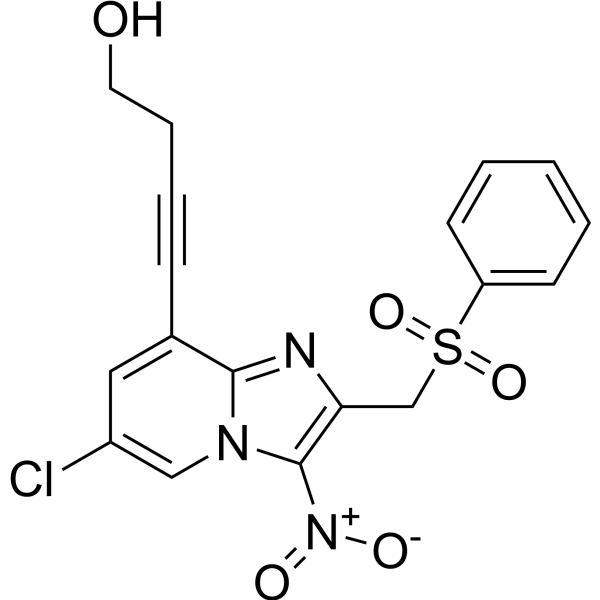
Antitrypanosomal agent 4 (compound 19) is a potent and blood-brain barrier permeable antitrypanosomal agent. Antitrypanosomal agent 4 has good activity against Trypanosoma cruzi (T. cruzi) and Trypanosoma brucei brucei (T. b. brucei) with IC50s of 1.2 μM and 70 nM, respectively. Antitrypanosomal agent 4 is a click chemistry reagent, it contains an Alkyne group and can undergo copper-catalyzed azide-alkyne cycloaddition (CuAAc) with molecules containing Azide groups.
For research use only. We do not sell to patients.
- CAS No.: 2456427-48-6
- Formula: C18H14ClN3O5S
- Molecular Weight:419.84
-
Storage:
Please store the product under the recommended conditions in the Certificate of Analysis.

To place orders, for customer services and technical support, please contact: MedChemExpress USA
Tel: 609-228-6898 E-mail: [email protected] [email protected]


-
 Biological Activity
-
Chemical Information
- Protocols
- Purity & Documentation
- References
-
 Help & FAQs


All Parasite Isoforms
More

Biological Activity
Description
IC50 & Target
|
Trypanosoma |
Cellular Effect
|
Cell Line

|
Type | Value | Description | References |
|---|---|---|---|---|
| HepG2 | CC50 |
>125 μM
Compound: 19
|
Cytotoxicity against human HepG2 cells assessed as reduction in cell viability after 72 hrs by MTT assay
Cytotoxicity against human HepG2 cells assessed as reduction in cell viability after 72 hrs by MTT assay
|
[PMID: 32652409] |
| THP-1 | CC50 |
>100 μM
Compound: 19
|
Cytotoxicity against human THP-1 cells assessed as reduction in cell viability after 72 hrs by MTT assay
Cytotoxicity against human THP-1 cells assessed as reduction in cell viability after 72 hrs by MTT assay
|
[PMID: 32652409] |


Chemical Information
-
CAS No. 2456427-48-6
-
Molecular Weight 419.84
-
Formula C18H14ClN3O5S
-
SMILES
OCCC#CC1=CC(Cl)=CN2C1=NC(CS(=O)(C3=CC=CC=C3)=O)=C2[N+]([O-])=O
-
Shipping
Room temperature in continental US; may vary elsewhere.
-
Storage
Please store the product under the recommended conditions in the Certificate of Analysis.


Purity & Documentation
References

Calculators
Concentration (start) × Volume (start) = Concentration (final) × Volume (final)


Antitrypanosomal agent 4 Related Classifications
HY-146049 Related Classifications
 Powered by Bioz