



ARD-1676
Based on 1 publication(s) in Google Scholar
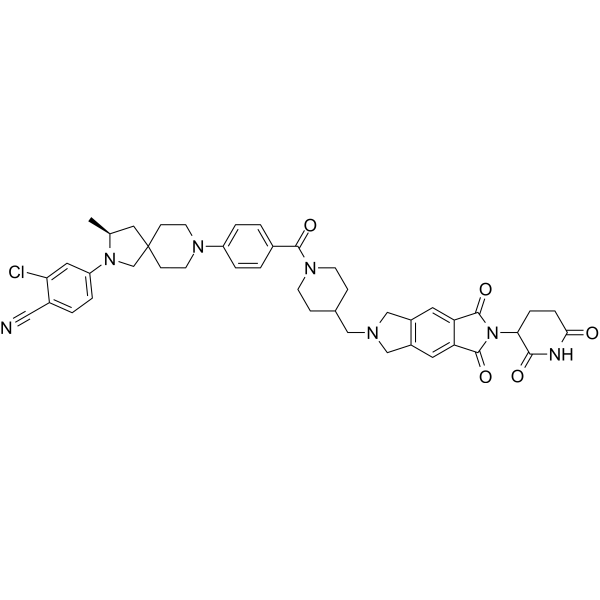
ARD-1676 is an orally active androgen receptor (AR) PROTAC degrader. ARD-1676 induces proteasomal degradation of AR, inhibits AR-regulated gene expression, suppresses cell growth, reduces AR protein levels and inhibits tumor growth in in vivo models. ARD-1676 can be used in studies related to AR+ human prostate cancer and spinal bulbar muscular atrophy.
(Pink: Androgen Receptor ligand (HY-150878); Blue: Cereblon ligand (HY-W248665); Black: linker).
연구목적의 판매만을 진행합니다. 환자를 대상으로 한 판매는 하지 않습니다.
- Purity : 98.21%
- CAS No.: 2632305-36-1
- 화학식: C44H46ClN7O5
- 분자량:788.33
-
보관:
4°C, protect from light
* In solvent : -80°C, 6 months; -20°C, 1 month (protect from light)

To place orders, for customer services and technical support, please contact: MedChemExpress USA
Tel: 609-228-6898 E-mail: [email protected] [email protected]


-
 Biological Activity
-
Chemical Information
-
용액&용해도
- Protocol
- 순도&문서
- References
-
 Help & FAQs


Publications Citing Use of MedChemExpress (MCE) ARD-1676
MoreAll PROTACs Isoforms
More

Biological Activity
제품 설명
Cellular Effect
|
Cell Line

|
Type | Value | Description | References |
|---|---|---|---|---|
| LNCaP | IC50 |
2.8 nM
Compound: 39; ARD-1676
|
Growth inhibition in human LNCaP cells assessed as reduction in cell viability
Growth inhibition in human LNCaP cells assessed as reduction in cell viability
|
[PMID: 37683104] |
| VCaP | IC50 |
11.5 nM
Compound: 39; ARD-1676
|
Growth inhibition in human VCaP cells
Growth inhibition in human VCaP cells
|
[PMID: 37683104] |
In Vitro
ARD-1676 (4 days) inhibits the growth of human prostate cancer LNCaP cells, with an IC50 of 2.8 nM after 4 days of co-incubation with 0.1 nM R1881[1].
ARD-1676 (10-100 nM; 1-24 h) induces rapid degradation of AR in human prostate cancer cell lines VCaP and LNCaP. At concentrations of 10 nM and 100 nM, the degradation rate exceeds 50% within 1 h, and reaches the maximum degradation level at 3-6 h[1].
ARD-1676 (0.03-30 nM; 24 h) potently inhibits AR-regulated KLK3 and TMPRSS2 gene expression in VCaP and LNCaP human prostate cancer cells[1].
ARD-1676 (0.1-1000 nM; 15 min-48 h) potently and rapidly induces proteasomal degradation of polyglutamine AR112Q in Tet-on PC12 cells. Its effect takes effect as early as 15 min and persists for up to 48 h, and it also effectively degrades both cytoplasmic and nuclear pools of this misfolded protein[2].
ARD-1676 (100 nM; 24 h) potently reduces AR protein levels in control and SBMA patient-derived iMNs without altering AR mRNA expression or inducing cytotoxicity[2].
MedChemExpress (MCE) has not independently confirmed the accuracy of these methods. They are for reference only.
-
Cell Line:HEK293 cells overexpressing clinically relevant AR mutants (wild-type, K388R, Δ388-390, L702H, V716M, W742C, H875Y, F877L, T878A, S889G, Δ873-879)
-
Concentration:1, 10, 100 nM, 1 and 10 μM
-
Incubation Time:24 h (in the presence of 50 μg/mL cycloheximide)
-
Result:Potently degraded wild-type, K388R, V716M, W742C, H875Y, F877L, and T878A AR mutants at concentrations as low as 1 nM.
Effectively depleted Δ388-390 and Δ873-879 deletion mutants.
Showed reduced efficacy against L702H and S889G mutants relative to other variants.
-
Cell Line:VCaP and LNCaP AR+ human prostate cancer cell lines
-
Concentration:0.03, 0.1, 0.3, 1, 3, 10 and 30 nM (in the presence of 0.1 nM R1881)
-
Incubation Time:24 h
-
Result:Reduced KLK3 and TMPRSS2 mRNA levels by > 50% at 1 nM in VCaP cells and 3 nM in LNCaP cells, demonstrating ~100-fold greater potency than enzalutamide for suppressing AR-regulated gene expression.
Parmacokinetics
| Species | Dose | Route | T1/2 | AUC0-t | Vss | CL | Tmax | Cmax | F |
|---|---|---|---|---|---|---|---|---|---|
| Mice[1] | 2 mg/kg | i.v. | 4.3 h | 50538 ng·h/mL | 0.23 L/kg | 0.04 L/h/kg | / | / | / |
| Mice[1] | 5 mg/kg | p.o. | 4.4 h | 85243 ng·h/mL | / | / | 2.0 h | 9124 ng/mL | 67 % |
| Rat[1] | 2 mg/kg | i.v. | 4.5 h | 5492 ng·h/mL | 1.7 L/kg | 0.36 L/h/kg | / | / | / |
| Rat[1] | 5 mg/kg | p.o. | 5.6 h | 6016 ng·h/mL | / | / | 4.0 h | 871 ng/mL | 44 % |
| Dog[1] | 1 mg/kg | i.v. | 9.9 h | 4857 ng·h/mL | 1.74 L/kg | 0.19 L/h/kg | / | / | / |
| Dog[1] | 10 mg/kg | p.o. | 27.4 h | 15170 ng·h/mL | / | / | 3.0 h | 1031 ng/mL | 31 % |
| Cynomolgus Monkey[1] | 1 mg/kg | i.v. | 10 h | 5171 ng·h/mL | 2.07 L/kg | 0.2 L/h/kg | / | / | / |
| Cynomolgus Monkey[1] | 2 mg/kg | p.o. | 9.62 h | 10302 ng·h/mL | / | / | 3.33 h | 1520 ng/mL | 99 % |
In Vivo
MedChemExpress (MCE) has not independently confirmed the accuracy of these methods. They are for reference only.
-
Animal Model:SCID mice (male)[1]
-
Dosage:10 mg/kg (TGI); 20 mg/kg (TGI); 40 mg/kg (TGI); 12.5 mg/kg (AR protein reduction)
-
Administration:p.o.; once daily for 45 days (for TGI); single dose (for AR protein reduction)
-
Result:Reduced AR protein levels in tumor tissue by 96% at 6 h and 93% at 24 h.
Achieved tumor growth inhibition (TGI) of 50% at 10 mg/kg, 68% at 20 mg/kg, and 85% at 40 mg/kg.
Caused no animal weight loss or signs of toxicity during treatment.
-
Animal Model:AR113Q knock-in (male, 8-10 weeks old)[2]
-
Dosage:30 mg/kg
-
Administration:p.o.; single dose
-
Result:Reduced polyQ androgen receptor (AR) protein levels significantly in levator ani/bulbocavernosus muscle compared to vehicle control.
Showed no change in Ar mRNA expression in tibialis anterior muscle.
Detected no significant change in AR protein levels in lumbar spinal cord.
Observed no alterations in serum liver or kidney function biomarkers, indicating no acute toxicity.
- RT-PCR
- RNA extraction experimental
- Somatic Cell Culture
- Patient-Derived Orthotopic Xenograft (PDOX)
- CCK-8/WST-8 Cell Proliferation Assay
- Cell Counting-Based Growth Curve Assay
- Real Time qPCR (Q-PCR)
- Cell Viability Determination by MTT Colorimetric Assay
- Protocol for Cell Counting and Cell Density Analysis
- Research Protocol for Endocrine Diseases
- Patient-Derived Xenograft (PDX)
- MTT Cell Proliferation Assay
- Subcutaneous Cell-Line-Derived Xenograft
- Orthotopic Cell-Line Xenograft


Chemical Information
-
CAS No. 2632305-36-1
-
Appearance Solid
-
분자량 788.33
-
화학식 C44H46ClN7O5
-
Color White to light yellow
-
SMILES
C[C@H]1CC2(CN1C3=CC=C(C(Cl)=C3)C#N)CCN(CC2)C4=CC=C(C=C4)C(N5CCC(CC5)CN6CC7=C(C6)C=C8C(N(C(C8=C7)=O)C9CCC(NC9=O)=O)=O)=O
-
선적
Room temperature in continental US; may vary elsewhere.
-
보관
4°C, protect from light
* In solvent : -80°C, 6 months; -20°C, 1 month (protect from light)


Publications (1)
-
Journal Impact Factor
-
Most Recent
-
Anal Chem
Hydrogen/Deuterium Exchange for Chiral Stability Assessment in Acidic Methine-Containing Compounds. [Abstract]2025 Dec 2;97(47):26097-26107. PMID: 41243541


용액&용해도
In Vitro:
DMSO : 100 mg/mL (126.85 mM; Need ultrasonic; Hygroscopic DMSO has a significant impact on the solubility of product, please use newly opened DMSO)
Please refer to the solubility information to select the appropriate solvent. Once prepared, please aliquot and store the solution to prevent product inactivation from repeated freeze-thaw cycles.
Storage method and period of stock solution: -80°C, 6 months; -20°C, 1 month (protect from light). When stored at -80°C, please use it within 6 months. When stored at -20°C, please use it within 1 month.
Please refer to the solubility information to select the appropriate solvent. Once prepared, please aliquot and store the solution to prevent product inactivation from repeated freeze-thaw cycles.
Storage method and period of stock solution: -80°C, 6 months; -20°C, 1 month (protect from light). When stored at -80°C, please use it within 6 months. When stored at -20°C, please use it within 1 month.
Concentration (start) × Volume (start) = Concentration (final) × Volume (final)
In Vivo:
Select the appropriate dissolution method based on your experimental animal and administration route.
- For the following dissolution methods, please ensure to first prepare a clear stock solution using an In Vitro approach and then sequentially add co-solvents:
- To ensure reliable experimental results, the clarified stock solution can be appropriately stored based on storage conditions. As for the working solution for In Vivo experiments, it is recommended to prepare freshly and use it on the same day.
- The percentages shown for the solvents indicate their volumetric ratio in the final prepared solution. If precipitation or phase separation occurs during preparation, heat and/or sonication can be used to aid dissolution.
Add each solvent one by one: 10% DMSO 40% PEG300 5% Tween-80 45% Saline
Solubility: ≥ 2.5 mg/mL (3.17 mM); Clear solution
This protocol yields a clear solution of ≥ 2.5 mg/mL (saturation unknown).
Taking 1 mL working solution as an example, add 100 μL DMSO stock solution (25.0 mg/mL) to 400 μL PEG300, and mix evenly; then add 50 μL Tween-80 and mix evenly; then add 450 μL Saline to adjust the volume to 1 mL.
Preparation of Saline: Dissolve 0.9 g sodium chloride in ddH₂O and dilute to 100 mL to obtain a clear Saline solution.
Add each solvent one by one: 10% DMSO 90% (20% SBE-β-CD in Saline)
Solubility: ≥ 2.5 mg/mL (3.17 mM); Clear solution
This protocol yields a clear solution of ≥ 2.5 mg/mL (saturation unknown).
Taking 1 mL working solution as an example, add 100 μL DMSO stock solution (25.0 mg/mL) to 900 μL 20% SBE-β-CD in Saline, and mix evenly.
Preparation of 20% SBE-β-CD in Saline (4°C, storage for one week): 2 g SBE-β-CD powder is dissolved in 10 mL Saline, completely dissolve until clear.
In Vivo Dissolution Calculator
Please enter the basic information of animal experiments:
-
-
-
-
Recommended: Prepare an additional quantity of animals to account for potential losses during experiments.
Please enter your animal formula composition:
-
%DMSO +
Recommended: Keep the proportion of DMSO in working solution below 2% if your animal is weak.
-
%+
-
+%Tween-80 + +
-
%Saline +
The co-solvents required include: DMSO, . All of co-solvents are available by MedChemExpress (MCE). , Tween 80. All of co-solvents are available by MedChemExpress (MCE).
Working solution concentration: 0.22 mg/mL
Method for preparing stock solution: mg drug dissolved in μL DMSO. Stock solution concentration: mg/mL. * In solvent : -80°C, 6 months; -20°C, 1 month (protect from light)
1. Take μL DMSO stock solution;
2. Add μL .
μL , mix evenly;
3. Then add μL Tween 80, mix evenly;
4. Then add μL
Please ensure that the stock solution in the first step is dissolved to a clear state, and add co-solvents in sequence. You can use ultrasonic heating (ultrasonic cleaner, recommended frequency 20-40 kHz), vortexing, etc. to assist dissolution.


순도&문서
-
Data Sheet (284 KB)
-
SDS (252 KB)
- English - EN (252 KB)
- Français - FR (252 KB)
- Deutsch - DE (252 KB)
- Norwegian - NO (252 KB)
- Español - ES (252 KB)
- Swedish - SV (252 KB)
- Italian - IT (252 KB)
- Korean - KR (252 KB)
- Portuguese - PT (252 KB)
-
Handling Instructions (2659 KB)
References
[1]. Xiang W, et al. Discovery of ARD-1676 as a Highly Potent and Orally Efficacious AR PROTAC Degrader with a Broad Activity against AR Mutants for the Treatment of AR + Human Prostate Cancer. Journal of medicinal chemistry. 2023 Sep 28;66(18):13280-13303. [Content Brief]
[2]. Sangotra A, et al. PROTACs therapeutically target the polyglutamine androgen receptor in spinal and bulbar muscular atrophy models. Neurotherapeutics : the journal of the American Society for Experimental NeuroTherapeutics. 2025 Oct;22(6):e00732. [Content Brief]


Complete Stock Solution Preparation Table
Please refer to the solubility information to select the appropriate solvent. Once prepared, please aliquot and store the solution to prevent product inactivation from repeated freeze-thaw cycles.
Storage method and period of stock solution: -80°C, 6 months; -20°C, 1 month (protect from light). When stored at -80°C, please use it within 6 months. When stored at -20°C, please use it within 1 month.
| Optional Solvent | Concentration Solvent Mass | 1 mg | 5 mg | 10 mg | 25 mg |
|---|---|---|---|---|---|
| DMSO | 1 mM | 1.2685 mL | 6.3425 mL | 12.6850 mL | 31.7126 mL |
| 5 mM | 0.2537 mL | 1.2685 mL | 2.5370 mL | 6.3425 mL | |
| 10 mM | 0.1269 mL | 0.6343 mL | 1.2685 mL | 3.1713 mL | |
| 15 mM | 0.0846 mL | 0.4228 mL | 0.8457 mL | 2.1142 mL | |
| 20 mM | 0.0634 mL | 0.3171 mL | 0.6343 mL | 1.5856 mL | |
| 25 mM | 0.0507 mL | 0.2537 mL | 0.5074 mL | 1.2685 mL | |
| 30 mM | 0.0423 mL | 0.2114 mL | 0.4228 mL | 1.0571 mL | |
| 40 mM | 0.0317 mL | 0.1586 mL | 0.3171 mL | 0.7928 mL | |
| 50 mM | 0.0254 mL | 0.1269 mL | 0.2537 mL | 0.6343 mL | |
| 60 mM | 0.0211 mL | 0.1057 mL | 0.2114 mL | 0.5285 mL | |
| 80 mM | 0.0159 mL | 0.0793 mL | 0.1586 mL | 0.3964 mL | |
| 100 mM | 0.0127 mL | 0.0634 mL | 0.1269 mL | 0.3171 mL |


ARD-1676 Related Classifications
HY-156111 Related Classifications
 Powered by Bioz
Keywords
- ARD-1676
- 2632305-36-1
- ARD1676
- ARD 1676
- PROTACs
- Androgen Receptor
- MDA-Pca-2b human prostate cancer cells
- cereblon
- LNCaP human prostate cancer cells
- SBMA patient-derived iSKMs
- VCaP human prostate cancer cells
- androgen receptor
- spinal and bulbar muscular atrophy
- Tet-on PC12 cells
- SBMA patient-derived iMNs
- HEK293 cells
- Inhibitor
- inhibitor
- inhibit