



MS98
Based on 1 publication(s) in Google Scholar
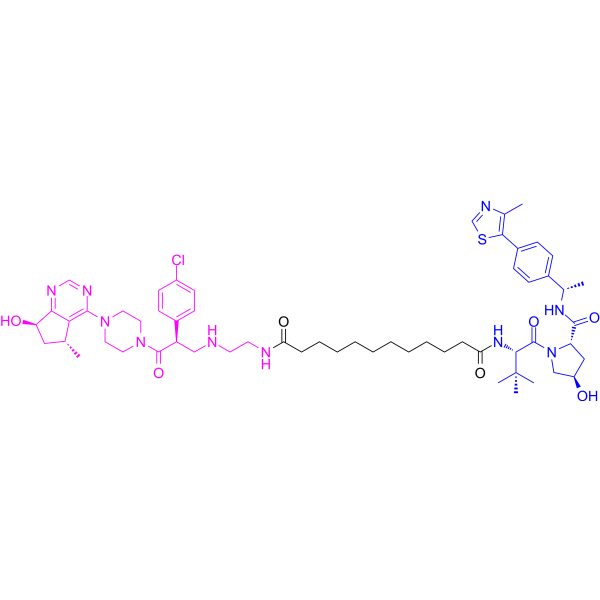
MS98 is a AKT PROTAC degrader with a DC50 of 78 nM in BT474 cells. MS98 binds to purified AKT1, AKT2 and AKT3 isoforms with Kd values of 4 nM, 140 nM and 8 nM, respectively. MS98 recruits the VHL E3 ligase to induce polyubiquitination and proteasomal degradation of AKT. MS98 inhibits downstream signal transduction of the PI3K/AKT/m-TOR pathway. MS98 suppresses cancer cell proliferation. MS98 can be used for the research of prostate cancer and breast cancer.
(Pink: Akt ligand (HY-15186); Blue: VHL ligand (HY-112078); Black: linker).
Nur für Forschungszwecke. Wir verkaufen nicht an Patienten.
- CAS. Nr.: 2376137-31-2
- Formel: C58H81ClN10O7S
- Molecular Weight:1097.84
-
Speicherung:
Please store the product under the recommended conditions in the Certificate of Analysis.

To place orders, for customer services and technical support, please contact: MedChemExpress USA
Tel: 609-228-6898 E-mail: [email protected] [email protected]


-
 Biologische Aktivität
-
Chemical Information
- Protokoll
- Reinheit & Dokumentation
- Verweise
-
 Help & FAQs


Publications Citing Use of MedChemExpress (MCE) MS98
MoreAlle PROTACs Isoform-spezifische Produkte anzeigen
More

Biologische Aktivität
Beschreibung
IC50 & Target
[1]|
Akt1 4 nM (Kd) |
Akt2 140 nM (Kd) |
Akt3 8.1 nM (Kd) |
VHL |
Cellular Effect
|
Cell Line

|
Type | Value | Description | References |
|---|---|---|---|---|
| BT-474 | DC50 |
78 nM
|
AKT degradation in human BT474 breast cancer cells assessed by western blot analysis of total AKT protein levels after 24 h incubation.
AKT degradation in human BT474 breast cancer cells assessed by western blot analysis of total AKT protein levels after 24 h incubation.
|
34855399 |
| BT-474 | GI50 |
1.5 μM
|
Antiproliferative activity against human BT474 breast cancer cells measured by cell proliferation inhibition assay.
Antiproliferative activity against human BT474 breast cancer cells measured by cell proliferation inhibition assay.
|
34855399 |
In Vitro
MS98 induces AKT degradation in a concentration-dependent manner in PC3 prostate cancer cells and MDA-MB-468 breast cancer cells[1].
MS98 (1 μM; 24 h) selectively reduces the protein levels of AKT1 and AKT2 in BT474 breast cancer cells[1].
MS98 inhibits the proliferation of BT474 breast cancer cells, with a GI50 of 1.5 μM[1].
MedChemExpress (MCE) has not independently confirmed the accuracy of these methods. They are for reference only.
-
Cell Line:BT474 breast cancer cells
-
Concentration:100 nM, 1 μM, 10 μM (24 h incubation); 1 μM (4 h, 8 h, 24 h incubation)
-
Incubation Time:24 h (100 nM, 1 μM, 10 μM); 4 h, 8 h, 24 h (1 μM)
-
Result:Concentration-dependently depleted cellular T-AKT with a DC50 of 78 nM.
Induced substantial T-AKT degradation at 100 nM, near-complete depletion at 1 μM, and no "hook effect" at concentrations up to 10 μM.
Induced rapid T-AKT degradation with obvious degradation at 4 h, near-complete degradation at 8 h, and sustained degradation for at least 24 h when treated at 1 μM.
- BrdU Incorporation Assay
- Somatic Cell Culture
- CFSE Dye Dilution Proliferation Assay
- Dye-dilution cell tracking and proliferation staining
- CCK-8/WST-8 Cell Proliferation Assay
- Protocol for Cell Cycle
- Cell Counting-Based Growth Curve Assay
- Colony Formation (Clonogenic) Assay
- Breast Cancer Modeling
- Cell Viability Determination by MTT Colorimetric Assay
- EdU Incorporation Assay (Click Chemistry-Based DNA Synthesis Measurement)
- Ki-67 Immunostaining Proliferation Assay
- PCNA Immunodetection Proliferation Assay
- Protocol for Cell Counting and Cell Density Analysis
- MTT Cell Proliferation Assay
Parmacokinetics
| Species | Dose | Route | Cmax |
|---|---|---|---|
| Mice[1] | 50 mg/kg | i.p. | 3.5 μM |


Chemical Information
-
CAS. Nr. 2376137-31-2
-
Molecular Weight 1097.84
-
Formel C58H81ClN10O7S
-
SMILES
C[C@H]1C2=C(N3CCN(CC3)C([C@@H](C4=CC=C(C=C4)Cl)CNCCNC(CCCCCCCCCCC(N[C@@H](C(C)(C)C)C(N5[C@@H](C[C@H](C5)O)C(N[C@H](C6=CC=C(C7=C(C)N=CS7)C=C6)C)=O)=O)=O)=O)=O)N=CN=C2[C@@H](C1)O
-
Versand
Room temperature in continental US; may vary elsewhere.
-
Speicherung
Please store the product under the recommended conditions in the Certificate of Analysis.


Publications (1)
-
Journal Impact Factor
-
Most Recent
-
ACS Omega
Dynamic Detection of the E3-PROTAC-Target Protein Ternary Complex In Vitro and In Vivo via Bimolecular Fluorescence Complementation. [Abstract]2024 Dec 3;9(50):49739-49748. PMID: 39713624


Reinheit & Dokumentation
Verweise

Calculators
Konzentration (Stammlösung) × Volumen (Stammlösung) = Konzentration (Ziellösung) × Volumen (Ziellösung)


MS98 Related Classifications
HY-145281 Related Classifications
 Powered by Bioz