



TK-129

Based on 1 Customer Validation
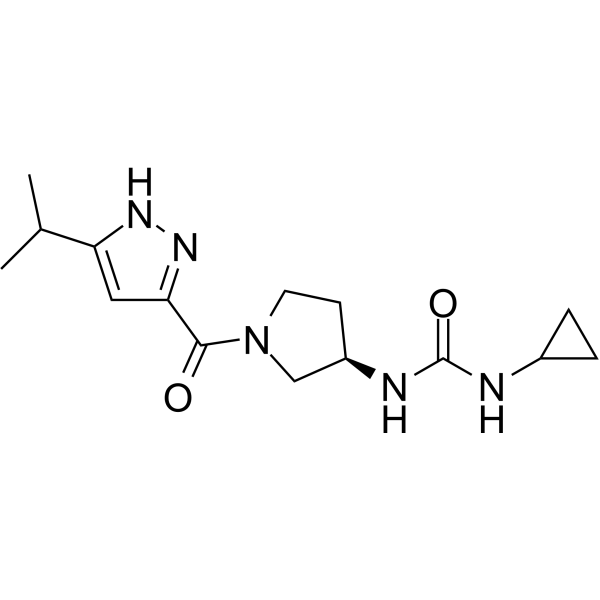
TK-129 is an orally active, low-toxicity, potent KDM5B inhibitor (with high affinity; IC50=44 nM). TK-129 exerts cardioprotective effects by inhibiting KDM5B and blocking the KDM5B-associated Wnt pathway. TK-129 reduces ang II-induced activation of cardiac fibroblasts in vitro and reduces isoprenaline-induced myocardial remodelling and fibrosis in vivo. TK-129 can be used in studies of cardiovascular disease.
Nur für Forschungszwecke. Wir verkaufen nicht an Patienten.
- Reinheit : ≥98.0%
- CAS. Nr.: 3031476-73-7
- Formel: C15H23N5O2
- Molecular Weight:305.38
-
Speicherung:Powder -20°C, 3 years ; In solvent -80°C, 6 months , -20°C, 1 month

To place orders, for customer services and technical support, please contact: MedChemExpress USA
Tel: 609-228-6898 E-mail: [email protected] [email protected]


-
 Biologische Aktivität
-
Chemical Information
-
Lösungsmittel & Löslichkeit
- Protokoll
- Reinheit & Dokumentation
- Verweise
-
 Help & FAQs




Biologische Aktivität
Beschreibung
IC50 & Target
[1]|
KDM5 44 nM (IC50) |
In Vitro
TK-129 mediates inhibition of KDM5B activity significantly reduces the activation, migration, and proliferation of myofibroblasts induced by Ang II in vitro[1].
TK-129 (10 μM; 48 h) shows low cytotoxicity in NRCFs and NRCMs[1].
TK-129 (0.1, 0.2, 0.3, 0.4, 0.5 μM; 48 h) can engage toand inhibit KDM5B activity in NRCFs[1].
MedChemExpress (MCE) has not independently confirmed the accuracy of these methods. They are for reference only. Further protocols information, click here.
-
Cell Line:NRCFs and NRCMs
-
Concentration:10 μM
-
Incubation Time:48 h
-
Result:Exhibited the cell survival rates were almost more than 90%.
-
Cell Line:NRCFs
-
Concentration:0.1, 0.2, 0.3, 0.4, 0.5 μM
-
Incubation Time:48 h
-
Result:Increased the expression level of KDM5B substrate H3K4me3 protein in a concentration-dependent manner.
In Vivo
TK-129 (50 mg/kg; p.o.; twice daily for 24 days) effectively reduces isoproterenol-induced pathological myocardial remodeling in vivo[1].
TK-129 (2 or 10 mg/kg; i.v. or p.o.; single) demonstrates favorable PK properties in vivo[1].
MedChemExpress (MCE) has not independently confirmed the accuracy of these methods. They are for reference only.
-
Animal Model:Wild C57BL/6 mice (8 to 10-week-old; half male and half female)[1].
-
Dosage:2 g/kg
-
Administration:Oral gavage, single.
-
Result:Exhibited all mice in the acute toxicity group survived and gained weight normally, after 2 weeks.
-
Animal Model:C57BL/6 mice (isoproterenol (ISO)-induced)[1].
-
Dosage:50 mg/kg
-
Administration:Oral gavage, twice daily for 24 days.
-
Result:Alleviated myocardial remodeling induced by ISO in vivo.
-
Animal Model:Male SD Rats (223.5-265.1 g)[1].
-
Dosage:2 mg/kg (for i.v.); 10 mg/kg (for p.o.).
-
Administration:Intravenous injection or oral gavage; single.
-
Result:
1.19 Pharmacokinetic Parameters of TK-129 in Male SD Rats[1].
PO (10 mg/kg) IV (2 mg/kg) CL (L/h/kg) 9.9 4.2 Vss (L/kg) 33.4 2.7 T1/2 (h) 2.4 0.4 Tmax (h) 0.4 - Cmax (ng/mL) 709.7 1229.1 AUC0-24 (ng/mL•h) 1038.2 479.6 F (%) 42.37 -


Chemical Information
-
CAS. Nr. 3031476-73-7
-
Appearance Solid
-
Molecular Weight 305.38
-
Formel C15H23N5O2
-
Color White to off-white
-
SMILES
O=C(N[C@H]1CN(C(C2=NNC(C(C)C)=C2)=O)CC1)NC3CC3
-
Versand
Room temperature in continental US; may vary elsewhere.
-
Speicherung
Powder -20°C 3 years In solvent -80°C 6 months -20°C 1 month


Lösungsmittel & Löslichkeit
In Vitro:
DMSO : 100 mg/mL (327.46 mM; Need ultrasonic; Hygroscopic DMSO has a significant impact on the solubility of product, please use newly opened DMSO)
Please refer to the solubility information to select the appropriate solvent. Once prepared, please aliquot and store the solution to prevent product inactivation from repeated freeze-thaw cycles.
Storage method and period of stock solution: -80°C, 6 months; -20°C, 1 month. When stored at -80°C, please use it within 6 months. When stored at -20°C, please use it within 1 month.
Please refer to the solubility information to select the appropriate solvent. Once prepared, please aliquot and store the solution to prevent product inactivation from repeated freeze-thaw cycles.
Storage method and period of stock solution: -80°C, 6 months; -20°C, 1 month. When stored at -80°C, please use it within 6 months. When stored at -20°C, please use it within 1 month.
Konzentration (Stammlösung) × Volumen (Stammlösung) = Konzentration (Ziellösung) × Volumen (Ziellösung)
In Vivo:
Select the appropriate dissolution method based on your experimental animal and administration route.
- For the following dissolution methods, please ensure to first prepare a clear stock solution using an In Vitro approach and then sequentially add co-solvents:
- To ensure reliable experimental results, the clarified stock solution can be appropriately stored based on storage conditions. As for the working solution for In Vivo experiments, it is recommended to prepare freshly and use it on the same day.
- The percentages shown for the solvents indicate their volumetric ratio in the final prepared solution. If precipitation or phase separation occurs during preparation, heat and/or sonication can be used to aid dissolution.
Add each solvent one by one: 10% DMSO 40% PEG300 5% Tween-80 45% Saline
Solubility: ≥ 2.5 mg/mL (8.19 mM); Clear solution
This protocol yields a clear solution of ≥ 2.5 mg/mL (saturation unknown).
Taking 1 mL working solution as an example, add 100 μL DMSO stock solution (25.0 mg/mL) to 400 μL PEG300, and mix evenly; then add 50 μL Tween-80 and mix evenly; then add 450 μL Saline to adjust the volume to 1 mL.
Preparation of Saline: Dissolve 0.9 g sodium chloride in ddH₂O and dilute to 100 mL to obtain a clear Saline solution.
Add each solvent one by one: 10% DMSO 90% (20% SBE-β-CD in Saline)
Solubility: ≥ 2.5 mg/mL (8.19 mM); Clear solution
This protocol yields a clear solution of ≥ 2.5 mg/mL (saturation unknown).
Taking 1 mL working solution as an example, add 100 μL DMSO stock solution (25.0 mg/mL) to 900 μL 20% SBE-β-CD in Saline, and mix evenly.
Preparation of 20% SBE-β-CD in Saline (4°C, storage for one week): 2 g SBE-β-CD powder is dissolved in 10 mL Saline, completely dissolve until clear.
In Vivo Dissolution Calculator
Please enter the basic information of animal experiments:
-
-
-
-
Recommended: Prepare an additional quantity of animals to account for potential losses during experiments.
Please enter your animal formula composition:
-
%DMSO +
Recommended: Keep the proportion of DMSO in working solution below 2% if your animal is weak.
-
%+
-
+%Tween-80 + +
-
%Saline +
The co-solvents required include: DMSO, . All of co-solvents are available by MedChemExpress (MCE). , Tween 80. All of co-solvents are available by MedChemExpress (MCE).
Working solution concentration: 0.22 mg/mL
Method for preparing stock solution: mg drug dissolved in μL DMSO. Stock solution concentration: mg/mL.
1. Take μL DMSO stock solution;
2. Add μL .
μL , mix evenly;
3. Then add μL Tween 80, mix evenly;
4. Then add μL
Please ensure that the stock solution in the first step is dissolved to a clear state, and add co-solvents in sequence. You can use ultrasonic heating (ultrasonic cleaner, recommended frequency 20-40 kHz), vortexing, etc. to assist dissolution.

Protokoll
-
Fibrosis/Collagen Morphometry
Fibrosis and collagen morphometry is based on the quantitative visualization of fibrillar collagen deposition in tissue sections using histochemical stains such as Sirius Red (Picrosirius Red) or Masson's trichrome, followed by image-based or polarization-enhanced analysis to estimate collagen proportional area as a surrogate of extracellular matrix accumulation during fibrotic remodeling. Sirius Red combined with polarized light microscopy enhances detection of collagen fibers due to birefringence properties, enabling more specific visualization of collagen type I and III fibrils compared to conventional bright-field histology, while whole-section or region-restricted digital morphometry reduces field-selection bias in fibrosis assessment. Alternative quantitative approaches include second harmonic generation (SHG) and two-photon excited fluorescence microscopy, which enable label-free detection of fibrillar collagen and have been validated against histological staining and biochemica
-
Collagen: Sirius Red Staining
Sirius Red or picrosirius red staining is a histochemical method for visualizing collagen-rich extracellular matrix in tissue sections, and collagen fibers are detected as red-stained structures under bright-field microscopy with enhanced birefringence under polarized light. Picrosirius red is useful for assessing total collagen organization, distribution, and fibrosis burden, but polarized color should not be interpreted as a definitive collagen type I versus type III readout because color is affected by fiber orientation, thickness, and packing.
-
Connective Tissue: Masson's Trichrome/Collagen Trichrome Staining
Masson’s Trichrome (collagen/trichrome staining) is a histological technique that differentially stains tissue compartments using sequential acidic dyes to distinguish collagen from muscle and cytoplasmic components based on dye affinity and tissue permeability differences, enabling visualization of fibrosis and connective tissue architecture in histological sections. The classical formulation typically uses Weigert's iron hematoxylin for nuclear staining, Biebrich scarlet-acid fuchsin for cytoplasm and muscle, and aniline blue (or light green variants) for collagen, producing a characteristic blue/green collagen signal contrasted against red cytoplasm and dark nuclei. The staining principle relies on selective displacement of smaller dye molecules by larger anionic dyes in collagen-rich regions under controlled acidified conditions, which enhances collagen-specific dye retention. This property makes the method widely used for fibrosis assessment in organs such as heart, liver, lung, a
-
Research Protocol for Cardiovascular Diseases
Cardiovascular disease can be modeled as maladaptive cardiac remodeling, where ischemic injury or pressure overload activates inflammatory signaling, fibroblast activation, extracellular-matrix deposition, cardiomyocyte hypertrophy, vascular remodeling, and progressive ventricular dysfunction. The TGF-β/SMAD axis is a central profibrotic pathway after myocardial injury and pressure overload, while innate immune and cytokine pathways regulate leukocyte recruitment, scar formation, and adverse remodeling. Key unresolved questions include which inflammatory signals are reparative versus harmful, when fibrosis is protective versus maladaptive, and whether pathway inhibition improves function without weakening necessary infarct healing or compensatory remodeling.


Reinheit & Dokumentation
-
Data Sheet (277 KB)
-
SDS (251 KB)
- English - EN (251 KB)
- Français - FR (251 KB)
- Deutsch - DE (251 KB)
- Norwegian - NO (251 KB)
- Español - ES (251 KB)
- Swedish - SV (251 KB)
- Italian - IT (251 KB)
- Korean - KR (251 KB)
- Portuguese - PT (251 KB)
-
Handling Instructions (2659 KB)
Verweise


Complete Stock Solution Preparation Table
Please refer to the solubility information to select the appropriate solvent. Once prepared, please aliquot and store the solution to prevent product inactivation from repeated freeze-thaw cycles.
Storage method and period of stock solution: -80°C, 6 months; -20°C, 1 month. When stored at -80°C, please use it within 6 months. When stored at -20°C, please use it within 1 month.
| Optional Solvent | Concentration Solvent Mass | 1 mg | 5 mg | 10 mg | 25 mg |
|---|---|---|---|---|---|
| DMSO | 1 mM | 3.2746 mL | 16.3730 mL | 32.7461 mL | 81.8652 mL |
| 5 mM | 0.6549 mL | 3.2746 mL | 6.5492 mL | 16.3730 mL | |
| 10 mM | 0.3275 mL | 1.6373 mL | 3.2746 mL | 8.1865 mL | |
| 15 mM | 0.2183 mL | 1.0915 mL | 2.1831 mL | 5.4577 mL | |
| 20 mM | 0.1637 mL | 0.8187 mL | 1.6373 mL | 4.0933 mL | |
| 25 mM | 0.1310 mL | 0.6549 mL | 1.3098 mL | 3.2746 mL | |
| 30 mM | 0.1092 mL | 0.5458 mL | 1.0915 mL | 2.7288 mL | |
| 40 mM | 0.0819 mL | 0.4093 mL | 0.8187 mL | 2.0466 mL | |
| 50 mM | 0.0655 mL | 0.3275 mL | 0.6549 mL | 1.6373 mL | |
| 60 mM | 0.0546 mL | 0.2729 mL | 0.5458 mL | 1.3644 mL | |
| 80 mM | 0.0409 mL | 0.2047 mL | 0.4093 mL | 1.0233 mL | |
| 100 mM | 0.0327 mL | 0.1637 mL | 0.3275 mL | 0.8187 mL |


TK-129 Related Classifications
HY-151483 Related Classifications
 Powered by Bioz