



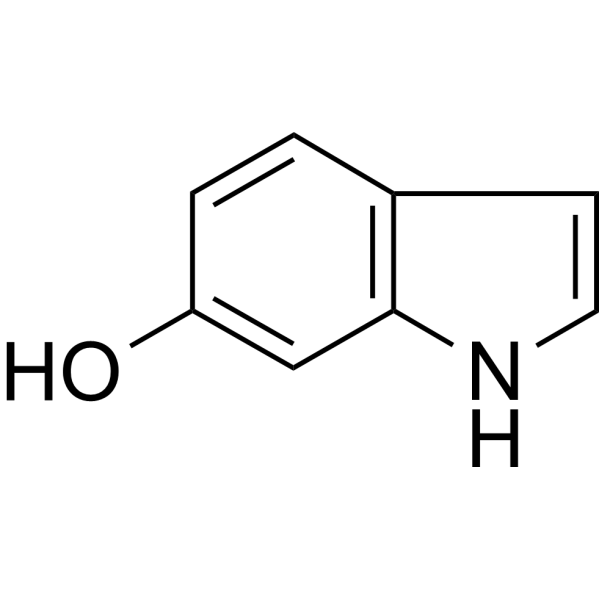
6-Hydroxyindole

Based on 1 Customer Validation
6-Hydroxyindole is an orally active, endogenous long-acting OATP1B1 inhibitor. 6-Hydroxyindole does not alter the cell surface expression or subcellular localization of OATP1B1. 6-Hydroxyindole protects cells against Ferroptosis. 6-Hydroxyindole possesses intrinsic radical-trapping antioxidant activity. 6-Hydroxyindole serves as a component of oxidative hair dyes. 6-Hydroxyindole can be used in research related to renal failure and neurodegenerative diseases.
For research use only. We do not sell to patients.
- Purity : 99.61%
- CAS No.: 2380-86-1
- Formula: C8H7NO
- Molecular Weight:133.15
-
Storage:Powder -20°C, 3 years , 4°C, 2 years ; In solvent -80°C, 6 months , -20°C, 1 month

To place orders, for customer services and technical support, please contact: MedChemExpress USA
Tel: 609-228-6898 E-mail: [email protected] [email protected]


-
 Biological Activity
-
Chemical Information
-
Solvent & Solubility
- Protocols
- Purity & Documentation
- References
-
 Help & FAQs



All Endogenous Metabolite Isoforms
More

Biological Activity
Description
IC50 & Target
[1]|
Human Endogenous Metabolite |
OATP1B1 |
In Vitro
6-Hydroxyindole (0.1-100 μM; 0.5 min-24 h) potently inhibits OATP1B1-mediated substrate uptake in HEK293/OATP1B1 cells via two mechanisms: direct action and long-lasting action, with an IC50 value ranging from 4.52 μM to 43.8 μM[1].
6-Hydroxyindole (100 μM; 3 h) does not alter the cell surface expression or subcellular localization of OATP1B1 in HEK293/OATP1B1 cells[1].
6-Hydroxyindole (20 μM; 22-24 h) protects HT-22 mouse hippocampal neurons against Erastin-induced ferroptosis[2].
6-Hydroxyindole (24 h) inhibits ferroptosis in HT-22 mouse hippocampal neurons, with an EC50 value of 15.8 μM against RSL3 and 8.4 μM against FINO2, and exerts partial protective effects against Erastin-induced ferroptosis[2].
6-Hydroxyindole (24 h) inhibits ferroptosis in N27 rat dopaminergic neurons, with an EC50 value of 9.1 μM against RSL3 and 8.1 μM against FINO2[2].
6-Hydroxyindole (0-103 μM; 7-15 min) exhibits dose-dependent free radical-scavenging antioxidant activity in cell-free ABTS assays[2].
6-Hydroxyindole (8-5000 μg/plate) exhibits mutagenicity towards *Salmonella typhimurium* strain TA 1535 under both metabolic activation and non-metabolic activation conditions[3].
MedChemExpress (MCE) has not independently confirmed the accuracy of these methods. They are for reference only.
-
Cell Line:HT-22 mouse hippocampal neurons
-
Concentration:Dose-range
-
Incubation Time:24 h
-
Result:Provided partial protection against Erastin-induced cytotoxicity (maximum protection was around 50%).
Exhibited EC50 values of 15.8 μM against RSL3 and 8.4 μM against FINO2; no EC50 was reported for Erastin.
In Vivo
6-Hydroxyindole (2000 mg/kg; percutaneous; single administration) does not cause death in rats, with a maximum non-lethal dose greater than 2000 mg/kg[3].
6-Hydroxyindole (15-240 mg/kg/d; p.o.; daily; gestational days 6-19) causes no maternal toxicity in rats, with only mild fetal ossification retardation observed at high doses[3].
MedChemExpress (MCE) has not independently confirmed the accuracy of these methods. They are for reference only.
-
Animal Model:Crl:CD(Sprague Dawley [SD])BR (male and female)[3]
-
Dosage:600 mg/kg
-
Administration:p.o.; single dose
-
Result:Caused 20% mortality (2 of 10 rats, both males).
Induced acute clinical signs (hunched posture, hypoactivity, prostration) on dosing day, with no signs in surviving animals after dosing day.
Resulted in no abnormal weight gain.
Caused spleen abnormalities in 1 male and uterine abnormalities in 1 female at necropsy.
-
Animal Model:Crl:CD(SD)BR (female mated, 24 per dose group)[3]
-
Dosage:15-240 mg/kg/d
-
Administration:p.o.; daily; gestation days 6-19
-
Result:Resulted in no mortalities, with ptyalism observed in 4 dams at 240 mg/kg/d.
Showed no treatment-related changes in body weight, body weight gain, or feed consumption.
Caused statistically significantly lower preimplantation loss in 60 and 240 mg/kg/d groups compared to controls, with numbers of resorptions, dead fetuses, and fetal sex ratio comparable to controls.
Led to slightly lower (not statistically significant) mean fetal body weight at 240 mg/kg/d, with no treatment-related visceral anomalies.
Resulted in retardation of general fetal ossification at 240 mg/kg/d, with no bone malformations.


Chemical Information
-
CAS No. 2380-86-1
-
Appearance Solid
-
Molecular Weight 133.15
-
Formula C8H7NO
-
Color White to yellow
-
SMILES
OC1=CC2=C(C=C1)C=CN2
-
Structure Classification
-
Initial Source
-
Shipping
Room temperature in continental US; may vary elsewhere.
-
Storage
Powder -20°C 3 years 4°C 2 years In solvent -80°C 6 months -20°C 1 month


Solvent & Solubility
In Vitro:
DMSO : 100 mg/mL (751.03 mM; Need ultrasonic; Hygroscopic DMSO has a significant impact on the solubility of product, please use newly opened DMSO)
Please refer to the solubility information to select the appropriate solvent. Once prepared, please aliquot and store the solution to prevent product inactivation from repeated freeze-thaw cycles.
Storage method and period of stock solution: -80°C, 6 months; -20°C, 1 month. When stored at -80°C, please use it within 6 months. When stored at -20°C, please use it within 1 month.
Please refer to the solubility information to select the appropriate solvent. Once prepared, please aliquot and store the solution to prevent product inactivation from repeated freeze-thaw cycles.
Storage method and period of stock solution: -80°C, 6 months; -20°C, 1 month. When stored at -80°C, please use it within 6 months. When stored at -20°C, please use it within 1 month.
Concentration (start) × Volume (start) = Concentration (final) × Volume (final)
In Vivo:
Select the appropriate dissolution method based on your experimental animal and administration route.
- For the following dissolution methods, please ensure to first prepare a clear stock solution using an In Vitro approach and then sequentially add co-solvents:
- To ensure reliable experimental results, the clarified stock solution can be appropriately stored based on storage conditions. As for the working solution for In Vivo experiments, it is recommended to prepare freshly and use it on the same day.
- The percentages shown for the solvents indicate their volumetric ratio in the final prepared solution. If precipitation or phase separation occurs during preparation, heat and/or sonication can be used to aid dissolution.
Add each solvent one by one: 10% DMSO 40% PEG300 5% Tween-80 45% Saline
Solubility: ≥ 2.5 mg/mL (18.78 mM); Clear solution
This protocol yields a clear solution of ≥ 2.5 mg/mL (saturation unknown).
Taking 1 mL working solution as an example, add 100 μL DMSO stock solution (25.0 mg/mL) to 400 μL PEG300, and mix evenly; then add 50 μL Tween-80 and mix evenly; then add 450 μL Saline to adjust the volume to 1 mL.
Preparation of Saline: Dissolve 0.9 g sodium chloride in ddH₂O and dilute to 100 mL to obtain a clear Saline solution.
Add each solvent one by one: 10% DMSO 90% (20% SBE-β-CD in Saline)
Solubility: ≥ 2.5 mg/mL (18.78 mM); Clear solution
This protocol yields a clear solution of ≥ 2.5 mg/mL (saturation unknown).
Taking 1 mL working solution as an example, add 100 μL DMSO stock solution (25.0 mg/mL) to 900 μL 20% SBE-β-CD in Saline, and mix evenly.
Preparation of 20% SBE-β-CD in Saline (4°C, storage for one week): 2 g SBE-β-CD powder is dissolved in 10 mL Saline, completely dissolve until clear.
In Vivo Dissolution Calculator
Please enter the basic information of animal experiments:
-
-
-
-
Recommended: Prepare an additional quantity of animals to account for potential losses during experiments.
Please enter your animal formula composition:
-
%DMSO +
Recommended: Keep the proportion of DMSO in working solution below 2% if your animal is weak.
-
%+
-
+%Tween-80 + +
-
%Saline +
The co-solvents required include: DMSO, . All of co-solvents are available by MedChemExpress (MCE). , Tween 80. All of co-solvents are available by MedChemExpress (MCE).
Working solution concentration: 0.22 mg/mL
Method for preparing stock solution: mg drug dissolved in μL DMSO. Stock solution concentration: mg/mL.
1. Take μL DMSO stock solution;
2. Add μL .
μL , mix evenly;
3. Then add μL Tween 80, mix evenly;
4. Then add μL
Please ensure that the stock solution in the first step is dissolved to a clear state, and add co-solvents in sequence. You can use ultrasonic heating (ultrasonic cleaner, recommended frequency 20-40 kHz), vortexing, etc. to assist dissolution.


Purity & Documentation
-
Data Sheet (277 KB)
-
SDS (699 KB)
- English - EN (699 KB)
- Français - FR (699 KB)
- Deutsch - DE (699 KB)
- Norwegian - NO (699 KB)
- Español - ES (699 KB)
- Swedish - SV (699 KB)
- Italian - IT (699 KB)
- Korean - KR (699 KB)
- Portuguese - PT (699 KB)
-
Handling Instructions (2659 KB)
References
[1]. Masuo Y, et al. 6-Hydroxyindole is an endogenous long-lasting OATP1B1 inhibitor elevated in renal failure patients. Drug Metab Pharmacokinet. 2020;35(6):555-562. [Content Brief]
[2]. Jakaria M, et al. The role of hydroxyindoles in protecting neuronal cultures from ferroptosis. Cell Death Discov. 2025;11(1):329. Published 2025 Jul 16. [Content Brief]
[3]. Burnett CL, et al. Safety assessment of 6-hydroxyindole as used in cosmetics. Int J Toxicol. 2014;33(3 Suppl):24S-35S. [Content Brief]


Complete Stock Solution Preparation Table
Please refer to the solubility information to select the appropriate solvent. Once prepared, please aliquot and store the solution to prevent product inactivation from repeated freeze-thaw cycles.
Storage method and period of stock solution: -80°C, 6 months; -20°C, 1 month. When stored at -80°C, please use it within 6 months. When stored at -20°C, please use it within 1 month.
| Optional Solvent | Concentration Solvent Mass | 1 mg | 5 mg | 10 mg | 25 mg |
|---|---|---|---|---|---|
| DMSO | 1 mM | 7.5103 mL | 37.5516 mL | 75.1033 mL | 187.7582 mL |
| 5 mM | 1.5021 mL | 7.5103 mL | 15.0207 mL | 37.5516 mL | |
| 10 mM | 0.7510 mL | 3.7552 mL | 7.5103 mL | 18.7758 mL | |
| 15 mM | 0.5007 mL | 2.5034 mL | 5.0069 mL | 12.5172 mL | |
| 20 mM | 0.3755 mL | 1.8776 mL | 3.7552 mL | 9.3879 mL | |
| 25 mM | 0.3004 mL | 1.5021 mL | 3.0041 mL | 7.5103 mL | |
| 30 mM | 0.2503 mL | 1.2517 mL | 2.5034 mL | 6.2586 mL | |
| 40 mM | 0.1878 mL | 0.9388 mL | 1.8776 mL | 4.6940 mL | |
| 50 mM | 0.1502 mL | 0.7510 mL | 1.5021 mL | 3.7552 mL | |
| 60 mM | 0.1252 mL | 0.6259 mL | 1.2517 mL | 3.1293 mL | |
| 80 mM | 0.0939 mL | 0.4694 mL | 0.9388 mL | 2.3470 mL | |
| 100 mM | 0.0751 mL | 0.3755 mL | 0.7510 mL | 1.8776 mL |


6-Hydroxyindole Related Classifications
HY-W002438 Related Classifications
 Powered by Bioz
Keywords
- 6-Hydroxyindole
- 2380-86-1
- Biochemical Assay Reagents
- Endogenous Metabolite
- OAT
- Ferroptosis
- glutathione
- HT-22 mouse hippocampal neurons
- OATP1B1
- HEK293/OATP1B1 cells
- organic anion transporting polypeptide 1B1
- blood-brain barrier
- N27 rat dopaminergic neurons
- neurodegenerative diseases
- renal failure
- ferroptosis
- Inhibitor
- inhibitor
- inhibit