



Baloxavir-d4

Based on 1 Customer Validation
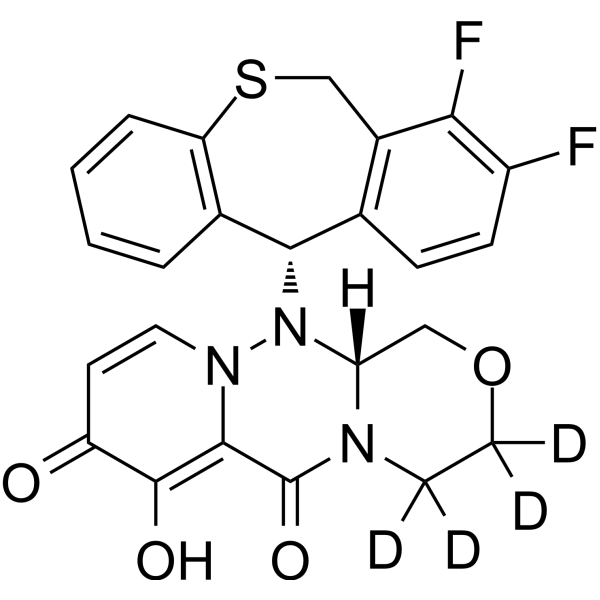
Baloxavir-d4 (Baloxavir acid-d4; S-033447-d4) is the deuterium-labeled Baloxavir (HY-109025A). Baloxavir-d4 (Baloxavir-d4 acid), derived from the proagent Baloxavir-d4 marboxil, is a first-in-class, potent and selective cap-dependent endonuclease (CEN) inhibitor within the polymerase PA subunit of influenza A and B viruses. Baloxavir-d4 inhibits viral RNA transcription and replication and has potently antiviral activity.
For research use only. We do not sell to patients.
- Purity : 99.27%
- CAS No.: 2415027-80-2
- Formula: C24H15D4F2N3O4S
- Molecular Weight:487.51
-
Storage:
4°C, protect from light
* In solvent : -80°C, 6 months; -20°C, 1 month (protect from light)

To place orders, for customer services and technical support, please contact: MedChemExpress USA
Tel: 609-228-6898 E-mail: [email protected] [email protected]


-
 Biological Activity
-
Chemical Information
- Protocols
- Purity & Documentation
-
 Help & FAQs




Biological Activity
Description
Application
1. This compound can be used as a tracer
2. This compound can be used as an internal standard for quantitative analysis by NMR, GC-MS, or LC-MS.


Chemical Information
-
CAS No. 2415027-80-2
-
Appearance Solid
-
Molecular Weight 487.51
-
Formula C24H15D4F2N3O4S
-
Color Off-white to yellow
-
SMILES
FC1=C(C(CSC2=C3C=CC=C2)=C([C@@H]3N4[C@]5(N(C(C6=C(C(C=CN64)=O)O)=O)C([2H])(C([2H])(OC5)[2H])[2H])[H])C=C1)F
-
Synonyms
Baloxavir acid-d4; S-033447-d4
-
Shipping
Room temperature in continental US; may vary elsewhere.
-
Storage
4°C, protect from light
* In solvent : -80°C, 6 months; -20°C, 1 month (protect from light)


Purity & Documentation
-
Data Sheet (256 KB)
-
SDS (252 KB)
- English - EN (252 KB)
- Français - FR (252 KB)
- Deutsch - DE (252 KB)
- Norwegian - NO (252 KB)
- Español - ES (252 KB)
- Swedish - SV (252 KB)
- Italian - IT (252 KB)
- Korean - KR (252 KB)
- Portuguese - PT (252 KB)
-
Handling Instructions (2659 KB)

Calculators
Concentration (start) × Volume (start) = Concentration (final) × Volume (final)


Baloxavir-d4 Related Classifications
HY-W751835 Related Classifications
 Powered by Bioz