



12(R)-HETE

Based on 1 Customer Validation
12(R)-HETE is a CYP-dependent arachidonic acid metabolite that acts as a proinflammatory lipid mediator. 12 (R)-HETE widely exists in various tissues including the eye, skin and liver. In the cornea, 12(R)-HETE is metabolized via pathways such as β-oxidation into the precursor of 12(R)-HETrE. Without direct receptor binding, 12(R)-HETE indirectly activates AHR-mediated target gene transcription, while inhibiting the enzymatic activity of Na+,K+-ATPase and the intracellular calcium elevation induced by TP agonists. 12(R)-HETE also possesses multiple physiological effects such as chemotaxis, proangiogenesis, vasodilation, natriuresis, diuresis and intraocular pressure reduction, and can be widely used in studies related to psoriasis, inflammatory skin diseases and ocular inflammation.
Nos produits utilisent uniquement pour la recherche. Nous ne vendons pas aux patients.
- Pureté : 99.68%
- CAS No.: 82337-46-0
- Formule: C20H32O3
- Masse moléculaire:320.47
-
Stockage:
Solution, -20°C, 2 years


To place orders, for customer services and technical support, please contact: MedChemExpress USA
Tel: 609-228-6898 E-mail: [email protected] [email protected]


-
 Activité biologique
-
Chemical Information
- Protocole
- Pureté et documentation
- Références
-
 Help & FAQs


-
HY-N0421
CinobufaginAnticancer Agent -
HY-N2033
Chebulinic acidDNA Gyrase Inhibitor -

HY-138971
(±)17(18)-EpETE-ethanolamide -
HY-130319A
9-HEPEPPAR Ligand -

HY-110406
13(S)-HPODE -
HY-W013627
trans,trans-2,4-DecadienalLipid Peroxidation Product -
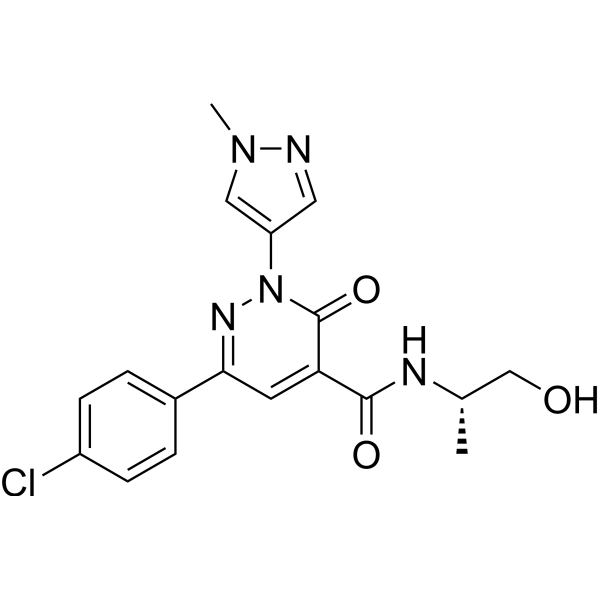
HY-135829
BAY 2416964AHR Antagonist -
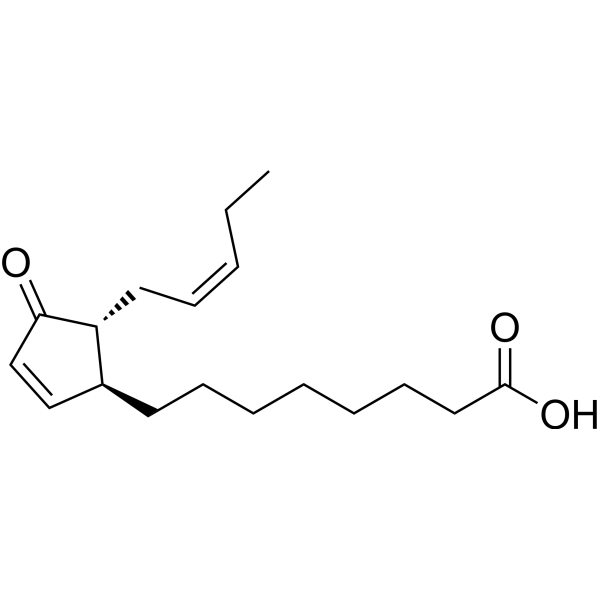
HY-118828A
(9S,13R)-12-Oxo phytodienoic acidmPGES-1 Inhibitor -

HY-B0259S1
Indapamide-13C,d3Stable Isotope -
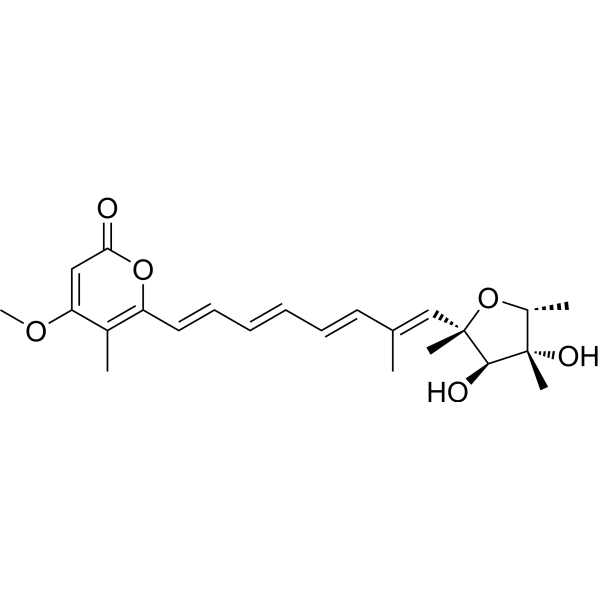
HY-N6745
CitreoviridinApoptosis Inducer -

HY-N0421R
Cinobufagin (Standard)Anticancer Agent -
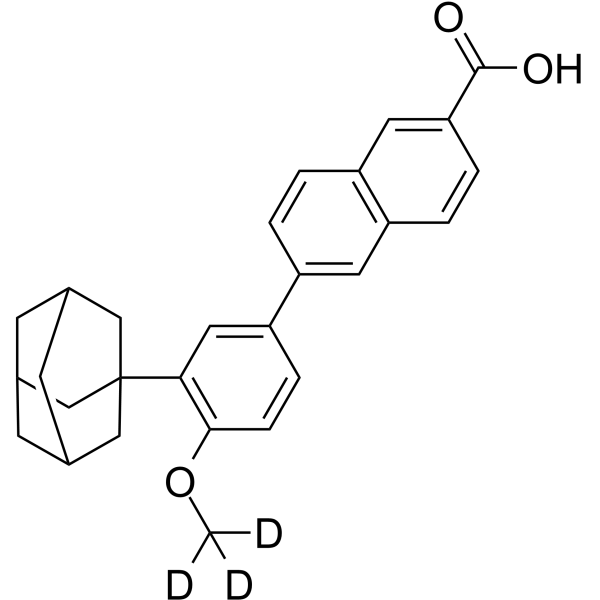
HY-B0091S
Adapalene-d3Stable Isotope


Activité biologique
Description
In Vitro
12 (R)-HETE (10-25 μM; 6 h) dose-dependently activates AHR-mediated transcription in human hepatocellular carcinoma HepG2 40/6 cells[1].
12 (R)-HETE (0.25-4.0 μM; 3 h) dose-dependently induces the mRNA expression of the AHR target gene CYP1A1 in human hepatocellular carcinoma HepG2 cells, and this inductive effect is not blocked by treatment with Cycloheximide (HY-12320)[1].
12 (R)-HETE activates AHR-mediated transcription of CYP1A1, CYP1B1 and AhRR in human keratinocyte HaCaT cells in an AHR-dependent manner[1].
12 (R)-HETE (1 μM; 10 min) potently relaxes mouse mesenteric arteries precontracted with U46619 (HY-108566) via a thromboxane receptor-dependent mechanism (EC50=0.05 μM, maximal relaxation rate=91.4%), inhibits U46619-induced contraction, and does not induce vasoconstriction or alter phenylephrine-mediated responses[2].
12 (R)-HETE (0.001-10 μM; 30 min) competes for binding to the thromboxane receptor (TXA) binding site in mouse platelets, with an IC50 of 0.32 μM, and exhibits stronger activity than 12 (S)-HETE[2].
MedChemExpress (MCE) has not independently confirmed the accuracy of these methods. They are for reference only.
-
Cell Line:Cycloheximide-treated human hepatoma HepG2 cells
-
Concentration:4.0 μM
-
Incubation Time:3 h
-
Result:Induced CYP1A1 mRNA expression that is not blocked by cycloheximide treatment.
Maintains induction at levels similar to cycloheximide-free 12(R)-HETE treatment.
- Imiquimod-Induced Psoriasiform Dermatitis
- Cell migration
- Chemotaxis Gradient Chamber Assay 1
- Under-Agarose Cell Migration Assay
- Transwell/Boyden Chamber Migration Assay
- Calcium Spark Assay
- Ca2+ Staining Technique
- Research Protocol for Inflammation-related Diseases
- Chemotaxis Gradient Chamber Assay 2


Chemical Information
-
CAS No. 82337-46-0
-
Appearance Liquid
-
Masse moléculaire 320.47
-
Formule C20H32O3
-
Color Colorless to light yellow
-
SMILES
CCCCC/C=C\C[C@H](/C=C/C=C\C/C=C\CCCC(O)=O)O
-
Livraison
Room temperature in continental US; may vary elsewhere.
-
Stockage
Solution, -20°C, 2 years


Pureté et documentation
-
Fiche technique (269 KB)
-
SDS (251 KB)
- English - EN (251 KB)
- Français - FR (251 KB)
- Deutsch - DE (251 KB)
- Norwegian - NO (251 KB)
- Español - ES (251 KB)
- Swedish - SV (251 KB)
- Italian - IT (251 KB)
- Korean - KR (251 KB)
- Portuguese - PT (251 KB)
-
Instruction de manipulation (2659 KB)
Références

Calculators
Concentration (start) × Volume (start) = Concentration (final) × Volume (final)


12(R)-HETE Related Classifications
HY-124404 Related Classifications
 Powered by Bioz