



Etrasimod
Based on 1 publication(s) in Google Scholar
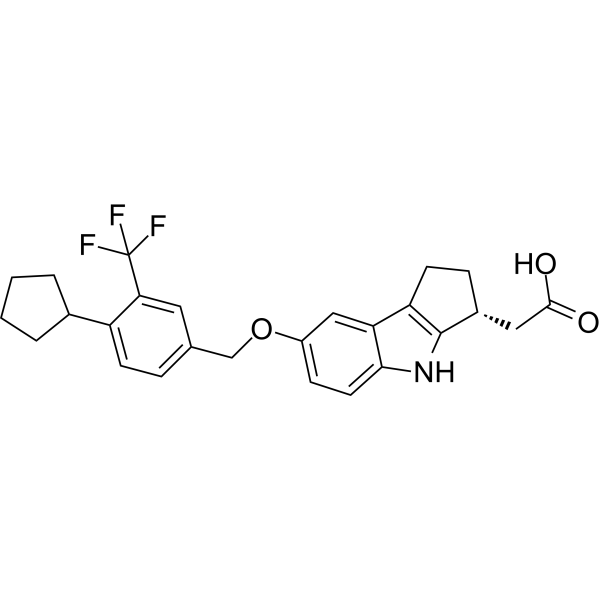
Etrasimod (APD334) is a potent, selective and orally available antagonist of the sphingosine-1-phosphate-1 (S1P1) receptor with an IC50 value of 1.88 nM in CHO cells.
Nos produits utilisent uniquement pour la recherche. Nous ne vendons pas aux patients.
- Pureté : 99.91%
- CAS No.: 1206123-37-6
- Formule: C26H26F3NO3
- Masse moléculaire:457.48
-
Stockage:Powder -20°C, 3 years , 4°C, 2 years ; In solvent -80°C, 2 years , -20°C, 1 year

To place orders, for customer services and technical support, please contact: MedChemExpress USA
Tel: 609-228-6898 E-mail: [email protected] [email protected]


-
 Activité biologique
-
Chemical Information
-
Solvant et solubilité
- Pureté et documentation
- Références
-
 Help & FAQs


-
HY-12355
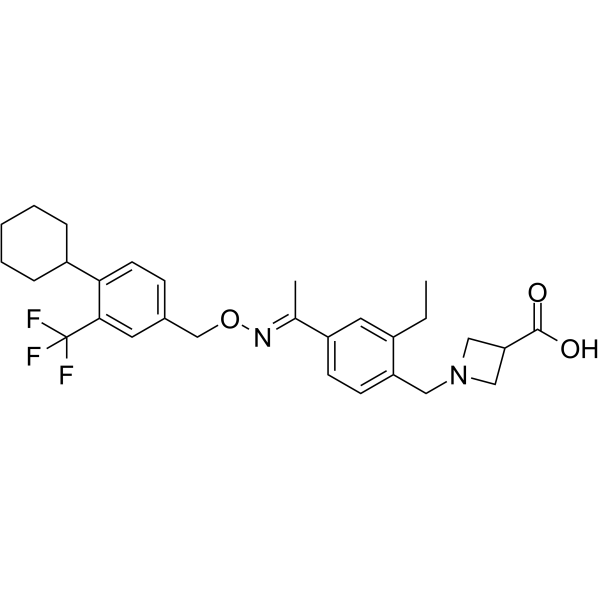
SiponimodS1P1/S1P5 Agonist -
HY-12288
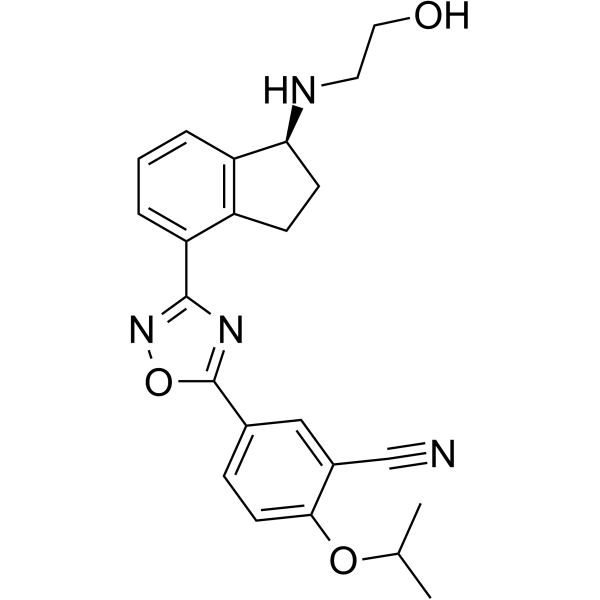
OzanimodS1P Receptor Modulator -
HY-10569
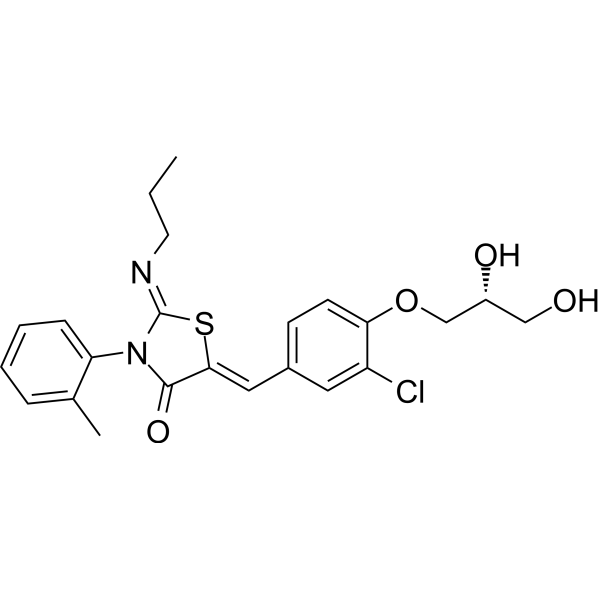
PonesimodS1P1 Agonist -
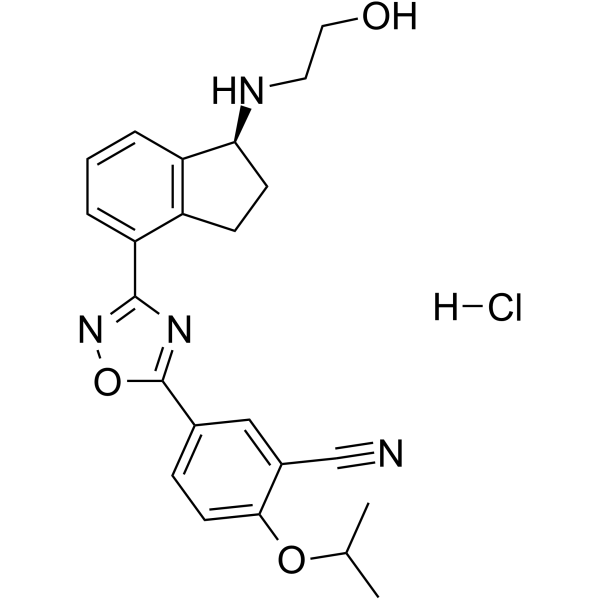
HY-12288A
Ozanimod hydrochlorideS1P Receptor Modulator -
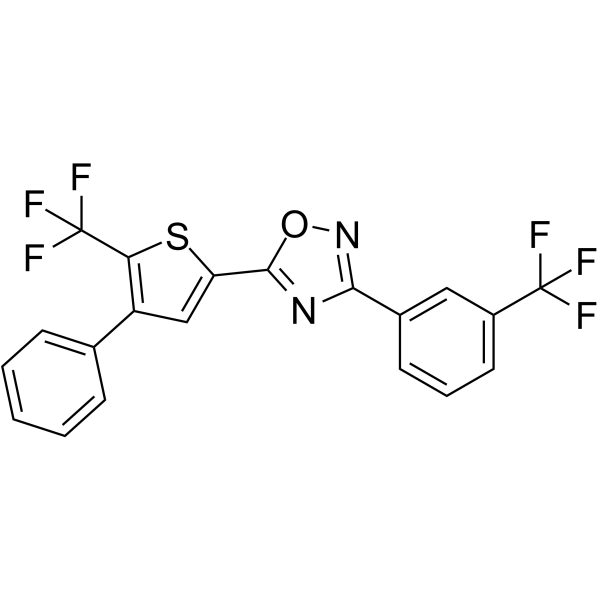
HY-W008947
SEW2871S1P1 Agonist -
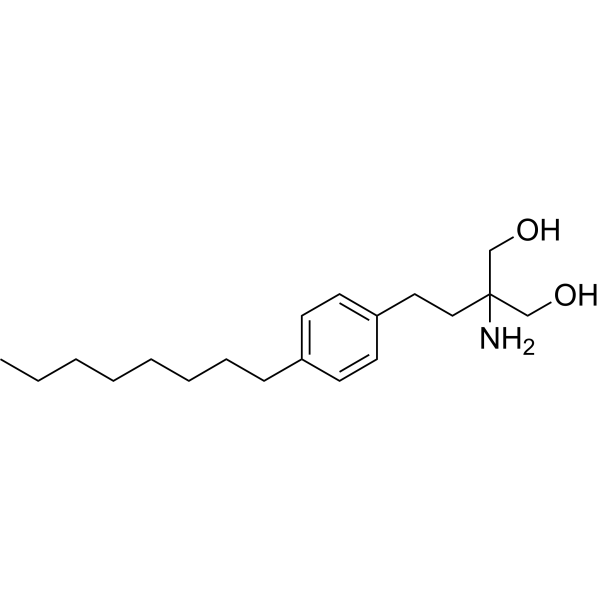
HY-11063
FingolimodS1P Antagonist -
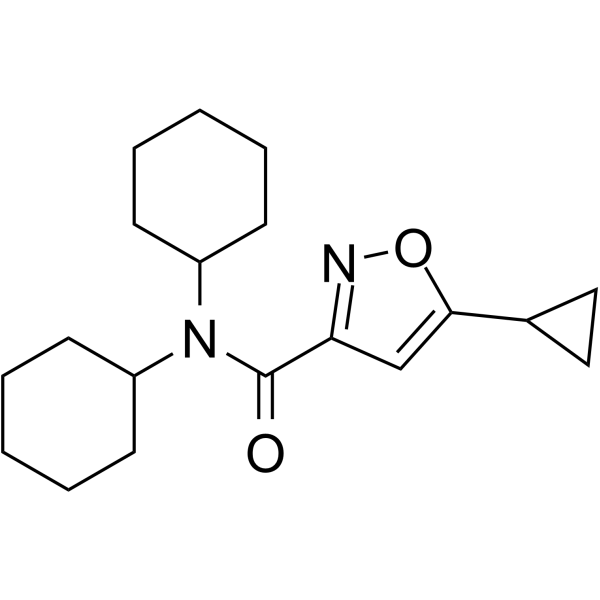
HY-101419
CYM-5541S1P3 Receptor Agonist -
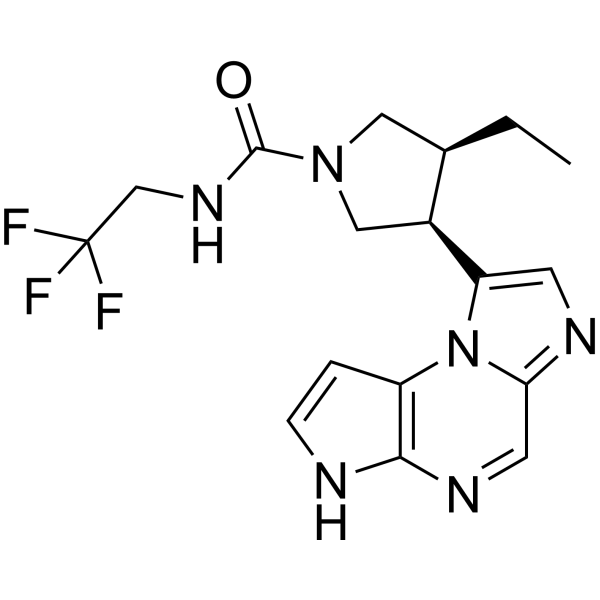
HY-19569
UpadacitinibJAK1 Inhibitor -
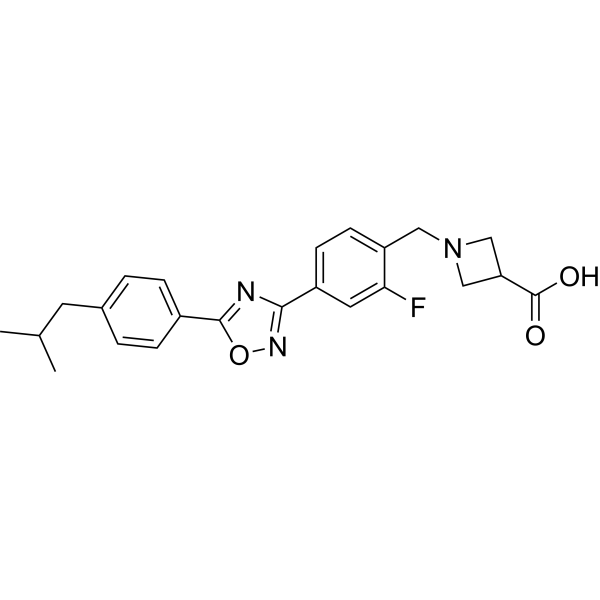
HY-101265
IcanbelimodS1P Receptor Agonist -
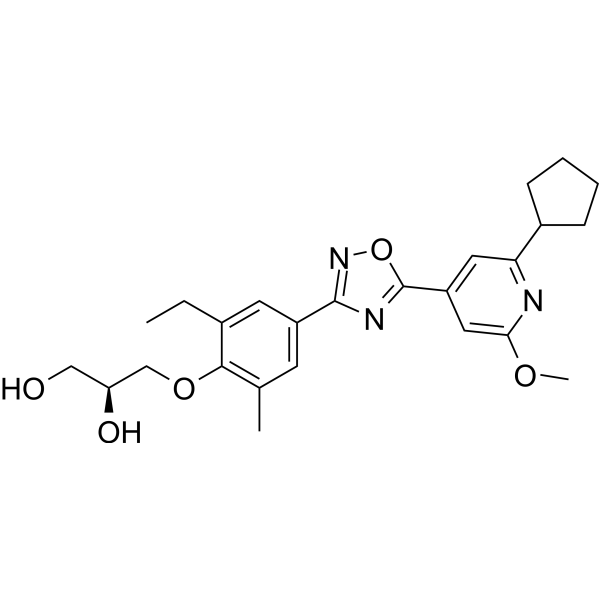
HY-17606
CenerimodS1P1 Agonist -
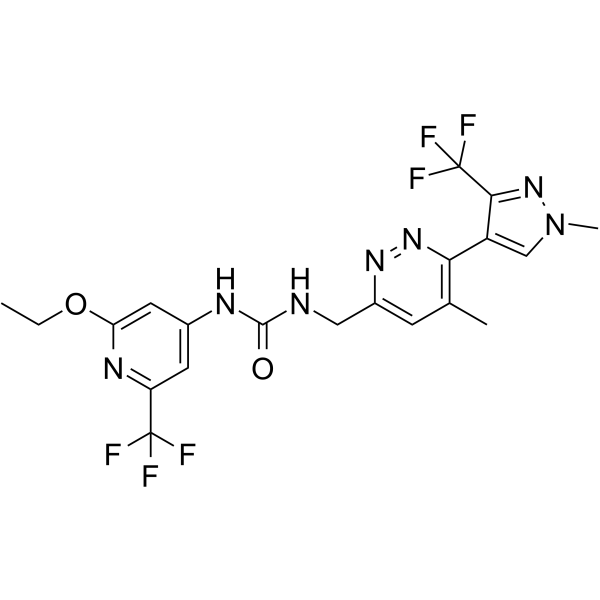
HY-139310
GLPG2938S1P2 Antagonist -
HY-19511
GSK2018682LPL Receptor Agonist
Publications Citing Use of MedChemExpress (MCE) Etrasimod
More

Activité biologique
Description
IC50 & Target
IC50: 1.88 nM (S1P1)[1]
Cellular Effect
|
Cell Line

|
Type | Value | Description | References |
|---|---|---|---|---|
| CHO | IC50 |
1.88 nM
Compound: (R)-4, APD334
|
Induction of internalization of HA-tagged human S1P1 receptor expressed in CHO cells
Induction of internalization of HA-tagged human S1P1 receptor expressed in CHO cells
|
[PMID: 25516790] |
| THP-1 | CC50 |
57.7 μM
Compound: 1; Etra
|
Cytotoxicity against human THP-1 cells assessed as reduction in cell viability incubated for 24 hrs by resazurin staining based analysis
Cytotoxicity against human THP-1 cells assessed as reduction in cell viability incubated for 24 hrs by resazurin staining based analysis
|
[PMID: 37948883] |
In Vitro
APD334 is a structurally novel, selective, functional antagonist of S1P1. In CHO cells expressing HA tagged S1P1, APD334 is found to have an IC50 value of 1.88 nM. Moderate agonism at human S1P4 and S1P5 is observed but is reduced relative to S1P1, both in terms of potency and efficacy. APD334 is devoid of any agonism or antagonism at human S1P2 and S1P3. APD334 achieves good central exposure following oral dosing and possesses a favorable pharmacokinetic profile in multiple preclinical species. S1P1 activity is maintained in mice (EC50=0.44 nM), rats (EC50=0.32 nM), dogs (EC50=0.34 nM) and monkeys (EC50=0.32 nM)[1].
MedChemExpress (MCE) has not independently confirmed the accuracy of these methods. They are for reference only.
In Vivo
MedChemExpress (MCE) has not independently confirmed the accuracy of these methods. They are for reference only.
Essai clinique
| NCT Number | Sponsor | Condition | Start Date |
Phase
|
|---|---|---|---|---|
| NCT01329991 | 2011-05 | PHASE1 |


Chemical Information
-
CAS No. 1206123-37-6
-
Appearance Solid
-
Masse moléculaire 457.48
-
Formule C26H26F3NO3
-
Color White to khaki
-
SMILES
FC(F)(F)C1=CC(COC2=CC=C(NC3=C4CC[C@@H]3CC(O)=O)C4=C2)=CC=C1C5CCCC5
-
Synonyms
APD334
-
Livraison
Room temperature in continental US; may vary elsewhere.
-
Stockage
Powder -20°C 3 years 4°C 2 years In solvent -80°C 2 years -20°C 1 year


Publications (1)
-
Journal Impact Factor
-
Most Recent
-
Heliyon
Development and validation of stability-indicating method of etrasimod by HPLC/DAD/MS/MS technique with greenness profiling. [Abstract]2024 Jul 4;10(13):e34066. PMID: 39071639


Solvant et solubilité
In Vitro:
DMSO : 116.67 mg/mL (255.03 mM; Need ultrasonic; Hygroscopic DMSO has a significant impact on the solubility of product, please use newly opened DMSO)
Please refer to the solubility information to select the appropriate solvent. Once prepared, please aliquot and store the solution to prevent product inactivation from repeated freeze-thaw cycles.
Storage method and period of stock solution: -80°C, 2 years; -20°C, 1 year. When stored at -80°C, please use it within 2 years. When stored at -20°C, please use it within 1 year.
Please refer to the solubility information to select the appropriate solvent. Once prepared, please aliquot and store the solution to prevent product inactivation from repeated freeze-thaw cycles.
Storage method and period of stock solution: -80°C, 2 years; -20°C, 1 year. When stored at -80°C, please use it within 2 years. When stored at -20°C, please use it within 1 year.
Concentration (start) × Volume (start) = Concentration (final) × Volume (final)


Pureté et documentation
-
Fiche technique (273 KB)
-
SDS (254 KB)
- English - EN (254 KB)
- Français - FR (254 KB)
- Deutsch - DE (254 KB)
- Norwegian - NO (254 KB)
- Español - ES (254 KB)
- Swedish - SV (254 KB)
- Italian - IT (254 KB)
- Korean - KR (254 KB)
- Portuguese - PT (254 KB)
-
Instruction de manipulation (2659 KB)
Références


Complete Stock Solution Preparation Table
Please refer to the solubility information to select the appropriate solvent. Once prepared, please aliquot and store the solution to prevent product inactivation from repeated freeze-thaw cycles.
Storage method and period of stock solution: -80°C, 2 years; -20°C, 1 year. When stored at -80°C, please use it within 2 years. When stored at -20°C, please use it within 1 year.
| Optional Solvent | Concentration Solvent Mass | 1 mg | 5 mg | 10 mg | 25 mg |
|---|---|---|---|---|---|
| DMSO | 1 mM | 2.1859 mL | 10.9294 mL | 21.8589 mL | 54.6472 mL |
| 5 mM | 0.4372 mL | 2.1859 mL | 4.3718 mL | 10.9294 mL | |
| 10 mM | 0.2186 mL | 1.0929 mL | 2.1859 mL | 5.4647 mL | |
| 15 mM | 0.1457 mL | 0.7286 mL | 1.4573 mL | 3.6431 mL | |
| 20 mM | 0.1093 mL | 0.5465 mL | 1.0929 mL | 2.7324 mL | |
| 25 mM | 0.0874 mL | 0.4372 mL | 0.8744 mL | 2.1859 mL | |
| 30 mM | 0.0729 mL | 0.3643 mL | 0.7286 mL | 1.8216 mL | |
| 40 mM | 0.0546 mL | 0.2732 mL | 0.5465 mL | 1.3662 mL | |
| 50 mM | 0.0437 mL | 0.2186 mL | 0.4372 mL | 1.0929 mL | |
| 60 mM | 0.0364 mL | 0.1822 mL | 0.3643 mL | 0.9108 mL | |
| 80 mM | 0.0273 mL | 0.1366 mL | 0.2732 mL | 0.6831 mL | |
| 100 mM | 0.0219 mL | 0.1093 mL | 0.2186 mL | 0.5465 mL |


Etrasimod Related Classifications
HY-12789 Related Classifications
 Powered by Bioz