



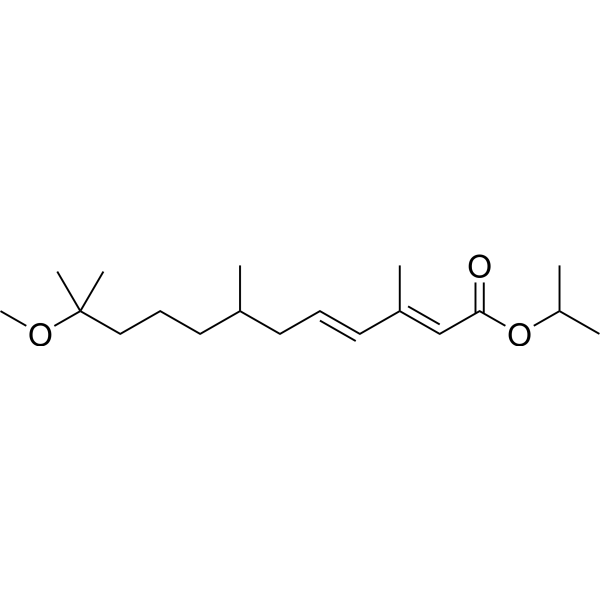
Methoprene
Based on 17 publication(s) in Google Scholar
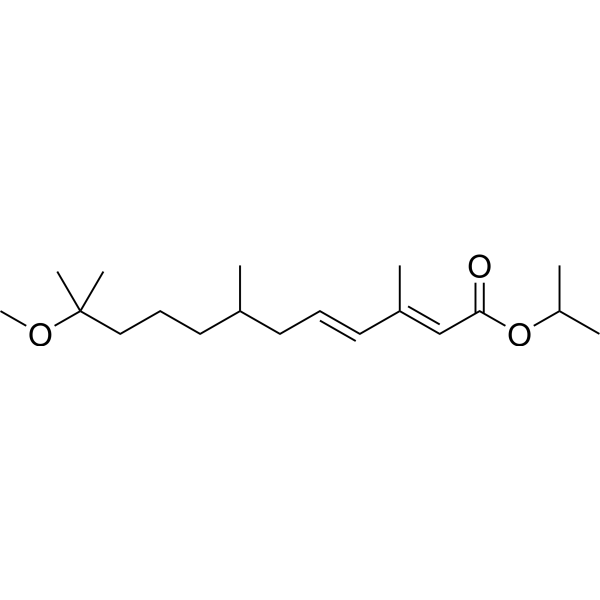
Methoprene, an insect juvenile growth hormone mimic, is a growth-regulating insecticide that manifests its toxicity to target organisms by acting as a juvenile hormone agonist.
Nos produits utilisent uniquement pour la recherche. Nous ne vendons pas aux patients.
- Pureté : 98.0%
- CAS No.: 40596-69-8
- Formule: C19H34O3
- Masse moléculaire:310.47
-
Stockage:Pure form -20°C, 3 years , 4°C, 2 years ; In solvent -80°C, 6 months , -20°C, 1 month

To place orders, for customer services and technical support, please contact: MedChemExpress USA
Tel: 609-228-6898 E-mail: [email protected] [email protected]


-
 Activité biologique
-
Chemical Information
-
Solvant et solubilité
- Protocole
- Pureté et documentation
- Références
-
 Help & FAQs


Publications Citing Use of MedChemExpress (MCE) Methoprene
More- J Agric Food Chem. 2020 Jan 29;68(4):982-988. [Abstract]
- BMC Biol. 2025 Jul 28;23(1):226. [Abstract]
- BMC Biol. 2022 Dec 13;20(1):278. [Abstract]
- Pestic Biochem Physiol. 2026 Jan;216(Pt 1):106726. [Abstract]
- Pestic Biochem Physiol. 2025 Dec:215:106655. [Abstract]
- Insect Biochem Mol Biol. 2026 Aug 3:195:104648.
- Insect Biochem Mol Biol. 2026 Jul:192:104565. [Abstract]
- Insect Biochem Mol Biol. 2022 Mar:142:103727. [Abstract]
- Development. 2020 Oct 23;147(20):dev188805. [Abstract]
- Insect Sci. 2024 Feb;31(1):186-200. [Abstract]
- Insect Sci. 2023 Apr;30(2):279-292. [Abstract]
- Insect Mol Biol. 2021 Aug;30(4):446-458. [Abstract]
- Open Biol. 2023 May;13(5):220372. [Abstract]
- Insects. 2021 Mar 11;12(3):237. [Abstract]
- J Appl Entomol. 2023 Aug 18.
- Arthropod Plant Interact. 2024 Dec.
- Research Square Print. 2022 Apr.


Activité biologique
Description
In Vitro
Methoprene reduces the growth rate of daphnids with evidence of only a single concentration-response line, having a threshold of 12.6 nM. Molt frequency is reduced by methoprene in a concentration-dependent manner, with a response curve corresponding to a 2-segmented line and thresholds at 4.2 and 0.21 nM. An endpoint related to reproductive maturation, the time of first brood deposition, is also affected by methoprene, with a clear concentration-dependent response and a NOEC of 32 nM. Methoprene reduces fecundity according to a 2-segmented line, with thresholds of 24 and < or =0.18 nM. Methoprene elicits significant toxicity to endocrine-related processes in the 5-50 nM concentration range[1].
MedChemExpress (MCE) has not independently confirmed the accuracy of these methods. They are for reference only.


Chemical Information
-
CAS No. 40596-69-8
-
Appearance Liquid (Density: 0.9261 g/cm3)
-
Masse moléculaire 310.47
-
Formule C19H34O3
-
Color Colorless to light yellow
-
SMILES
CC(C)(OC)CCCC(C)C/C=C/C(C)=C/C(OC(C)C)=O
-
Synonyms
ZR-515
-
Livraison
Room temperature in continental US; may vary elsewhere.
-
Stockage
Pure form -20°C 3 years 4°C 2 years In solvent -80°C 6 months -20°C 1 month


Publications (17)
-
Journal Impact Factor
-
Most Recent
-
J Agric Food Chem
2020 Jan 29;68(4):982-988. PMID: 31909997 -
BMC Biol
An ovarian insulin-like peptide specifically regulates energy allocation and oocyte development in nutrition-restricted cockroaches. [Abstract]2025 Jul 28;23(1):226. PMID: 40717121 -
BMC Biol
2022 Dec 13;20(1):278. PMID: 36514097 -
Pestic Biochem Physiol
Polyethyleneimine-modified mesoporous silica nanoparticles loaded with methoprene increased the insecticidal efficacy against Tribolium castaneum. [Abstract]2026 Jan;216(Pt 1):106726. PMID: 41326093 -
Pestic Biochem Physiol
Mechanistic insights into chlorogenic acid and caffeic acid as novel juvenile hormone antagonists. [Abstract]2025 Dec:215:106655. PMID: 41162045 -
-
Insect Biochem Mol Biol
EcR-JHAMT3 axis regulates reproductive plasticity in the predatory beetle Harmonia axyridis. [Abstract]2026 Jul:192:104565. PMID: 42070723 -
Insect Biochem Mol Biol
MicroRNA let-7-5p targets the juvenile hormone primary response gene Krüppel homolog 1 and regulates reproductive diapause in Galeruca daurica. [Abstract]2022 Mar:142:103727. PMID: 35092820 -
Development
Insulin/IGF signaling and TORC1 promote vitellogenesis via inducing juvenile hormone biosynthesis in the American cockroach. [Abstract]2020 Oct 23;147(20):dev188805. PMID: 33097549 -
Insect Sci
Hexamerin and allergen are required for female reproduction in the American cockroach, Periplaneta americana. [Abstract]2024 Feb;31(1):186-200. PMID: 37327125 -
Insect Sci
MicroRNA miR-2765-3p regulates reproductive diapause by targeting FoxO in Galeruca daurica. [Abstract]2023 Apr;30(2):279-292. PMID: 35731017 -
Insect Mol Biol
Juvenile hormone regulates the reproductive diapause through Methoprene-tolerant gene in Galeruca daurica. [Abstract]2021 Aug;30(4):446-458. PMID: 33949026 -
Open Biol
Krüppel-homologue 1 regulates the development of Tuta absoluta and its cascade regulation pattern in the juvenile hormone signalling pathway. [Abstract]2023 May;13(5):220372. PMID: 37253420 -
Insects
Regulation of Juvenile Hormone on Summer Diapause of Geleruca daurica and Its Pathway Analysis. [Abstract]2021 Mar 11;12(3):237. PMID: 33799822 -
-
-


Solvant et solubilité
In Vitro:
DMSO : 50 mg/mL (161.05 mM; Need ultrasonic; Hygroscopic DMSO has a significant impact on the solubility of product, please use newly opened DMSO)
Acetone : 50 mg/mL (161.05 mM; Need ultrasonic)
Please refer to the solubility information to select the appropriate solvent. Once prepared, please aliquot and store the solution to prevent product inactivation from repeated freeze-thaw cycles.
Storage method and period of stock solution: -80°C, 6 months; -20°C, 1 month. When stored at -80°C, please use it within 6 months. When stored at -20°C, please use it within 1 month.
Please refer to the solubility information to select the appropriate solvent. Once prepared, please aliquot and store the solution to prevent product inactivation from repeated freeze-thaw cycles.
Storage method and period of stock solution: -80°C, 6 months; -20°C, 1 month. When stored at -80°C, please use it within 6 months. When stored at -20°C, please use it within 1 month.
Concentration (start) × Volume (start) = Concentration (final) × Volume (final)
In Vivo:
Select the appropriate dissolution method based on your experimental animal and administration route.
- For the following dissolution methods, please ensure to first prepare a clear stock solution using an In Vitro approach and then sequentially add co-solvents:
- To ensure reliable experimental results, the clarified stock solution can be appropriately stored based on storage conditions. As for the working solution for In Vivo experiments, it is recommended to prepare freshly and use it on the same day.
- The percentages shown for the solvents indicate their volumetric ratio in the final prepared solution. If precipitation or phase separation occurs during preparation, heat and/or sonication can be used to aid dissolution.
Add each solvent one by one: 10% DMSO 40% PEG300 5% Tween-80 45% Saline
Solubility: ≥ 2.5 mg/mL (8.05 mM); Clear solution
This protocol yields a clear solution of ≥ 2.5 mg/mL (saturation unknown).
Taking 1 mL working solution as an example, add 100 μL DMSO stock solution (25.0 mg/mL) to 400 μL PEG300, and mix evenly; then add 50 μL Tween-80 and mix evenly; then add 450 μL Saline to adjust the volume to 1 mL.
Preparation of Saline: Dissolve 0.9 g sodium chloride in ddH₂O and dilute to 100 mL to obtain a clear Saline solution.
Add each solvent one by one: 10% DMSO 90% (20% SBE-β-CD in Saline)
Solubility: 2.5 mg/mL (8.05 mM); Suspended solution; Need ultrasonic
This protocol yields a suspended solution of 2.5 mg/mL. Suspended solution can be used for oral and intraperitoneal injection.
Taking 1 mL working solution as an example, add 100 μL DMSO stock solution (25.0 mg/mL) to 900 μL 20% SBE-β-CD in Saline, and mix evenly.
Preparation of 20% SBE-β-CD in Saline (4°C, storage for one week): 2 g SBE-β-CD powder is dissolved in 10 mL Saline, completely dissolve until clear.
Add each solvent one by one: 10% EtOH 40% PEG300 5% Tween-80 45% Saline
Solubility: ≥ 2.5 mg/mL (8.05 mM); Clear solution
This protocol yields a clear solution of ≥ 2.5 mg/mL (saturation unknown).
Taking 1 mL working solution as an example, add 100 μL EtOH stock solution (25.0 mg/mL) to 400 μL PEG300, and mix evenly; then add 50 μL Tween-80 and mix evenly; then add 450 μL Saline to adjust the volume to 1 mL.
Preparation of Saline: Dissolve 0.9 g sodium chloride in ddH₂O and dilute to 100 mL to obtain a clear Saline solution.
Add each solvent one by one: 10% EtOH 90% (20% SBE-β-CD in Saline)
Solubility: ≥ 2.5 mg/mL (8.05 mM); Suspended solution
This protocol yields a suspended solution of ≥ 2.5 mg/mL (saturation unknown). Suspended solution can be used for oral and intraperitoneal injection.
Taking 1 mL working solution as an example, add 100 μL EtOH stock solution (25.0 mg/mL) to 900 μL 20% SBE-β-CD in Saline, and mix evenly.
Preparation of 20% SBE-β-CD in Saline (4°C, storage for one week): 2 g SBE-β-CD powder is dissolved in 10 mL Saline, completely dissolve until clear.
Add each solvent one by one: 10% EtOH 90% Corn Oil
Solubility: ≥ 2.5 mg/mL (8.05 mM); Clear solution
This protocol yields a clear solution of ≥ 2.5 mg/mL (saturation unknown). If the continuous dosing period exceeds half a month, please choose this protocol carefully.
Taking 1 mL working solution as an example, add 100 μL EtOH stock solution (25.0 mg/mL) to 900 μL Corn oil, and mix evenly.
In Vivo Dissolution Calculator
Please enter the basic information of animal experiments:
-
-
-
-
Recommended: Prepare an additional quantity of animals to account for potential losses during experiments.
Please enter your animal formula composition:
-
%DMSO +
Recommended: Keep the proportion of DMSO in working solution below 2% if your animal is weak.
-
%+
-
+%Tween-80 + +
-
%Saline +
The co-solvents required include: DMSO, . All of co-solvents are available by MedChemExpress (MCE). , Tween 80. All of co-solvents are available by MedChemExpress (MCE).
Working solution concentration: 0.22 mg/mL
Method for preparing stock solution: mg drug dissolved in μL DMSO. Stock solution concentration: mg/mL.
1. Take μL DMSO stock solution;
2. Add μL .
μL , mix evenly;
3. Then add μL Tween 80, mix evenly;
4. Then add μL
Please ensure that the stock solution in the first step is dissolved to a clear state, and add co-solvents in sequence. You can use ultrasonic heating (ultrasonic cleaner, recommended frequency 20-40 kHz), vortexing, etc. to assist dissolution.


Pureté et documentation
-
Fiche technique (269 KB)
-
SDS (597 KB)
- English - EN (597 KB)
- Français - FR (597 KB)
- Deutsch - DE (597 KB)
- Norwegian - NO (597 KB)
- Español - ES (597 KB)
- Swedish - SV (597 KB)
- Italian - IT (597 KB)
- Korean - KR (597 KB)
- Portuguese - PT (597 KB)
-
Instruction de manipulation (2659 KB)
Références
[1]. Olmstead AW, LeBlanc GL. Low exposure concentration effects of methoprene on endocrine-regulated processes in the crustacean Daphnia magna. Toxicol Sci. 2001;62(2):268-273. [Content Brief]
[2]. Monteiro JP, et al. Toxicity of methoprene as assessed by the use of a model microorganism. Toxicol In Vitro. 2005;19(7):951-956. [Content Brief]


Complete Stock Solution Preparation Table
Please refer to the solubility information to select the appropriate solvent. Once prepared, please aliquot and store the solution to prevent product inactivation from repeated freeze-thaw cycles.
Storage method and period of stock solution: -80°C, 6 months; -20°C, 1 month. When stored at -80°C, please use it within 6 months. When stored at -20°C, please use it within 1 month.
| Optional Solvent | Concentration Solvent Mass | 1 mg | 5 mg | 10 mg | 25 mg |
|---|---|---|---|---|---|
| DMSO / Acetone | 1 mM | 3.2209 mL | 16.1046 mL | 32.2092 mL | 80.5231 mL |
| 5 mM | 0.6442 mL | 3.2209 mL | 6.4418 mL | 16.1046 mL | |
| 10 mM | 0.3221 mL | 1.6105 mL | 3.2209 mL | 8.0523 mL | |
| 15 mM | 0.2147 mL | 1.0736 mL | 2.1473 mL | 5.3682 mL | |
| 20 mM | 0.1610 mL | 0.8052 mL | 1.6105 mL | 4.0262 mL | |
| 25 mM | 0.1288 mL | 0.6442 mL | 1.2884 mL | 3.2209 mL | |
| 30 mM | 0.1074 mL | 0.5368 mL | 1.0736 mL | 2.6841 mL | |
| 40 mM | 0.0805 mL | 0.4026 mL | 0.8052 mL | 2.0131 mL | |
| 50 mM | 0.0644 mL | 0.3221 mL | 0.6442 mL | 1.6105 mL | |
| 60 mM | 0.0537 mL | 0.2684 mL | 0.5368 mL | 1.3421 mL | |
| 80 mM | 0.0403 mL | 0.2013 mL | 0.4026 mL | 1.0065 mL | |
| 100 mM | 0.0322 mL | 0.1610 mL | 0.3221 mL | 0.8052 mL |


Methoprene Related Classifications
HY-B1161 Related Classifications
 Powered by Bioz