



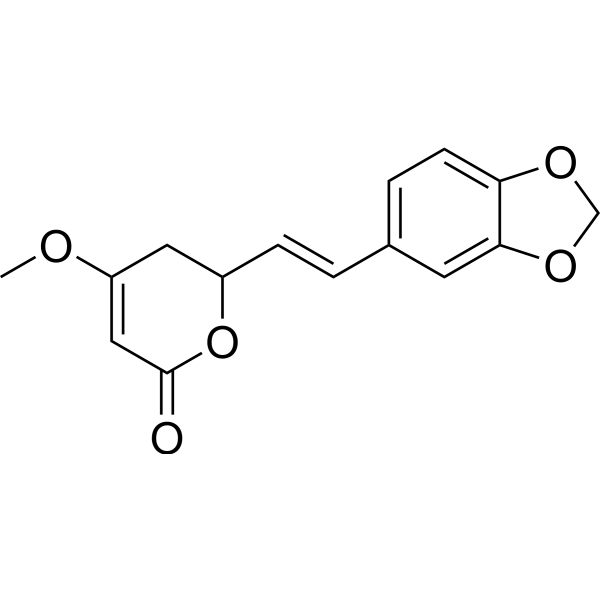
Methysticin
Methysticin is a major kavalactone in kava extract to induce CYP1A1.
Nos produits utilisent uniquement pour la recherche. Nous ne vendons pas aux patients.
- CAS No.: 20697-20-5
- Formule: C15H14O5
- Masse moléculaire:274.27
-
Stockage:
Please store the product under the recommended conditions in the Certificate of Analysis.

To place orders, for customer services and technical support, please contact: MedChemExpress USA
Tel: 609-228-6898 E-mail: [email protected] [email protected]


-
 Activité biologique
-
Chemical Information
- Pureté et documentation
- Références
-
 Help & FAQs




Activité biologique
Description
IC50 & Target
[1]|
CYP1A1 |
Cellular Effect
|
Cell Line

|
Type | Value | Description | References |
|---|---|---|---|---|
| A549 | IC50 |
0.19 μg/mL
Compound: (+)-Methysticin
|
Inhibition of TNF-alpha-induced NF-kappaB expressed in human A549 cells treated 1 hr after TNFalpha challenge measured after 6 hrs by luciferase reporter gene assay
Inhibition of TNF-alpha-induced NF-kappaB expressed in human A549 cells treated 1 hr after TNFalpha challenge measured after 6 hrs by luciferase reporter gene assay
|
[PMID: 19716299] |
In Vitro
Methysticin triggers the most profound inducing effect on CYP1A1. Consistent with the experimental results, in silico molecular docking studies based on the aryl hydrocarbon receptor (AhR)-ligand binding domain homology model also reveals favorable binding to AhR for Methysticin compared with the remaining kavalactones. Additionally, results from a luciferase gene reporter assay suggested that kava extract, Methysticin is able to activate the AhR signaling pathway. Kava extract induces the expression of CYP1A1 via an AhR-dependent mechanism and that Methysticin contributes to CYP1A1 induction. The induction of CYP1A1 indicates a potential interaction between kava or kavalactones and CYP1A1-mediated chemical carcinogenesis. The MTS cell viability assay is used to determine the effects of kava extract and kavalactones on cell viability in mouse hepatic cells. Hepa1c1c7 cells are treated with various concentrations of kava extract (0-50 µg/mL) and six kavalactones (0-100 µM) for 24 h. The results indicate that kava extract at concentrations up to 50 µg/mL and kavalactones up to 100 µM do not induce cell death. For the following studies, kava extract at 0.78-6.25 µg/mL and kavalactones at 0.78-25 µM, concentrations that cause no damage to cells, are used[1].
MedChemExpress (MCE) has not independently confirmed the accuracy of these methods. They are for reference only.
In Vivo
MedChemExpress (MCE) has not independently confirmed the accuracy of these methods. They are for reference only.


Chemical Information
-
CAS No. 20697-20-5
-
Masse moléculaire 274.27
-
Formule C15H14O5
-
SMILES
O=C1C=C(OC)CC(/C=C/C2=CC=C(OCO3)C3=C2)O1
-
Synonyms
DL-Methysticin; (±)-Methystici
-
Structure Classification
-
Initial Source
-
Livraison
Room temperature in continental US; may vary elsewhere.
-
Stockage
Please store the product under the recommended conditions in the Certificate of Analysis.


Pureté et documentation
Références
[1]. Li Y, et al. Methysticin and 7,8-dihydromethysticin are two major kavalactones in kava extract to induce CYP1A1. Toxicol Sci. 2011 Dec;124(2):388-99. [Content Brief]
[2]. Fragoulis A, et al. Oral administration of Methysticin improves cognitive deficits in a mouse model of Alzheimer's disease. Redox Biol. 2017 Aug;12:843-853. [Content Brief]

Calculators
Concentration (start) × Volume (start) = Concentration (final) × Volume (final)


Methysticin Related Classifications
HY-N0922 Related Classifications
 Powered by Bioz