



Isepamicin
Based on 1 publication(s) in Google Scholar
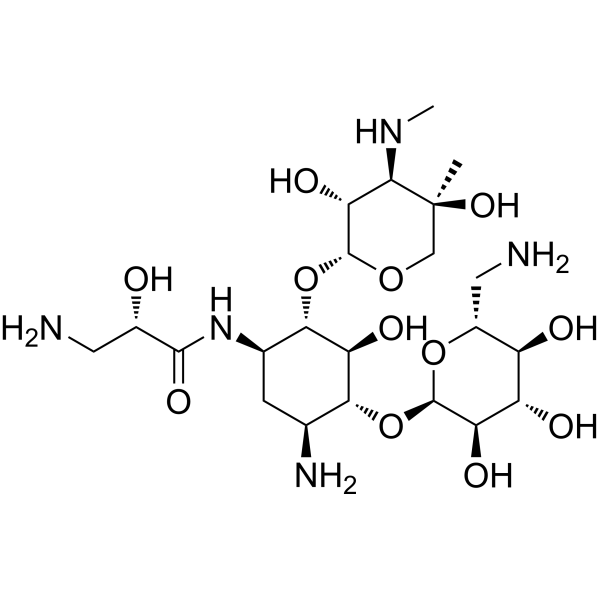
Isepamicin (Sch 21420) is an aminoglycoside antibacterial. Isepamicin has better activity against strains producing type I 6'-acetyltransferase. Isepamicin’s antibacterial spectrum includes Enterobacteriaceae and staphylococci. Anaerobes, Neisseriaceae and streptococci are resistant. Isepamicin exhibits a strong concentration-dependent bactericidal effect, a long post-antibiotic effect (several hours) and induces adaptive resistance.
Nos produits utilisent uniquement pour la recherche. Nous ne vendons pas aux patients.
- CAS No.: 58152-03-7
- Formule: C22H43N5O12
- Masse moléculaire:569.60
-
Stockage:
Please store the product under the recommended conditions in the Certificate of Analysis.

To place orders, for customer services and technical support, please contact: MedChemExpress USA
Tel: 609-228-6898 E-mail: [email protected] [email protected]


-
 Activité biologique
-
Chemical Information
- Protocole
- Pureté et documentation
- Références
-
 Help & FAQs


Publications Citing Use of MedChemExpress (MCE) Isepamicin
MoreVoir tous les produits spécifiques à Isoform Antibiotic
More

Activité biologique
Description
IC50 & Target
|
Aminoglycoside |


Chemical Information
-
CAS No. 58152-03-7
-
Masse moléculaire 569.60
-
Formule C22H43N5O12
-
SMILES
NC[C@H](O)C(N[C@H](C[C@@H]([C@H]([C@@H]1O)O[C@H]2O[C@@H]([C@H]([C@@H]([C@H]2O)O)O)CN)N)[C@@H]1O[C@@H]3[C@@H]([C@H]([C@@](O)(CO3)C)NC)O)=O
-
Synonyms
Sch 21420
-
Livraison
Room temperature in continental US; may vary elsewhere.
-
Stockage
Please store the product under the recommended conditions in the Certificate of Analysis.


Publications (1)
-
Journal Impact Factor
-
Most Recent
-
Int J Mol Sci
Discovery of TRPV4-Targeting Small Molecules with Anti-Influenza Effects Through Machine Learning and Experimental Validation. [Abstract]2025 Feb 6;26(3):1381. PMID: 39941149

Protocole
-
Research Protocol for Infectious Diseases
Infectious-disease experiments test how pathogens interact with host barriers, innate immune receptors, inflammatory signaling, pathogen replication, and tissue injury; pattern-recognition receptors such as TLRs, RIG-I-like receptors, NOD-like receptors, and inflammasomes detect microbial molecules and activate NF-κB, interferon, and cytokine responses. The central hypothesis is that infection severity reflects the balance between pathogen burden and host response: protective inflammation restricts pathogen growth, whereas excessive or mislocalized inflammation contributes to tissue damage and disease phenotype. Unresolved questions include which host pathways are protective versus pathogenic, why some infection models fail to translate to human disease, and which combined readouts best predict clinically relevant infection outcomes.


Pureté et documentation
Références

Calculators
Concentration (start) × Volume (start) = Concentration (final) × Volume (final)


Isepamicin Related Classifications
HY-106668 Related Classifications
 Powered by Bioz