



56-54-2
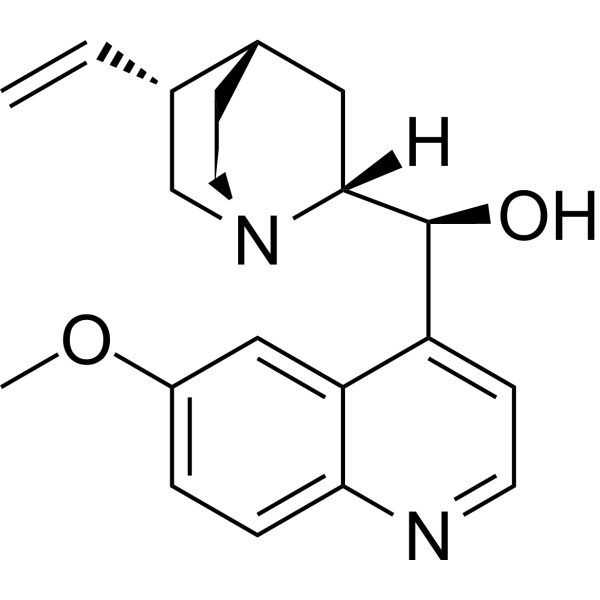
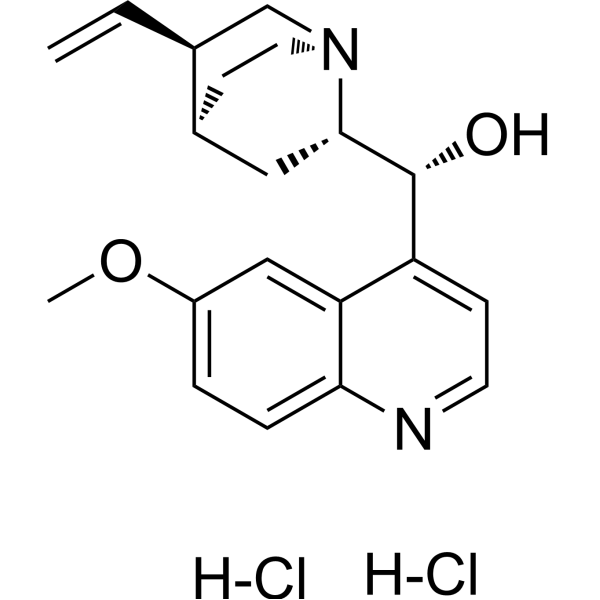
Chemical Structure
Quinidine (15% dihydroquinidine)
- CAS No.: 56-54-2
- Formula:C20H24N2O2
- Molecular Weight:324.42
IUPAC Name: (S)-(6-methoxyquinolin-4-yl)((1S,2R,4S,5R)-5-vinylquinuclidin-2-yl)methanol
InChIKey: LOUPRKONTZGTKE-LHHVKLHASA-N
SMILES: C=C[C@H]1C[N@](CC[C@H]1C2)[C@@]2([H])[C@@H](O)C3=CC=NC4=CC=C(OC)C=C34
Biological Activity: Quinidine (15% dihydroquinidine) is an orally active antiarrhythmic agent. Quinidine (15% dihydroquinidine) reduces the expression level of P-gp, inhibits P-gp-mediated efflux, increases the intracellular accumulation of P-gp substrates, induces PARP cleavage and Caspase-3 activation, and elevates the proportion of Apoptotic cells at the sub-G1 phase. Quinidine (15% dihydroquinidine) exerts sustained block and open-channel block effects on IK(f). Quinidine (15% dihydroquinidine) alters the urinary metabolic ratio of Amphetamine, modulates the Pentylenetetrazol-induced seizure threshold, and regulates the anticonvulsant effect of Dextromethorphan. Quinidine (15% dihydroquinidine) can be used in studies related to uterine sarcoma and seizures[1][2][3][4].
| Cat. No. | 상품명 | Purity | 제품 설명 | Pricing | |||||||||||||||||||
|---|---|---|---|---|---|---|---|---|---|---|---|---|---|---|---|---|---|---|---|---|---|---|---|
|
|
Quinidine (15% dihydroquinidine) | 98.36% | Quinidine (15% dihydroquinidine) is an orally active antiarrhythmic agent. Quinidine (15% dihydroquinidine) reduces the expression level of P-gp, inhibits P-gp-mediated efflux, increases the intracellular accumulation of P-gp substrates, induces PARP cleavage and Caspase-3 activation, and elevates the proportion of Apoptotic cells at the sub-G1 phase. Quinidine (15% dihydroquinidine) exerts sustained block and open-channel block effects on IK(f). Quinidine (15% dihydroquinidine) alters the urinary metabolic ratio of Amphetamine, modulates the Pentylenetetrazol-induced seizure threshold, and regulates the anticonvulsant effect of Dextromethorphan. Quinidine (15% dihydroquinidine) can be used in studies related to uterine sarcoma and seizures. | ||||||||||||||||||||
|
loading...
/
|
|||||||||||||||||||||||
|
|
Quinidine (15% dihydroquinidine) (Standard) | 99.22% | Quinidine (15% dihydroquinidine) (Standard) is the analytical standard of Quinidine (15% dihydroquinidine) (HY-B1751). This product is intended for research and analytical applications. Quinidine (15% dihydroquinidine) is an orally active antiarrhythmic agent. Quinidine (15% dihydroquinidine) reduces the expression level of P-gp, inhibits P-gp-mediated efflux, increases the intracellular accumulation of P-gp substrates, induces PARP cleavage and Caspase-3 activation, and elevates the proportion of Apoptotic cells at the sub-G1 phase. Quinidine (15% dihydroquinidine) exerts sustained block and open-channel block effects on IK(f). Quinidine (15% dihydroquinidine) alters the urinary metabolic ratio of Amphetamine, modulates the Pentylenetetrazol-induced seizure threshold, and regulates the anticonvulsant effect of Dextromethorphan. Quinidine (15% dihydroquinidine) can be used in studies related to uterine sarcoma and seizures. | ||||||||||||||||||||
|
loading...
/
|
|||||||||||||||||||||||
|
|
Quinidine-d3 | Quinidine-d3 is the deuterated-labeled Quinidine (HY-B1751H). Quinidine is an orally effective antiarrhythmic agent. Quinidine blocks the fast inward sodium current in a use-dependent manner, blocks IKr in a reverse use-dependent manner, and blocks the ultra-rapid delayed rectifier potassium current with an EC50 of 6.2 μM, while also inhibiting CYP2D6 and P-gp. Quinidine induces PARP cleavage, Caspase-3 activation, and increases the proportion of sub-G1 phase apoptotic (Apoptotic) cells. Quinidine can be used in research on ischemia/reperfusion-induced cardiac injury, drug-resistant leukemia, convulsions, and uterine sarcoma. | |||||||||||||||||||||
|
loading...
/
|
|||||||||||||||||||||||
|
|
Quinidine-13C, d2 hydrochloride | Quinidine-13C, d2 hydrochloride is the deuterated, 13C-labeled Quinidine (HY-B1751H). Quinidine is an orally effective antiarrhythmic agent. Quinidine blocks the fast inward sodium current in a use-dependent manner, blocks IKr in a reverse use-dependent manner, and blocks the ultra-rapid delayed rectifier potassium current with an EC50 of 6.2 μM, while also inhibiting CYP2D6 and P-gp. Quinidine induces PARP cleavage, Caspase-3 activation, and increases the proportion of sub-G1 phase apoptotic (Apoptotic) cells. Quinidine can be used in research on ischemia/reperfusion-induced cardiac injury, drug-resistant leukemia, convulsions, and uterine sarcoma. | |||||||||||||||||||||
|
loading...
/
|
|||||||||||||||||||||||
-
Similarity Score 1.00
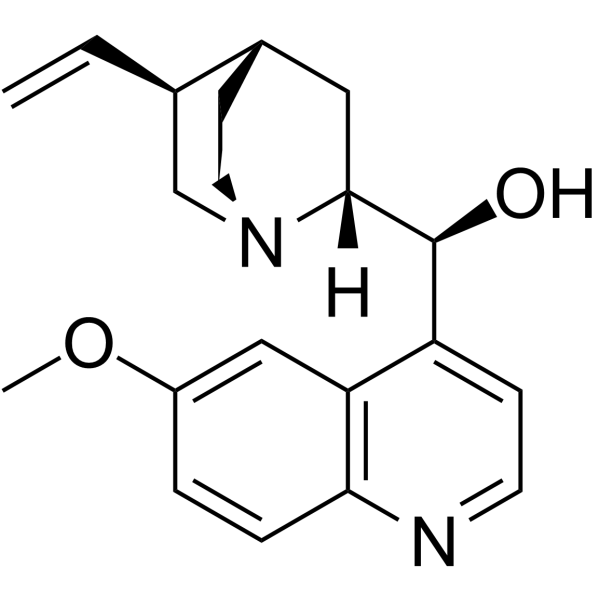 HY-114029Ep vinyl quinidine
-
Similarity Score 1.00
 HY-D0143RQuinine (Standard)
-
Similarity Score 1.00
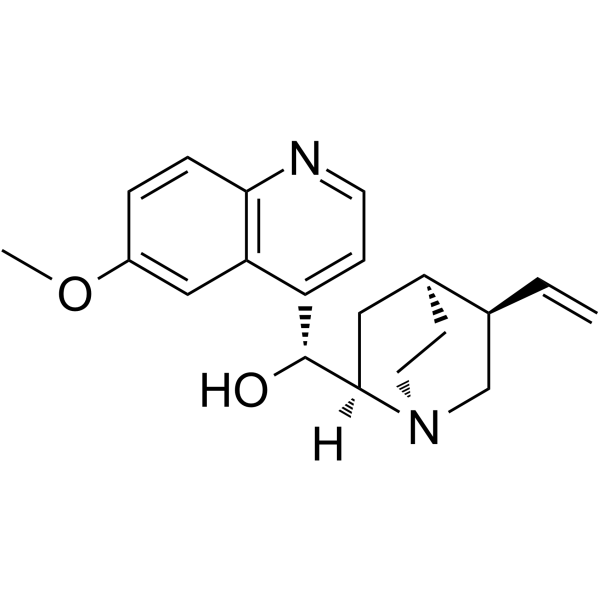 HY-W048510Epiquinidine
-
Similarity Score 1.00
 HY-W842297Epiquinine
-
Similarity Score 0.98
 HY-110082Quinine (hydrochloride)
-
Similarity Score 0.98
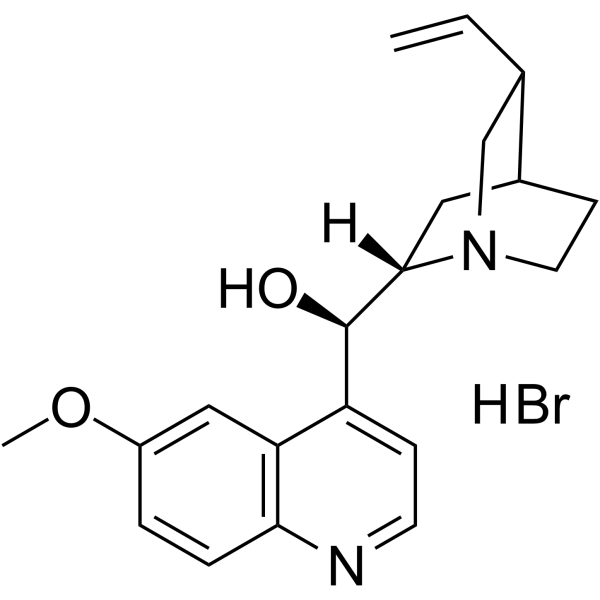 HY-B1751CQuinine hydrobromide
-
Similarity Score 0.98
 HY-W115674Quinidine hydrochloride
-
Similarity Score 0.97
 HY-B1302RQuinidine hydrochloride monohydrate (Standard)
-
Similarity Score 0.97
 HY-D0143AQuinine dihydrochloride
-

Explore the MedChemAI to find more analogs


References
- [1]. Lee SY, et al. Hydrocinchonine, cinchonine, and quinidine potentiate paclitaxel-induced cytotoxicity and apoptosis via multidrug resistance reversal in MES-SA/DX5 uterine sarcoma cells. Environ Toxicol. 2011 Aug;26(4):424-31. [Content Brief]
- [2]. Kehl SJ, et al. Quinidine-induced inhibition of the fast transient outward K+ current in rat melanotrophs. Br J Pharmacol. 1991;103(3):1807-1813. [Content Brief]
- [3]. Moody DE, et al. Quinidine inhibits in vivo metabolism of amphetamine in rats: impact upon correlation between GC/MS and immunoassay findings in rat urine. J Anal Toxicol. 1990;14(5):311-317. [Content Brief]
- [4]. Jamali H, et al. Effect of dextromethorphan/quinidine on pentylenetetrazole- induced clonic and tonic seizure thresholds in mice. Neurosci Lett. 2020;729:134988. [Content Brief]



