



Cefazolin-13C2,15N

Based on 1 Customer Validation
Cefazolin-13C2,15N (Cephazolin-13C2,15N) is 13C and 15N labeled Cefazolin. Cefazolin (Cephazolin) is a first-generation cephalosporin antibiotic and can be used in varieties of bacterial infections research. Cefazolin has anti-inflammatory effect and can attenuate post-operative cognitive dysfunction (POCD).
For research use only. We do not sell to patients.
- Purity : 99.76%
- CAS No.: 2101505-58-0
- Formula: C1213C2H14N715NO4S3
- Molecular Weight:457.49
-
Storage:Powder -20°C, 3 years ; In solvent -80°C, 6 months , -20°C, 1 month


To place orders, for customer services and technical support, please contact: MedChemExpress USA
Tel: 609-228-6898 E-mail: [email protected] [email protected]


-
 Biological Activity
-
Chemical Information
- Protocols
- Purity & Documentation
- References
-
 Help & FAQs


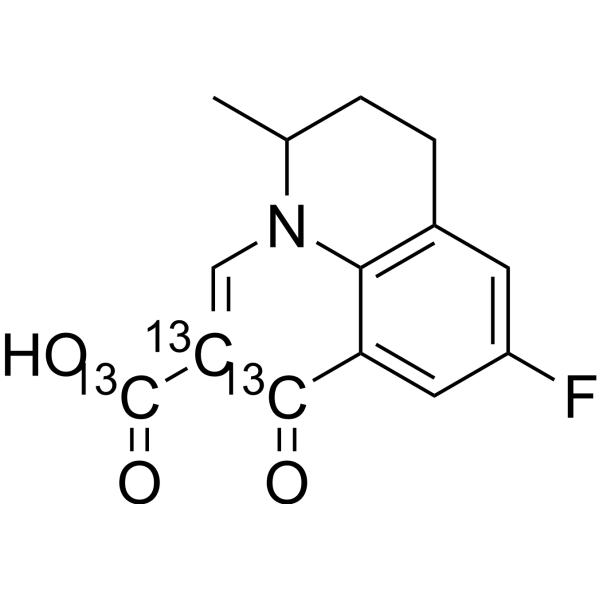
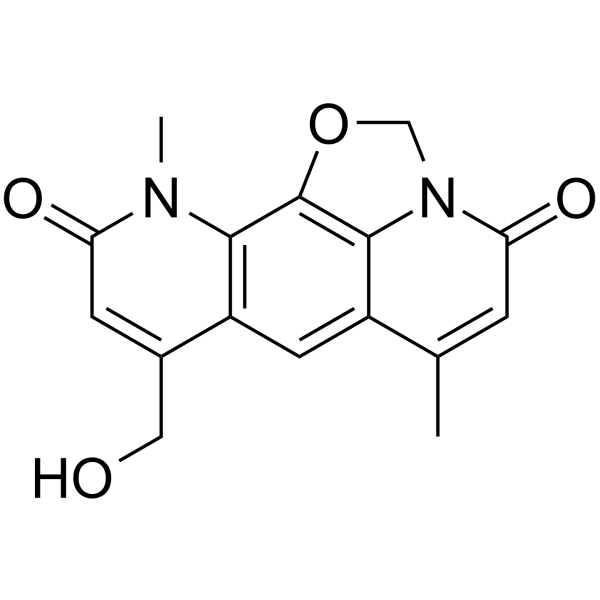
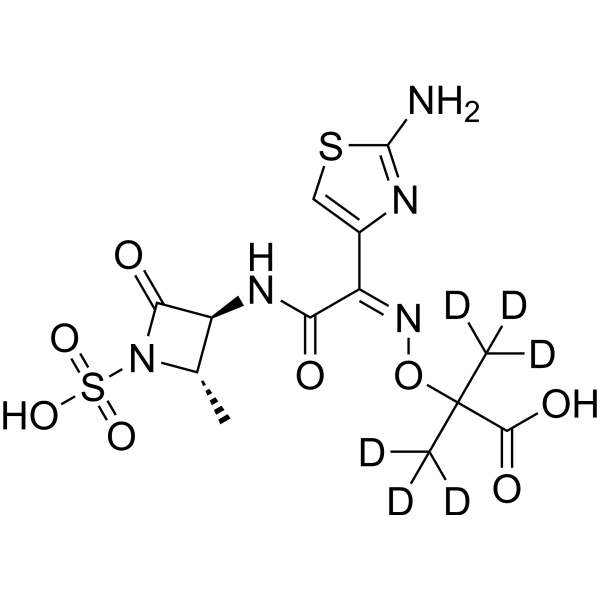

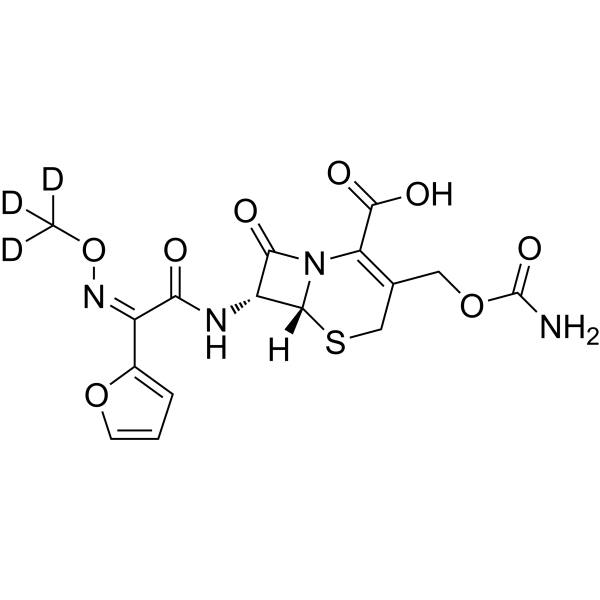
All Antibiotic Isoforms
More

Biological Activity
Description
In Vitro
Stable heavy isotopes of hydrogen, carbon, and other elements have been incorporated into drug molecules, largely as tracers for quantitation during the drug development process. Deuteration has gained attention because of its potential to affect the pharmacokinetic and metabolic profiles of drugs.
MedChemExpress (MCE) has not independently confirmed the accuracy of these methods. They are for reference only. Further protocols information, click here.
Application
1. This compound can be used as a tracer
2. This compound can be used as an internal standard for quantitative analysis by NMR, GC-MS, or LC-MS.


Chemical Information
-
CAS No. 2101505-58-0
-
Unlabeled CAS 25953-19-9
-
Appearance Solid
-
Molecular Weight 457.49
-
Formula C1213C2H14N715NO4S3
-
SMILES
O=[13C](N[C@@H]([C@@]1(N2C(C(O)=O)=C(CS1)CSC3=NN=C(S3)C)[H])C2=O)[13CH2][15N]4N=NN=C4
-
Synonyms
Cephazolin-13C2,15N
-
Shipping
Room temperature in continental US; may vary elsewhere.
-
Storage
Powder -20°C 3 years In solvent -80°C 6 months -20°C 1 month

Protocols
-
Research Protocol for Inflammation-related Diseases
The NLRP3 inflammasome is a cytosolic innate immune signaling platform that integrates priming signals and danger-signal activation to promote caspase-1 activation, maturation of IL-1β and IL-18, and gasdermin D-mediated pyroptotic cell death. The core experimental logic is to determine whether inflammatory disease phenotypes are driven by increased NLRP3 expression, ASC-containing inflammasome assembly, caspase-1 cleavage, GSDMD cleavage, and extracellular release of IL-1β/IL-18 rather than by nonspecific cell injury alone. The pathway is strongly linked to inflammation-related disease phenotypes because monosodium urate crystals activate NALP3/NLRP3 inflammasome signaling in gout-like crystal inflammation, cholesterol crystals activate NLRP3 inflammasomes in atherogenesis models, and DSS-induced intestinal inflammation has been reported to involve NLRP3 inflammasome activity. However, experimental colitis studies also show context-dependent protective effects of NLRP3 inflammasome co


Purity & Documentation
References
[1]. Russak EM, et al. Impact of Deuterium Substitution on the Pharmacokinetics of Pharmaceuticals. Ann Pharmacother. 2019 Feb;53(2):211-216. [Content Brief]
[2]. R Quintiliani, et al. Cefazolin. Ann Intern Med. 1978 Nov;89(5 Pt 1):650-6. [Content Brief]
[3]. Peng Liang, et al. Perioperative use of cefazolin ameliorates postoperative cognitive dysfunction but induces gut inflammation in mice. J Neuroinflammation. 2018 Aug 22;15(1):235. [Content Brief]
[4]. Barbara Żyżyńska-Granica, et al. The anti-inflammatory potential of cefazolin as common gamma chain cytokine inhibitor. Sci Rep. 2020 Feb 19;10(1):2886. [Content Brief]

Calculators
Concentration (start) × Volume (start) = Concentration (final) × Volume (final)


Cefazolin-13C2,15N Related Classifications
HY-B1892S1 Related Classifications
 Powered by Bioz