



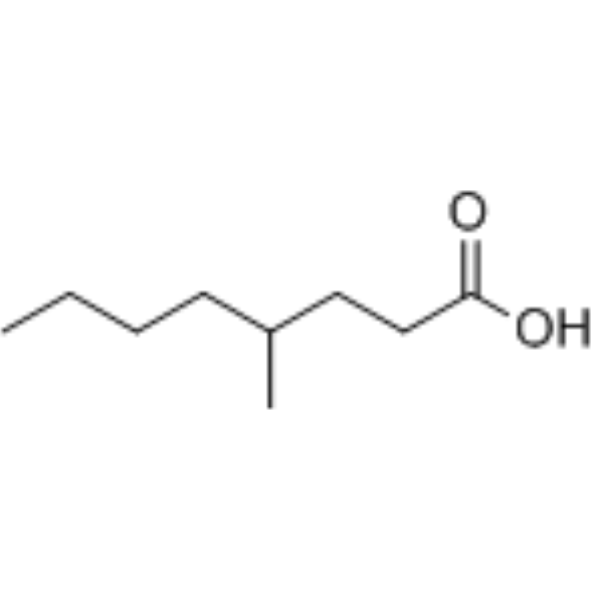
4-Methyloctanoic acid

Based on 1 Customer Validation
4-Methyloctanoic acid is an endogenous branched-chain medium-chain fatty acid and a negative regulator of the cAMP/PKA signaling pathway. 4-Methyloctanoic acid exerts antiepileptic effects by inhibiting epileptiform discharges and terminating behavioral and electroencephalographic seizures. 4-Methyloctanoic acid has neuroprotective effects; its polar metabolites can cross the blood-brain barrier, repair presynaptic release defects, improve motor function and alleviate neuromuscular degeneration in ALS models. 4-Methyloctanoic acid regulates phosphatidylinositol metabolism, reduces PIP/PIP2 levels and increases inositol levels. 4-Methyloctanoic acid can be used in studies related to epilepsy and amyotrophic lateral sclerosis.
Nur für Forschungszwecke. Wir verkaufen nicht an Patienten.
- Reinheit : 99.85%
- CAS. Nr.: 54947-74-9
- Formel: C9H18O2
- Molecular Weight:158.24
-
Speicherung:
Store at room temperature 3 years.
In solvent -80°C, 2 years , -20°C, 1 year

To place orders, for customer services and technical support, please contact: MedChemExpress USA
Tel: 609-228-6898 E-mail: [email protected] [email protected]


-
 Biologische Aktivität
-
Chemical Information
-
Lösungsmittel & Löslichkeit
- Reinheit & Dokumentation
- Verweise
-
 Help & FAQs



Alle Endogenous Metabolite Isoform-spezifische Produkte anzeigen
More

Biologische Aktivität
Beschreibung
IC50 & Target
[1]|
cAMP |
In Vitro
4-Methyloctanoic acid (1 mM; 40 minutes) potently suppresses PTZ-induced epileptiform burst discharge frequency in combined entorhinal cortex-hippocampal slices, reducing activity to 49.14% of baseline[1].
4-Methyloctanoic acid (1 mM; 40 minutes) nearly eliminates low-Mg2+-induced epileptiform recurrent short discharge frequency in combined entorhinal cortex-hippocampal slices, reducing activity to 1.60% of baseline[1].
4-Methyloctanoic acid (1 mM) does not alter baseline transmission or short-term potentiation at mossy fibre to CA3 synapses in normal rat hippocampal slices[1].
4-Methyloctanoic acid (1 mM) potently inhibits forskolin-induced mossy fibre response enhancement in normal rat hippocampal slices, reducing fEPSP amplitude to 231.67% of baseline[1].
4-Methyloctanoic acid (0.1-1 μM; 40 min) potently reduces PTZ-induced epileptiform discharge frequency in rat entorhinal cortex-hippocampus slices, with greater efficacy than VPA at 0.5 μM and 1 μM concentrations[2].
4-Methyloctanoic acid is potent in blocking chemotactic cell movement via inhibition of phosphoinositide production in Dictyostelium discoideum cells[3].
4-Methyloctanoic acid (0.5 mM; 3 min pre-treatment, 6 min labelling incubation) potently inhibits phosphoinositide synthesis in developed Dictyostelium AX2 cells, reducing PIP production to 12% of control levels, while simultaneously increasing cellular inositol levels[6].
4-Methyloctanoic acid (up to 10 mM) does not inhibit human HDAC activity at concentrations up to 10 mM, unlike VPA which potently inhibits HDAC activity at these levels[2].
4-Methyloctanoic acid (0.01-10 mM; 24 h) has minimal toxicity to human Huh7 hepatoma cells, with an IC50 of 7.3 mM, indicating a lower hepatotoxic potential than some other medium chain fatty acids tested[2].
MedChemExpress (MCE) has not independently confirmed the accuracy of these methods. They are for reference only. .
In Vivo
4-Methyloctanoic acid (400-600 mg/kg; i.p.; single administration) completely terminates electroencephalographic and behavioral seizures in all tested animals, but fails to prevent hippocampal hilar neuron loss after seizure onset. However, it induces sedation in healthy male Sprague-Dawley rats, with severe sedation observed at 600 mg/kg[2].
Radiolabeled 4-Methyloctanoic acid ([18F]-19) (59-740 kBq; intravenous injection; single administration) exhibits low initial brain uptake of 0.15 % dose/g in fasted male Wistar rats, and its brain radioactivity retention is mainly attributed to polar metabolites that can cross the blood-brain barrier[4].
4-Methyloctanoic acid (100 µM; incorporated into standard fly food; continuous feeding; from mating through larval development) partially reverses impaired motor function in ALS Drosophila models, fully rescues presynaptic neurotransmitter release, alters NMJ morphology, and partially corrects ALS-associated metabolic dysregulation[5].
MedChemExpress (MCE) has not independently confirmed the accuracy of these methods. They are for reference only.
-
Animal Model:Self-sustaining status epilepticus was induced in male Sprague-Dawley rats (250-330 g) by perforant path stimulation (4-5 mA, 50 μs, 20 Hz, for 2 hours)[1]
-
Dosage:400 mg/kg
-
Administration:i.p.; single dose
-
Result:Reduced mean EEG spike frequency to 39.33% of baseline in the first hour, 18.06% in the second hour, and 26.85% in the third hour.
Terminated status epilepticus (spike frequency <1 Hz) in all treated animals.
Suppressed spike amplitude to 27.17% of baseline in the first hour, 18.87% in the second hour, and 44.45% in the third hour.
Significantly reduced seizure severity compared to controls in the first hour (P<0.01).
Stopped behavioural seizures in all animals by the second hour.
Prevented seizure recurrence in over half of animals by the third hour.
Reduced neurodegeneration in the hippocampal CA1 and CA3 regions.
-
Animal Model:Sprague-Dawley (male, 300-400 g, self-sustaining status epilepticus induced by 2 h of perforant path electrical stimulation with 3-5 mA, 50 msec monopolar pulses at 20 Hz)[2]
-
Dosage:400 mg/kg; 600 mg/kg
-
Administration:i.p.; single dose
-
Result:Reduced average EEG spike frequency to 24.9%, 18.7%, and 28.3% of baseline in the first, second, and third hours post-administration, respectively.
Completely terminated status epilepticus in all animals.
Reduced behavioural seizure severity to 0.0%, 0.0%, and 18.8% of baseline in the first, second, and third hours post-administration, respectively.
Measured neuronal loss in the hippocampal hilus at 74.4% of control levels two months post-status epilepticus.
Caused mild sedation with a mean score of 1.2 in the first hour, and no sedation in the second and third hours at 400 mg/kg.
Caused more severe sedation with mean scores of 2.5, 1.4, and 1.5 in the first, second, and third hours post-administration, respectively at 600 mg/kg.
Resulted in one animal death 170 minutes after 600 mg/kg dose.
-
Animal Model:Wistar (male, 150-200 g, fasted 24-48 hours prior to experiment)[4]
-
Dosage:370-740 kBq (direct injection); 59-93 kBq (plasma reinjection)
-
Administration:i.v.; single dose
-
Result:Achieved brain uptake (corrected for blood contribution) of 0.15 % dose/g at 5 minutes post-direct injection.
Reached blood uptake of 0.77 % dose/g, liver uptake of 0.41 % dose/g, kidney uptake of 3.17 % dose/g, heart uptake of 1.13 % dose/g, and bone uptake of 0.21 % dose/g at 5 minutes post-direct injection.
Attained brain uptake of 0.10 % dose/g at 5 minutes post-plasma reinjection, which was higher than the predicted 0.02 % dose/g if only unmetabolized [18F]-19 crossed the blood-brain barrier.
Detected 59% of radioactivity in plasma (94% in protein-free plasma) at 5 minutes post-injection.
Found only 10-15% of radioactivity in protein-free plasma co-migrated with unmetabolized [18F]-19, with at least three polar radioactive metabolite peaks detected via TLC.
-
Animal Model:D42-GAL4 driver line, UAS-GR100 line, w1118 line (larvae overexpressing 100 copies of arginine-rich (GR) dipeptide repeats in motor neurons via the GAL4-UAS system)[5]
-
Dosage:100 µM
-
Administration:incorporated into standard fly food; continuous feeding; from mating through larval development
-
Result:Increased crawling speed in ALS-model larvae by ~55% and body contraction frequency by ~57%; also increased performance of control larvae by 20-30%.
Fully rescued defective presynaptic action-potential-evoked vesicular release, restoring evoked excitatory junctional current (eEJC) amplitudes to levels statistically indistinguishable from control larvae; no significant effect on miniature excitatory junctional current (mEJC) amplitude or frequency in ALS-model larvae.
Reduced postsynaptic GluRIIA signal intensity by ~50% (not statistically significant); decreased muscle 6/7 area and increased the number of type Ib synaptic boutons in ALS-model larvae to match control levels; no effect on NMJ area or length.
Partially rescued ALS-associated metabolic dysregulation in whole larvae, normalizing the abundance of 10 out of 11 metabolites in a circuit linking the GABA glutamate shunt, nicotinamide/nicotinate metabolism, aspartate/alanine/asparagine metabolism, the urea cycle, and pyrimidine metabolism; in CNS tissue, rescued nicotinate and glutamate abundances; in muscle tissue, rescued cytosine, nicotinate, and uracil abundances and exacerbated cytidine levels.


Chemical Information
-
CAS. Nr. 54947-74-9
-
Appearance Liquid (Density: 0.91 g/cm3)
-
Molecular Weight 158.24
-
Formel C9H18O2
-
Color Colorless to light yellow
-
SMILES
CCCCC(C)CCC(O)=O
-
Structure Classification
-
Initial Source
sheep milk
-
Versand
Room temperature in continental US; may vary elsewhere.
-
Speicherung
Store at room temperature 3 years
In solvent -80°C 2 years -20°C 1 year


Lösungsmittel & Löslichkeit
In Vitro:
DMSO : 100 mg/mL (631.95 mM; Need ultrasonic; Hygroscopic DMSO has a significant impact on the solubility of product, please use newly opened DMSO)
Please refer to the solubility information to select the appropriate solvent. Once prepared, please aliquot and store the solution to prevent product inactivation from repeated freeze-thaw cycles.
Storage method and period of stock solution: -80°C, 2 years; -20°C, 1 year. When stored at -80°C, please use it within 2 years. When stored at -20°C, please use it within 1 year.
Please refer to the solubility information to select the appropriate solvent. Once prepared, please aliquot and store the solution to prevent product inactivation from repeated freeze-thaw cycles.
Storage method and period of stock solution: -80°C, 2 years; -20°C, 1 year. When stored at -80°C, please use it within 2 years. When stored at -20°C, please use it within 1 year.
Konzentration (Stammlösung) × Volumen (Stammlösung) = Konzentration (Ziellösung) × Volumen (Ziellösung)
In Vivo:
Select the appropriate dissolution method based on your experimental animal and administration route.
- For the following dissolution methods, please ensure to first prepare a clear stock solution using an In Vitro approach and then sequentially add co-solvents:
- To ensure reliable experimental results, the clarified stock solution can be appropriately stored based on storage conditions. As for the working solution for In Vivo experiments, it is recommended to prepare freshly and use it on the same day.
- The percentages shown for the solvents indicate their volumetric ratio in the final prepared solution. If precipitation or phase separation occurs during preparation, heat and/or sonication can be used to aid dissolution.
Add each solvent one by one: 10% DMSO 40% PEG300 5% Tween-80 45% Saline
Solubility: ≥ 2.5 mg/mL (15.80 mM); Clear solution
This protocol yields a clear solution of ≥ 2.5 mg/mL (saturation unknown).
Taking 1 mL working solution as an example, add 100 μL DMSO stock solution (25.0 mg/mL) to 400 μL PEG300, and mix evenly; then add 50 μL Tween-80 and mix evenly; then add 450 μL Saline to adjust the volume to 1 mL.
Preparation of Saline: Dissolve 0.9 g sodium chloride in ddH₂O and dilute to 100 mL to obtain a clear Saline solution.
Add each solvent one by one: 10% DMSO 90% (20% SBE-β-CD in Saline)
Solubility: ≥ 2.5 mg/mL (15.80 mM); Clear solution
This protocol yields a clear solution of ≥ 2.5 mg/mL (saturation unknown).
Taking 1 mL working solution as an example, add 100 μL DMSO stock solution (25.0 mg/mL) to 900 μL 20% SBE-β-CD in Saline, and mix evenly.
Preparation of 20% SBE-β-CD in Saline (4°C, storage for one week): 2 g SBE-β-CD powder is dissolved in 10 mL Saline, completely dissolve until clear.
In Vivo Dissolution Calculator
Please enter the basic information of animal experiments:
-
-
-
-
Recommended: Prepare an additional quantity of animals to account for potential losses during experiments.
Please enter your animal formula composition:
-
%DMSO +
Recommended: Keep the proportion of DMSO in working solution below 2% if your animal is weak.
-
%+
-
+%Tween-80 + +
-
%Saline +
The co-solvents required include: DMSO, . All of co-solvents are available by MedChemExpress (MCE). , Tween 80. All of co-solvents are available by MedChemExpress (MCE).
Working solution concentration: 0.22 mg/mL
Method for preparing stock solution: mg drug dissolved in μL DMSO. Stock solution concentration: mg/mL.
1. Take μL DMSO stock solution;
2. Add μL .
μL , mix evenly;
3. Then add μL Tween 80, mix evenly;
4. Then add μL
Please ensure that the stock solution in the first step is dissolved to a clear state, and add co-solvents in sequence. You can use ultrasonic heating (ultrasonic cleaner, recommended frequency 20-40 kHz), vortexing, etc. to assist dissolution.


Reinheit & Dokumentation
-
Data Sheet (286 KB)
-
SDS (476 KB)
- English - EN (476 KB)
- Français - FR (476 KB)
- Deutsch - DE (476 KB)
- Norwegian - NO (476 KB)
- Español - ES (476 KB)
- Swedish - SV (476 KB)
- Italian - IT (476 KB)
- Korean - KR (476 KB)
- Portuguese - PT (476 KB)
-
Handling Instructions (2659 KB)
Verweise
[2]. Chang P, et al. Seizure control by ketogenic diet-associated medium chain fatty acids. Neuropharmacology. 2013;69:105-114. [Content Brief]
[3]. Walker MC, et al. New experimental therapies for status epilepticus in preclinical development. Epilepsy & Behavior. 2015 Aug 1;49:290-3. [Content Brief]
[4]. Nagatsugi F, et al. 18F-labeled octanoates as potential agents for cerebral fatty acid studies. The influence of 4-substitution and the fluorine position on biodistribution. Chem Pharm Bull (Tokyo). 1995 Apr;43(4):607-15. [Content Brief]
[5]. Dunn E, et al. Medium-Chain Fatty Acids Rescue Motor Function and Neuromuscular Junction Degeneration in a Drosophila Model of Amyotrophic Lateral Sclerosis. Cells. 2023;12(17):2163. Published 2023 Aug 28. [Content Brief]
[6]. Chang P, et al. The antiepileptic drug valproic acid and other medium-chain fatty acids acutely reduce phosphoinositide levels independently of inositol in Dictyostelium. Dis Model Mech. 2012;5(1):115-124. [Content Brief]


Complete Stock Solution Preparation Table
Please refer to the solubility information to select the appropriate solvent. Once prepared, please aliquot and store the solution to prevent product inactivation from repeated freeze-thaw cycles.
Storage method and period of stock solution: -80°C, 2 years; -20°C, 1 year. When stored at -80°C, please use it within 2 years. When stored at -20°C, please use it within 1 year.
| Optional Solvent | Concentration Solvent Mass | 1 mg | 5 mg | 10 mg | 25 mg |
|---|---|---|---|---|---|
| DMSO | 1 mM | 6.3195 mL | 31.5976 mL | 63.1951 mL | 157.9879 mL |
| 5 mM | 1.2639 mL | 6.3195 mL | 12.6390 mL | 31.5976 mL | |
| 10 mM | 0.6320 mL | 3.1598 mL | 6.3195 mL | 15.7988 mL | |
| 15 mM | 0.4213 mL | 2.1065 mL | 4.2130 mL | 10.5325 mL | |
| 20 mM | 0.3160 mL | 1.5799 mL | 3.1598 mL | 7.8994 mL | |
| 25 mM | 0.2528 mL | 1.2639 mL | 2.5278 mL | 6.3195 mL | |
| 30 mM | 0.2107 mL | 1.0533 mL | 2.1065 mL | 5.2663 mL | |
| 40 mM | 0.1580 mL | 0.7899 mL | 1.5799 mL | 3.9497 mL | |
| 50 mM | 0.1264 mL | 0.6320 mL | 1.2639 mL | 3.1598 mL | |
| 60 mM | 0.1053 mL | 0.5266 mL | 1.0533 mL | 2.6331 mL | |
| 80 mM | 0.0790 mL | 0.3950 mL | 0.7899 mL | 1.9748 mL | |
| 100 mM | 0.0632 mL | 0.3160 mL | 0.6320 mL | 1.5799 mL |


4-Methyloctanoic acid Related Classifications
HY-W010178 Related Classifications
 Powered by Bioz